. 2020 Jun 23:7:348.
doi: 10.3389/fmed.2020.00348. eCollection 2020.

Systematic Review and Meta-Analysis of Sex-Specific COVID-19 Clinical Outcomes

Affiliations

Systematic Review and Meta-Analysis of Sex-Specific COVID-19 Clinical Outcomes

Thushara Galbadage et al. Front Med (Lausanne). .

Abstract

To successfully mitigate the extraordinary devastation caused by the Coronavirus disease 2019 (COVID-19) pandemic, it is crucial to identify important risk factors for this disease. One such neglected health determinant is the sex of the patient. This is an essential clinical characteristic, as it can factor into a patient's clinical management and preventative measures. Some clinical studies have shown disparities in the proportion between males and females that have more severe clinical outcomes or, subsequently, die from this disease. However, this association has not been unequivocally established. Thus, the purpose of this investigation was to examine the association between male sex and COVID-19 severity. We systematically reviewed the literature, identified studies that matched predetermined selection criteria, and performed a meta-analysis to evaluate the proportion of males among four disease severity categories. Appropriate assessment strategies were implemented to assess and minimize potential biases. The results of this meta-analysis indicated that males constituted a significantly higher proportion of those who had adverse clinical outcomes and died from COVID-19. As the coronavirus spread from the East to the West, male sex remained a consistent risk factor. Our results support the establishment of the male sex as an important risk factor for this disease. Early identification and appropriate medical care for males with lab-confirmed COVID-19 may substantially change the course of clinical prognosis, resulting in greater numbers of lives saved.

Keywords: COVID-19; SARS-CoV-2; clinical outcomes; coronavirus; disparity; male; mortality; pandemic.


Figures

Figure 1
Figure 1
COVID-19 sex-specific clinical outcomes flow diagram of the inclusion criteria of studies eligible for meta-analysis. Flow diagram template adopted from the PRISMA approach to meta-analysis (36).
Figure 2
Figure 2
Countries and locations for the selected studies used in the meta-analysis. Total patient populations in each of the study locations are illustrated with a colored circle and correspond to the size of study populations. Each point represents a research study, except for China, which represents the total patient population from 24 different studies. The world map was obtained from Wikimedia Commons, the free media repository licensed under the Creative Commons Attribution-Share Alike 3.0 Unported license.
Figure 3
Figure 3
Timeline illustrating the study period of each of the research studies used for the meta-analysis. Each research study used for the meta-analysis is represented by the study name (study sample), duration of the study with a line corresponding to the length of the study, and the start and end date of the study. The studies were ordered according to the start date of each study.
Figure 4
Figure 4
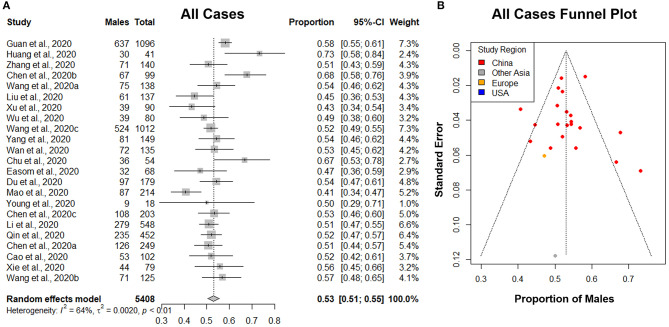
The proportion of males in all lab-confirmed COVID-19 cases. (A) Forest plot of sex-distribution in all lab-confirmed COVID-19 cases in each of the studies. Proportions of males and the 95% confidence intervals (CIs) are indicated. The vertical dotted line represents the combined proportion of all studies. The diamond represents the combined 95% CI, the left and right endpoints of which are the lower and upper bounds of the CI, respectively. (B) Funnel plot with 95% confidence region of sex-distribution in all lab-confirmed COVID-19 cases in each of the studies.
Figure 5
Figure 5
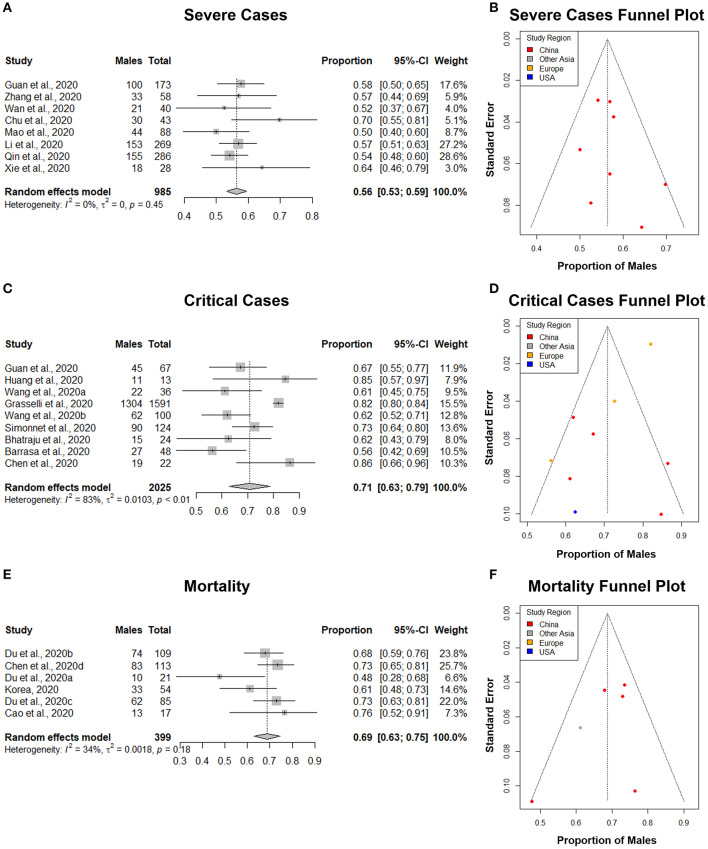
The proportion of males in COVID-19 severe cases, critical cases, and mortalities. (A,C,E) Forest plot of sex-distribution in COVID-19 cases in each of the studies. Proportions of males and the 95% confidence intervals (CIs) are indicated. The vertical dotted lines represent the combined proportion of all studies. The diamond represents the combined 95% CI, the left and right endpoints of which are the lower and upper bounds of the CI, respectively. (A) Severe cases defined as having at least one of the following clinical findings: breathing rate ≥30/min, pulse oximeter oxygen saturation (SpO2) ≤93% at rest, or ration of the partial pressure of arterial oxygen (PaO2) to the fraction of inspired oxygen (FiO2) ≤300 mmHg. (C) Critical case defined as: received mechanical ventilation, clinically diagnosed with shock, received care in the intensive care unit (ICU), or transferred to a tertiary care hospital. (E) Mortality defined as all deaths in COVID-19 patients that occurred during the study period. (B,D,F) Funnel plot with 95% confidence region of sex-distribution in COVID-19 severe cases, critical cases, and mortality in each of the studies.
Figure 6
Figure 6
Comparison of the proportion of males in COVID-19 critical cases in Asia and the West. (A,C) Forest plot of sex-distribution in COVID-19 critical cases in each of the studies. Proportions of males and the 95% confidence intervals (CIs) are indicated. The vertical dotted lines represent the combined proportion of all studies. The diamond represents the combined 95% CI, the left and right endpoints of which are the lower and upper bounds of the CI, respectively. Critical case defined as: received mechanical ventilation, clinically diagnosed with shock, received care in the intensive care unit (ICU), or transferred to a tertiary care hospital. (A) Critical cases in Asian countries. (C) Critical Cases in western countries. (B,D) Funnel plot with 95% confidence region of sex-distribution in COVID-19 critical cases in each of the studies.
Figure 7
Figure 7
The median age of COVID-19 patients stratified according to disease severity. The median age of COVID-19 patients in all cases, severe cases, critically ill cases, and mortalities. Error bars represent 95% confidence intervals of the median. The median age for all COVID-19 cases was 50, severe cases was 61, critically ill cases was 63, and mortality was 70. A Kruskal-Wallis ranked-sum test conducted on the medians showed that age was significantly different amount the COVID-19 disease severity groups (chi-squared = 24.07, df = 3, p = <0.0001).

References

    1. Convertino VA. Gender differences in autonomic functions associated with blood pressure regulation. Am J Physiol. (1998) 275:R1909–20. 10.1152/ajpregu.1998.275.6.R1909 - DOI - PubMed
    1. Reckelhoff JF. Gender differences in the regulation of blood pressure. Hypertension. (2001) 37:1199–208. 10.1161/01.HYP.37.5.1199 - DOI - PubMed
    1. Fischer M, Baessler A, Schunkert H. Renin angiotensin system and gender differences in the cardiovascular system. Cardiovasc Res. (2002) 53:672–7. 10.1016/S0008-6363(01)00479-5 - DOI - PubMed
    1. Kang AK, Miller JA. Effects of gender on the renin-angiotensin system, blood pressure, and renal function. Curr Hypertens Rep. (2002) 4:143–51. 10.1007/s11906-002-0039-9 - DOI - PubMed
    1. Sandberg K, Ji H. Sex and the renin angiotensin system: implications for gender differences in the progression of kidney disease. Adv Ren Replace Ther. (2003) 10:15–23. 10.1053/jarr.2003.50006 - DOI - PubMed

Publication types