. 2020 Jul 2;5(3):200-205.
doi: 10.1016/j.synbio.2020.06.009. eCollection 2020 Sep.

Engineering Escherichia coli to improve tryptophan production via genetic manipulation of precursor and cofactor pathways

Affiliations

Engineering Escherichia coli to improve tryptophan production via genetic manipulation of precursor and cofactor pathways

Zhu Li et al. Synth Syst Biotechnol. .

Abstract

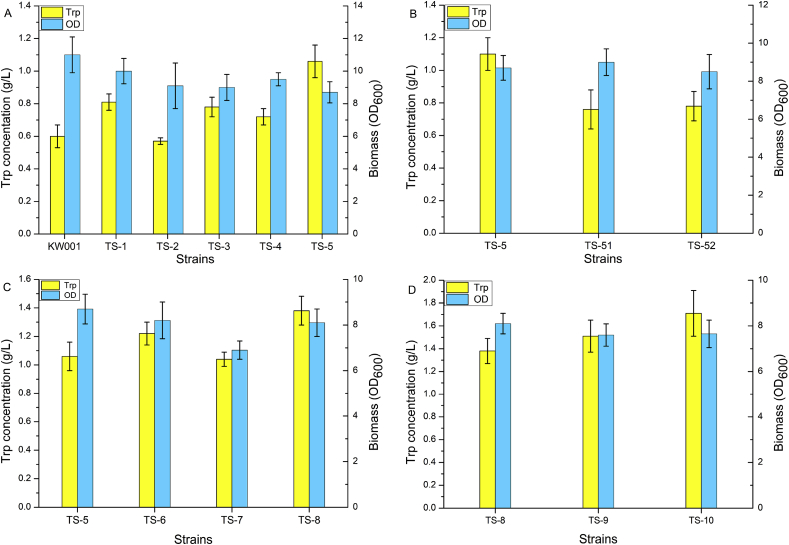
Optimizing the supply of biosynthetic precursors and cofactors is usually an effective metabolic strategy to improve the production of target compounds. Here, the combination of optimizing precursor synthesis and balancing cofactor metabolism was adopted to improve tryptophan production in Escherichia coli. First, glutamine synthesis was improved by expressing heterologous glutamine synthetase from Bacillus subtilis and Bacillus megaterium in the engineered Escherichia coli strain KW001, resulting in the best candidate strain TS-1. Then icd and gdhA were overexpressed in TS-1, which led to the accumulation of 1.060 g/L tryptophan. Subsequently, one more copy of prs was introduced on the chromosome to increase the flux of 5-phospho-α-d-ribose 1-diphosphate followed by the expression of mutated serA and thrA to increase the precursor supply of serine, resulting in the accumulation of 1.380 g/L tryptophan. Finally, to maintain cofactor balance, sthA and pntAB, encoding transhydrogenase, were overexpressed. With sufficient amounts of precursors and balanced cofactors, the engineered strain could produce 1.710 g/L tryptophan after 48 h of shake-flask fermentation, which was 2.76-times higher than the titer of the parent strain. Taken together, our results demonstrate that the combination of optimizing precursor supply and regulating cofactor metabolism is an effective approach for high-level production of tryptophan. Similar strategies could be applied to the production of other amino acids or related derivatives.

Keywords: Cofactor supply; Escherichia coli; Metabolic precursors; Tryptophan.


Figures

Fig. 1
Fig. 1
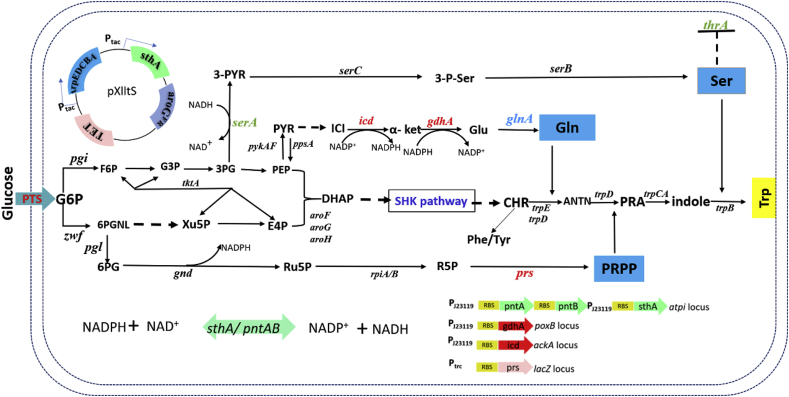
Biosynthetic pathway of tryptophan from glucose and the metabolic engineering strategies used in this study. Abbreviations: pgi, glucose-6-phosphate isomerase; zwf, glucose-6-phosphate 1-dehydrogenase; pgl, 6-phosphogluconolactonase; tktA, transketolase I; gnd: 6-phosphogluconate dehydrogenase; rpiA, ribose-5-phosphate isomerase A; prs, ribose-phosphate diphosphokinase; aroF, aroG and aroH: 3-deoxy-7-phosphoheptulonate synthase; pykAF: pyruvate kinases I and II; ppsA, PEP synthetase; serA, phosphoglycerate dehydrogenase; serC, phosphoserine/phosphohydroxythreonine aminotransferase; serB, phosphoserine phosphatase; icd, isocitrate dehydrogenase; gdhA, glutamate dehydrogenase; glnA; glutamine synthetase; sthA, soluble pyridine nucleotide transhydrogenase; pntAB, pyridine nucleotide transhydrogenase; thrA, fused aspartate kinase/homoserine dehydrogenase 1; trpD and trpE, anthranilate synthase; trpC, fused indole-3-glycerol phosphate synthase/phosphoribosyl anthranilate isomerase; trpB, tryptophan synthase subunit beta; trpA, tryptophan synthase subunit alpha. G6P, glucose-6-phosphate; F6P, fructose-6-phosphate; 6PGNL, 6-phosphoglucono-lactone, G3P, glyceraldehyde-3-phosphate; 3 PG, glycerate-3-phosphate; 3-PYR, 3-phosphonooxypruvate; PEP, phosphoenolpyruvate; Xu5P, xylulose-5-phosphat;E4P, erythrose-4-phosphate; Ru5P, ribulose-5-phosphate; R5P, ribose-5-phosphate; PRPP, phosphoribosyl pyrophosphate; PYR, pyruvate; ICI, isocitrate; α-ket; α-ketoglutarate; Glu, glutamate; Gln, glutamine; 3-P-Ser, 3-phosphoserine; Ser, serine; DHAP, 3-deoxy-d-arabinoheptulosonate-7-phosphate; CHR, chorismate; ANTN, anthranilate; PRA, N-(5′-phosphoribosyl)-anthranilate; Trp, tryptophan. Overexpressed genes are marked in red, expressed heterologous genes are marked in blue and mutated genes are marked in green. RBS: ribosome bind site, whose sequence is AAGGAGATATA. PJ23119: J23119 promoter (http://parts.igem.org/Part:BBa_J23119), whose sequence is TTGACAGCTAGCTCAGTCCTAGGTATAATGCTAGC.
Fig. 2
Fig. 2
Fermentation results of the strains. (A) KW001, TS-1, TS-2, TS-3, TS-4 and TS-5. (B) TS-5, TS-51 and TS-52. (C) TS-5, TS-6, TS-7and TS-8. (D) TS-8, TS-9 and TS-10. Yellow box, Trp concentration (g/L); blue box, biomass (OD600). Error bars indicate the standard deviations from three independent cultures.

Similar articles

Cited by

References

    1. Won-Gi Bang S.L., Hermann Sahm T., Fritz Wagner. Production of L-tryptophan by Escherichia coli cells. Cell. 1983;XXV:999–1011. - PubMed
    1. Zhao Z.J., Zou C., Zhu Y.X., Dai J., Chen S., Wu D. Development of L-tryptophan production strains by defined genetic modification in Escherichia coli. J Ind Microbiol Biotechnol. 2011;38:1921–1929. - PubMed
    1. Alberto Rodriguez J.A.M., Flores Noemí, Escalante Adelfo, Gosset Guillermo, Bolivar Francisco. Engineering Escherichia coli to overproduce aromatic amino acids and derived compounds. Microb Cell Factories. 2014;13 - PMC - PubMed
    1. Ikeda M., Katsumata R. Tryptophan production by transport mutants of Corynebacterium glutamicum. Biosci Biotechnol Biochem. 1995;59:1600–1602.
    1. Katsumata2 M.I.A.R. Hyperproduction of tryptophan by Corynebacterium glutamicum with the modified pentose phosphate pathway. Appl Environ Microbiol. 1999:2497–2502. - PMC - PubMed

LinkOut - more resources