


The Role of Sex-Specific Risk Factors in the Risk Assessment of Atherosclerotic Cardiovascular Disease for Primary Prevention in Women
- PMID: 32671475
- PMCID: PMC7889439
- DOI: 10.1007/s11883-020-00864-6
The Role of Sex-Specific Risk Factors in the Risk Assessment of Atherosclerotic Cardiovascular Disease for Primary Prevention in Women
Abstract
Purpose of review: Robust evidence is emerging regarding the contribution of sex-specific risk factors to a woman's unique risk of atherosclerotic cardiovascular disease (ASCVD). This review summarizes the available literature regarding the association of sex-specific risk factors and ASCVD in women.
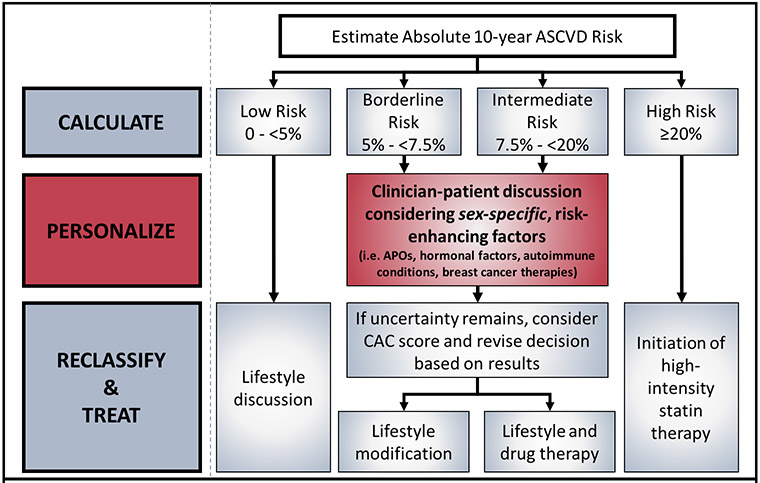
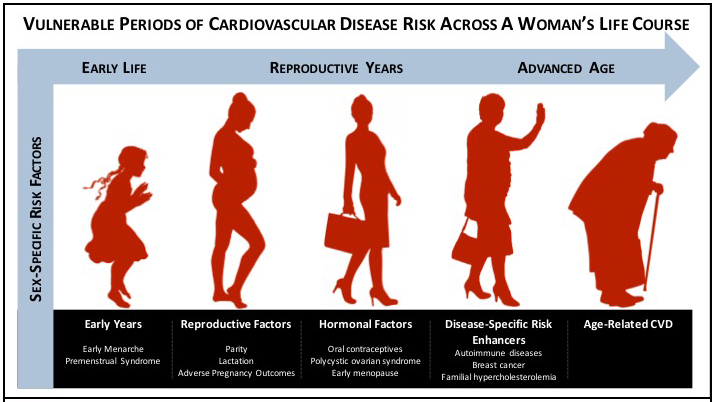
Recent findings: The American College of Cardiology and American Heart Association Guidelines recommend estimation of 10-year risk of a first ASCVD event using the 2013 Pooled Cohort Equations. This can be further personalized by identifying sex-specific risk factors present in a woman's history. There are multiple vulnerable periods across a woman's life course that are associated with increased risk of ASCVD. Risk factors across the reproductive life course that have been shown to correlate with higher risk for future ASCVD include early menarche, adverse pregnancy outcomes (such as pre-eclampsia or preterm birth), and early natural or surgical menopause. In addition, certain conditions that are more common among women, including autoimmune diseases, history of chest irradiation, and certain chemotherapies, also need to be considered. Finally, risk assessment can be refined with subclinical disease imaging (coronary calcium score) if there remains uncertainty about clinical management with lipid-lowering therapies for primary prevention after inclusion of these risk enhancers. Risk assessment for ASCVD in women requires a personalized approach that incorporates sex-specific risk factors to guide primary prevention measures, such as lipid-lowering therapies. Coronary calcium score imaging may also help further refine risk assessment, but no clinical trials conducted to date have addressed this question.
Keywords: Adverse pregnancy outcomes; Atherosclerotic cardiovascular disease; Primary prevention; Risk prediction; Sex-specific risk factors.
Conflict of interest statement
Conflict of Interest
Dr. Mehta has nothing to disclose.
Dr. Khan reports grants from NIH/NCATS, and grants from American Heart association, which are outside the submitted work.
Dr. Lloyd-Jones has nothing to disclose.
Dr. Stone has nothing to disclose.
Figures
References
-
- Heron M. Deaths: Leading Causes for 2017. National Vital Statistics Report. 2019;68(6). - PubMed
-
- World health statistics 2019: monitoring health for the SDGs, sustainable development goals. World Health Organization; 2019.
-
- Stone NJ, Robinson JG, Lichtenstein AH, Bairey Merz CN, Blum CB, Eckel RH, et al. 2013 ACC/AHA guideline on the treatment of blood cholesterol to reduce atherosclerotic cardiovascular risk in adults: a report of the American College of Cardiology/American Heart Association Task Force on Practice Guidelines. Circulation. 2014;129(25 Suppl 2):S1–45. - PubMed
-
-
Grundy SM, Stone NJ, Bailey AL, Beam C, Birtcher KK, Blumenthal RS, et al. 2018 AHA/ACC/AACVPR/AAPA/ABC/ACPM/ADA/AGS/APhA/ASPC/NLA/PCNA Guideline on the Management of Blood Cholesterol. Journal of the American College of Cardiology. 2019;73(24):e285–e350.
** Guideline document that highlights importance of incorporating risk enhancing factors and sex-specific risk factors into primary prevention risk assessment.
-
-
- Lloyd-Jones DM, Braun LT, Ndumele CE, Smith SC Jr., Sperling LS, Virani SS, et al. Use of Risk Assessment Tools to Guide Decision-Making in the Primary Prevention of Atherosclerotic Cardiovascular Disease: A Special Report From the American Heart Association and American College of Cardiology. J Am Coll Cardiol. 2019;73(24):3153–67. - PubMed
Publication types
MeSH terms
Grants and funding
LinkOut - more resources
Full Text Sources
Medical
Research Materials
