Infertility Treatment in France, 2008-2017: A Challenge of Growing Treatment Needs at Older Ages
- PMID: 32673116
- PMCID: PMC7427244
- DOI: 10.2105/AJPH.2020.305781
Infertility Treatment in France, 2008-2017: A Challenge of Growing Treatment Needs at Older Ages
Abstract
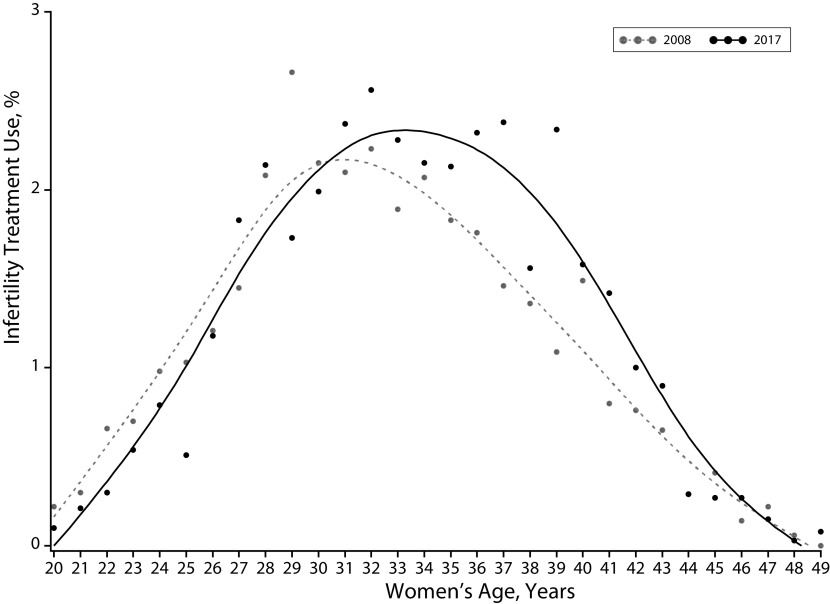
Objectives. To measure trends in infertility treatment use between 2008 and 2017 in France using data from the national health insurance system.Methods. Between 2008 and 2017, we observed a representative national sample of nearly 1% of all women aged 20 to 49 years who were affiliated with the main health insurance scheme in France (more than 100 000 women observed each year). We exhaustively recorded all health care reimbursed to these women.Results. Among women aged 20 to 49 years, 1.25% were treated for infertility each year. Logistic regression analysis showed a significant interaction between age and year of treatment use (P < .001). Over the decade, infertility treatment use increased by 23.9% among women aged 34 years or older, whereas among women younger than 34 years there was a nonsignificant variation.Conclusions. Women aged 34 years or older were increasingly treated for infertility between 2008 and 2017.Public Health Implications. Treatment efficiency decreases strongly with a woman's age, presenting a challenge for medical infertility care.
Figures
References
-
- Sun H, Gong T-T, Jiang Y-T, Zhang S, Zhao Y-H, Wu Q-J. Global, regional, and national prevalence and disability-adjusted life-years for infertility in 195 countries and territories, 1990–2017: results from a Global Burden of Disease Study, 2017. Aging (Albany NY) 2019;11(23):10952–10991. - PMC - PubMed
-
- É Beaujouan, Reimondos A, Gray E, Evans A, Sobotka T. Declining realisation of reproductive intentions with age. Hum Reprod. 2019;34(10):1906–1914. - PubMed
-
- Chandra A, Copen CE, Stephen EH. Infertility service use in the United States: data from the National Survey of Family Growth, 1982–2010. Natl Health Stat Report. 2014;(73):1–21. - PubMed
-
- Macaluso M, Wright-Schnapp TJ, Chandra A et al. A public health focus on infertility prevention, detection, and management. Fertil Steril. 2010;93(1):16.e1–16.e10. - PubMed
Publication types
MeSH terms
LinkOut - more resources
Full Text Sources
Medical