


A Retrospective Analysis of Provider-to-Patient Secure Messages: How Much Are They Increasing, Who Is Doing the Work, and Is the Work Happening After Hours?
- PMID: 32673238
- PMCID: PMC7381047
- DOI: 10.2196/16521
A Retrospective Analysis of Provider-to-Patient Secure Messages: How Much Are They Increasing, Who Is Doing the Work, and Is the Work Happening After Hours?
Abstract
Background: Patient portal registration and the use of secure messaging are increasing. However, little is known about how the work of responding to and initiating patient messages is distributed among care team members and how these messages may affect work after hours.
Objective: This study aimed to examine the growth of secure messages and determine how the work of provider responses to patient-initiated secure messages and provider-initiated secure messages is distributed across care teams and across work and after-work hours.
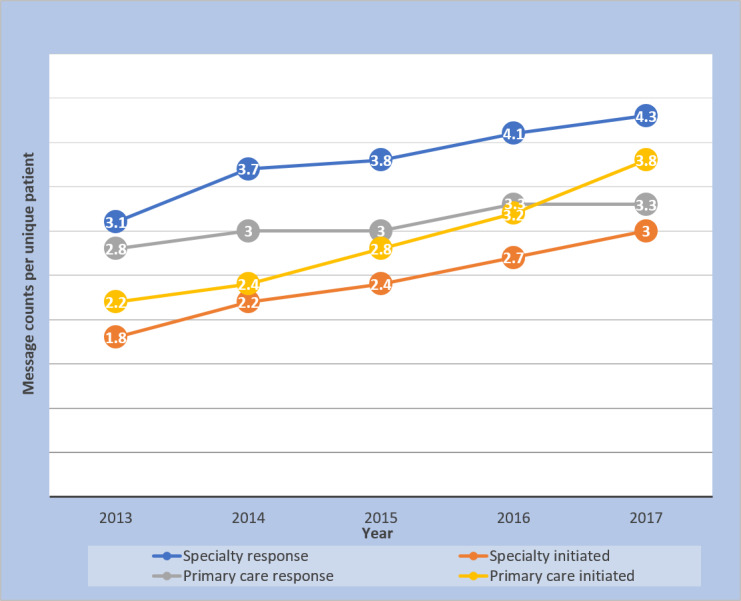
Methods: We collected secure messages sent from providers from January 1, 2013, to March 15, 2018, at Mayo Clinic, Rochester, Minnesota, both in response to patient secure messages and provider-initiated secure messages. We examined counts of messages over time, how the work of responding to messages and initiating messages was distributed among health care workers, messages sent per provider, messages per unique patient, and when the work was completed (proportion of messages sent after standard work hours).
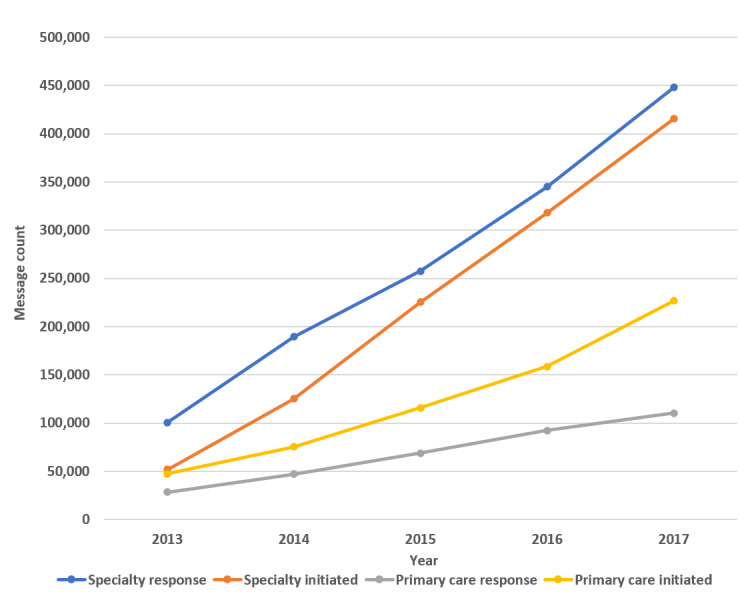
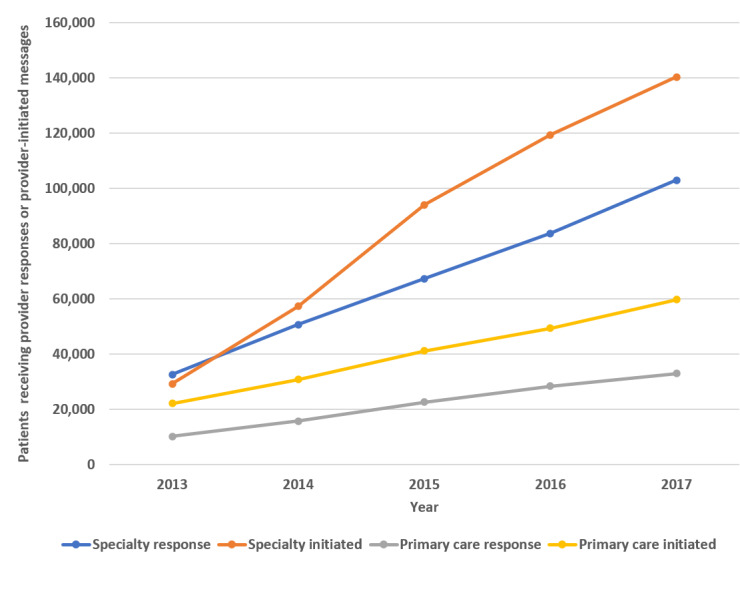
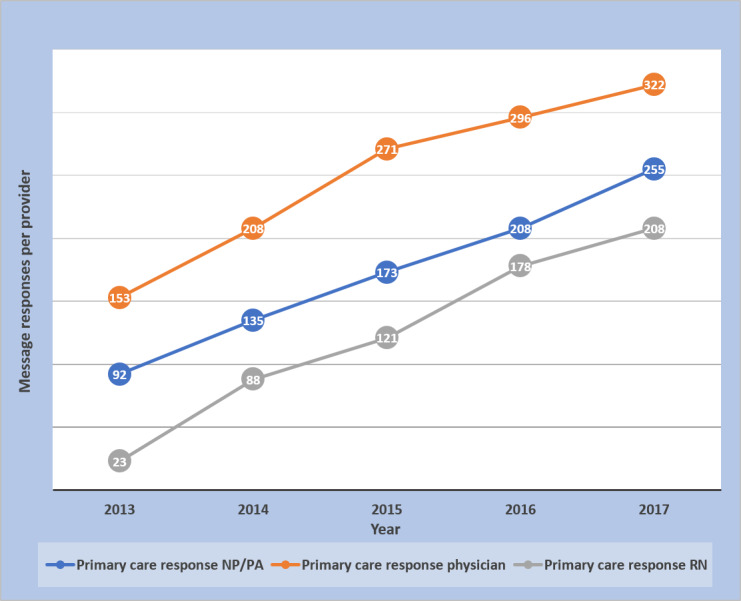
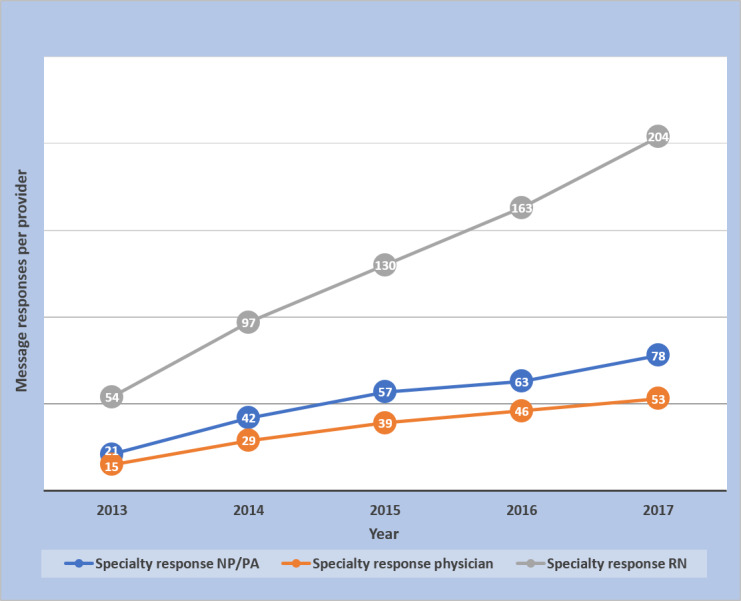
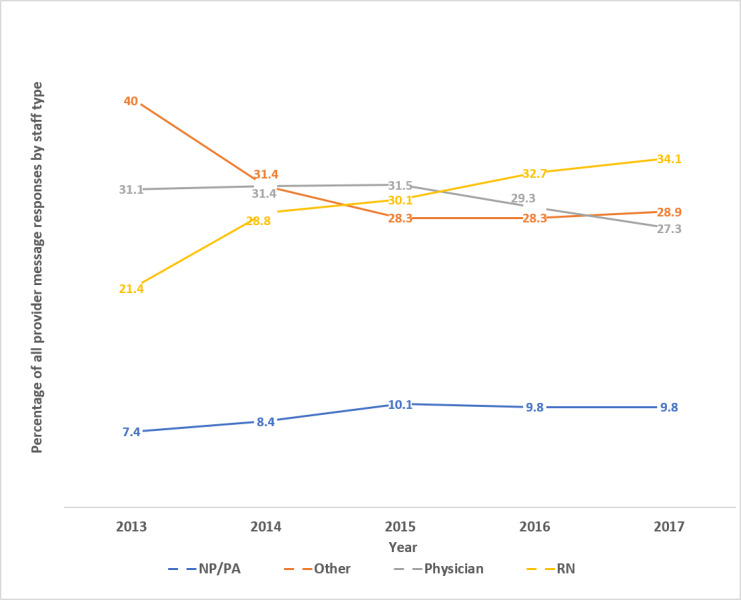
Results: Portal registration for patients having clinic visits increased from 33% to 62%, and increasingly more patients and providers were engaged in messaging. Provider message responses to individual patients increased significantly in both primary care and specialty practices. Message responses per specialty physician provider increased from 15 responses per provider per year to 53 responses per provider per year from 2013 to 2018, resulting in a 253% increase. Primary care physician message responses increased from 153 per provider per year to 322 from 2013 to 2018, resulting in a 110% increase. Physicians, nurse practitioners, physician assistants, and registered nurses, all contributed to the substantial increases in the number of messages sent.
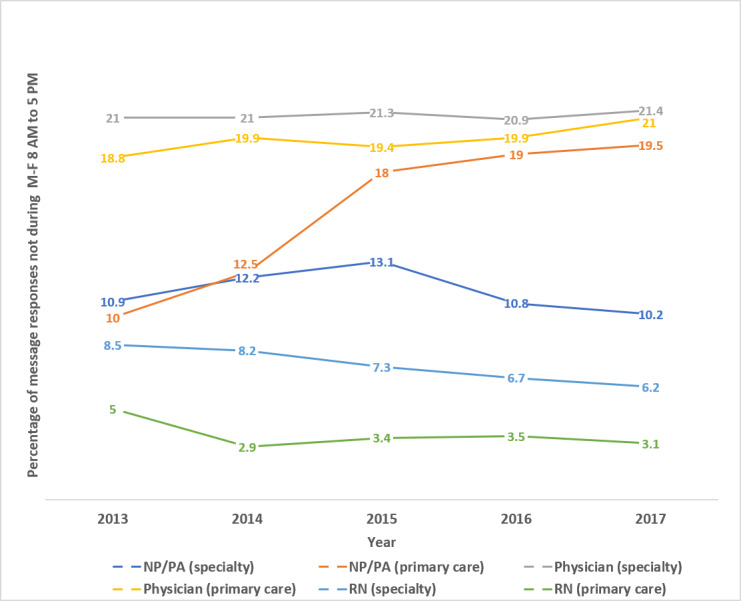
Conclusions: Provider-sent secure messages at a large health care institution have increased substantially since implementation of secure messaging between patients and providers. The effort of responding to and initiating messages to patients was distributed across multiple provider categories. The percentage of message responses occurring after hours showed little substantial change over time compared with the overall increase in message volume.
Keywords: communication; electronic health records; electronic mail; nurse practitioners; nurses; patient messages; patient portal; patients; physician assistants; physicians; provider messages; secure messages.
©Frederick North, Kristine E Luhman, Eric A Mallmann, Toby J Mallmann, Sidna M Tulledge-Scheitel, Emily J North, Jennifer L Pecina. Originally published in JMIR Medical Informatics (http://medinform.jmir.org), 08.07.2020.
Conflict of interest statement
Conflicts of Interest: None declared.
Figures
References
-
- National Cancer Institute Health Information National Trends Survey: HINTS. 2013. [2020-05-05]. Health Information Trends Survey Responses to Question 'In the Last 12 Months, Have You Used the Internet for Any of the Following Reasons' Used E-mail or the Internet to Communicate With a Doctor or Doctor's Office https://hints.cancer.gov/view-questions-topics/question-details.aspx?PK_.... - PMC - PubMed
-
- Lee JL, Choudhry NK, Wu AW, Matlin OS, Brennan TA, Shrank WH. Patient use of email, Facebook, and physician websites to communicate with physicians: a national online survey of retail pharmacy users. J Gen Intern Med. 2016 Jan;31(1):45–51. doi: 10.1007/s11606-015-3374-7. http://europepmc.org/abstract/MED/26105675 - DOI - PMC - PubMed
-
- Crotty BH, Tamrat Y, Mostaghimi A, Safran C, Landon BE. Patient-to-physician messaging: volume nearly tripled as more patients joined system, but per capita rate plateaued. Health Aff (Millwood) 2014 Oct;33(10):1817–22. doi: 10.1377/hlthaff.2013.1145. http://europepmc.org/abstract/MED/25288428 - DOI - PMC - PubMed
-
- Cronin RM, Davis SE, Shenson JA, Chen Q, Rosenbloom ST, Jackson GP. Growth of secure messaging through a patient portal as a form of outpatient interaction across clinical specialties. Appl Clin Inform. 2015;6(2):288–304. doi: 10.4338/ACI-2014-12-RA-0117. http://europepmc.org/abstract/MED/26171076 - DOI - PMC - PubMed
-
- Masterman M, Cronin R, Davis S, Shenson J, Jackson G. Adoption of secure messaging in a patient portal across pediatric specialties. AMIA Annu Symp Proc. 2016;2016:1930–9. http://europepmc.org/abstract/MED/28269952 - PMC - PubMed
LinkOut - more resources
Full Text Sources
