Review
. 2020 Sep:131:170369.
doi: 10.1016/j.peptides.2020.170369. Epub 2020 Jul 13.

Glycopeptide drugs: A pharmacological dimension between "Small Molecules" and "Biologics"

Affiliations
Review

Glycopeptide drugs: A pharmacological dimension between "Small Molecules" and "Biologics"

Christopher R Apostol et al. Peptides. 2020 Sep.

Abstract

Peptides are an important class of molecules with diverse biological activities. Many endogenous peptides, especially neuropeptides and peptide hormones, play critical roles in development and regulating homeostasis. Furthermore, as drug candidates their high receptor selectivity and potent binding leads to reduced off-target interactions and potential negative side effects. However, the therapeutic potential of peptides is severely hampered by their poor stability in vivo and low permeability across biological membranes. Several strategies have been successfully employed over the decades to address these concerns, and one of the most promising strategies is glycosylation. It has been demonstrated in numerous cases that glycosylation is an effective synthetic approach to improve the pharmacokinetic profiles and membrane permeability of peptides. The effects of glycosylation on peptide stability and peptide-membrane interactions in the context of blood-brain barrier penetration will be explored. Numerous examples of glycosylated analogues of endogenous peptides targeting class A and B G-protein coupled receptors (GPCRs) with an emphasis on O-linked glycopeptides will be reviewed. Notable examples of N-, S-, and C-linked glycopeptides will also be discussed. A small section is devoted to synthetic methods for the preparation of glycopeptides and requisite amino acid glycoside building blocks.

Keywords: Blood-brain barrier; CNS; GPCR; Glycopeptide; Hormone; Opioid peptide.


Conflict of interest statement

Declaration of Competing Interest None.

Figures
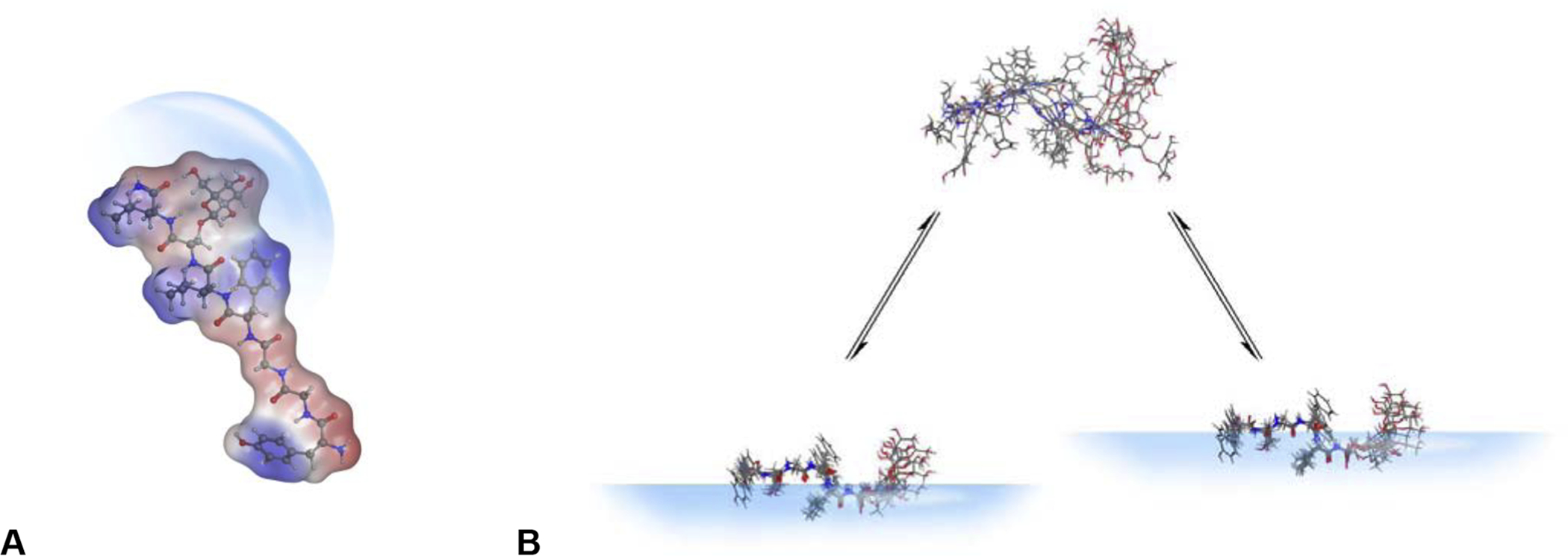
Figure 1.
Figure 1.
A. Glycosylation provides a steric shield towards proteolysis. B. Introduction of a carbohydrate moiety into the peptide backbone gives the peptide “biousian character.” A glycopeptide lacking a carbohydrate will strongly interact with the lipid bilayer and adopt an amphipathic α-helical conformation. The introduction of a carbohydrate will increase the water solubility of the peptide message and allow it to “hop” into the aqueous phase where it can adopt an ensemble of random coil conformations. This “hopping” behavior allows glycopeptides to assess a greater amount of surface area compared to their un-glycosylated counterparts.
Figure 2.
Figure 2.
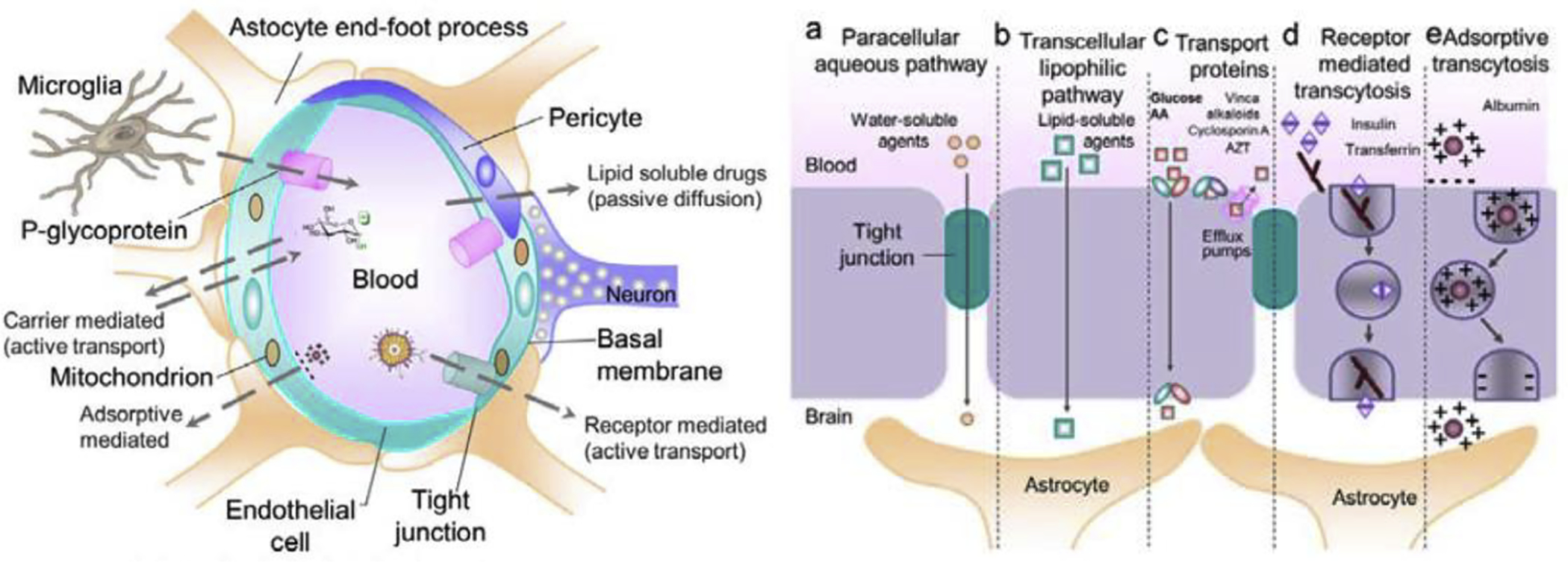
The BBB is comprised of tightly packed endothelial cells that act as a barrier preventing foreign substances from entering the brain. Essential nutrients can pass through the BBB via passive transport, passage through specific proteins or channels, receptor mediated transport, and adsorptive transcytosis. Adapted from Nanotechnology-based Targeted Drug Delivery Systems for Brain Tumors https://doi.org/10.1016/B978-0-12-812218-1.00003-8.
Figure 3.
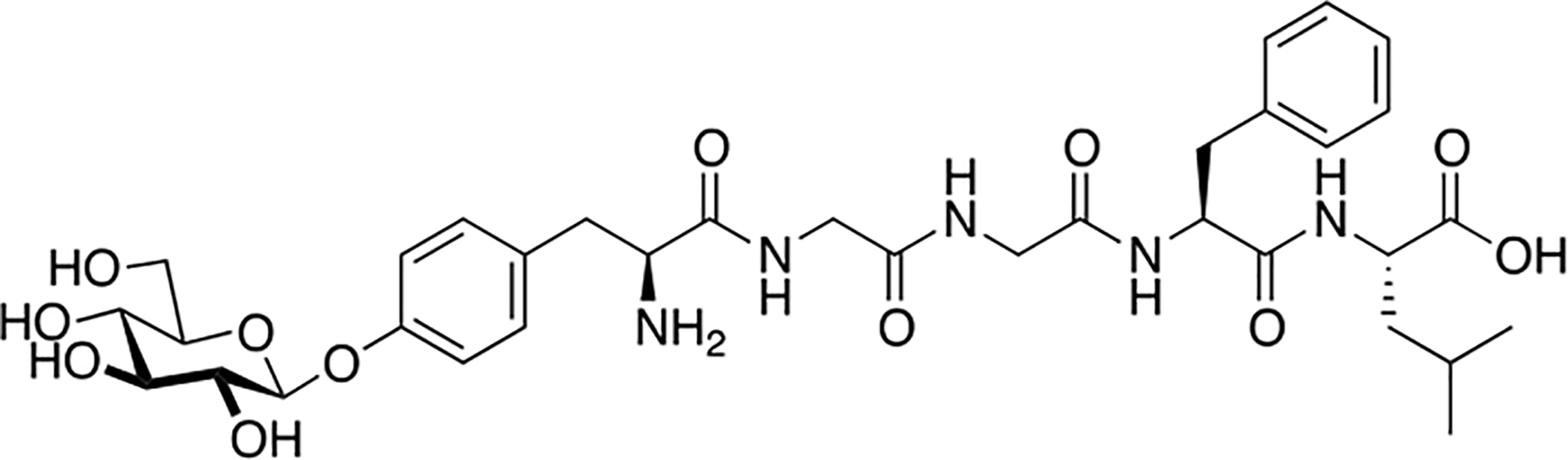
Figure 3.. Phenolic Leu-Enkephalin β-D-Glucoside.
Glycosylation of the phenolic oxygen of Leucine Enkephalin strongly reduced activity in the MVD and GPI assays. (Varga and Schiller, 1987) [72].
Figure 4.
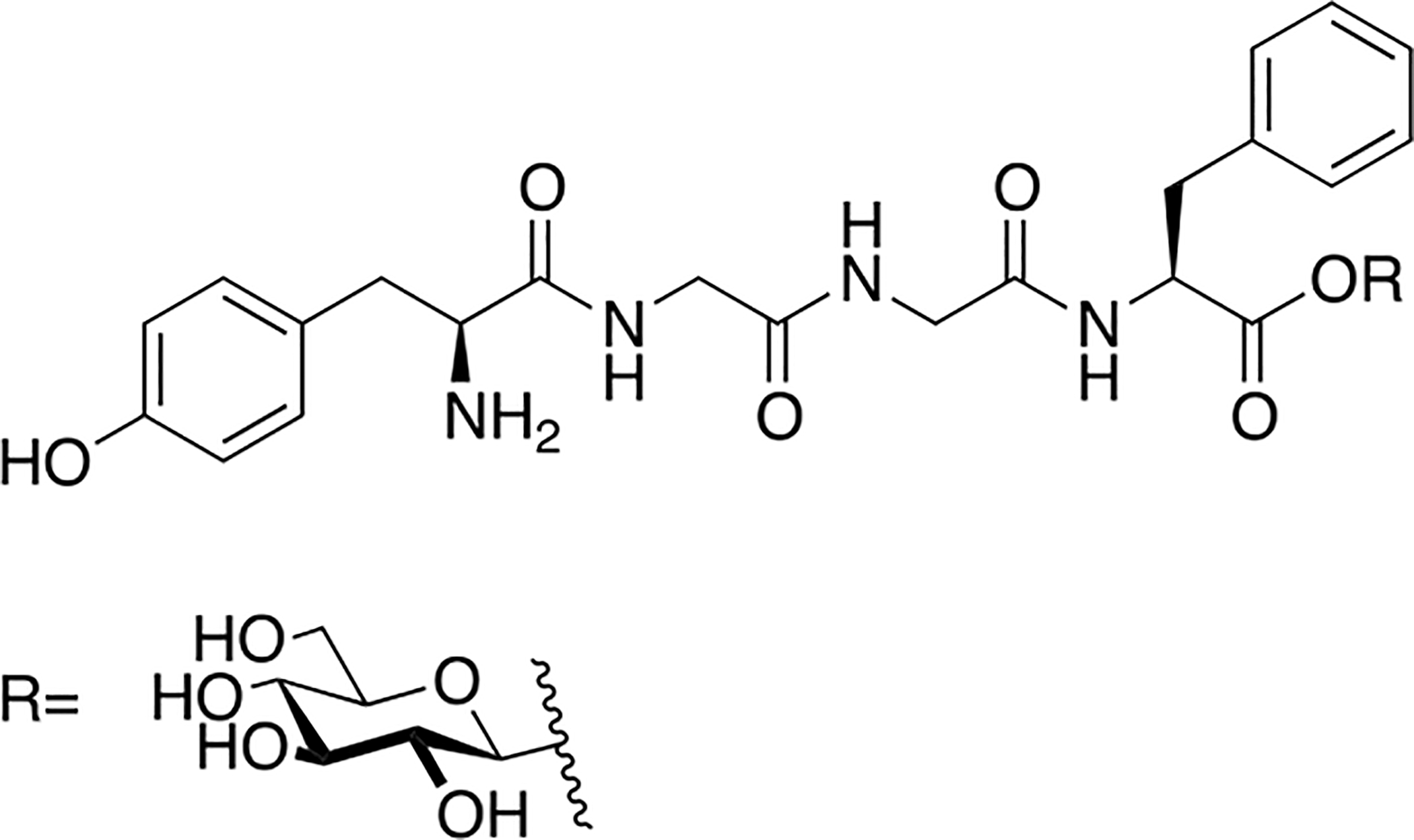
Figure 4.. C-Terminal Ester Enkephalin Glycopeptides.
Enkephalin glycopeptides containing a β-D-glucose moiety at the C-terminus exhibited similar activity to that of [Leu5] enkephalin (Horvat and Schiller, 1988) [73].
Figure 5.
Figure 5.. C-Terminally N-Glycosyl Enkephalin Glycopeptides.
An N-linked glucosylated enkephalin glycopeptide exhibited significantly greater analgesic activity compared to morphine in vivo. (Torres 1988) [74].
Figure 6.
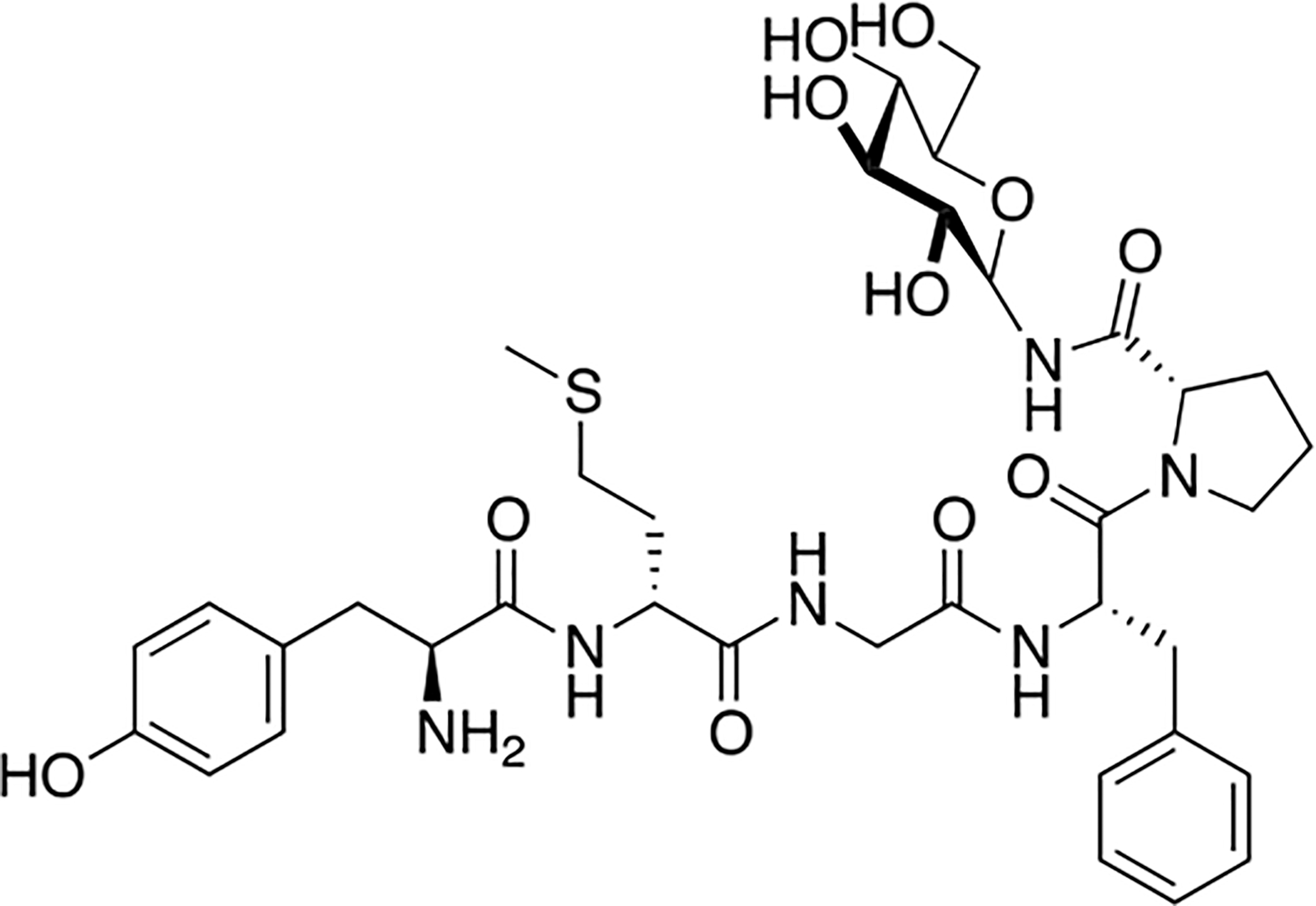
Figure 6.. Hydroxyproline (Hyp)-Containing Glycopeptides Related to Enkephalin.
Hydroxyproline glycopeptides related to enkephalin were roughly 5500 times more potent than morphine in vivo. (Rodriguez 1989) [75].
Figure 7.
Figure 7.. Opioid Glycopeptide Derived from DPDPE.
Glycopeptides related to the [Met5] enkephalinamide and DPDPE were synthesized and studied for antinociception in vivo. One particular glucosylated analogue of DPDPE produced analgesia following i.p. administration. Naloxone administration antagonized the effects of this glycopeptide following i.c.v. administration but not i.p. administration, suggesting this glycopeptide is able to penetrate the BBB and act in the CNS. (Polt 1994) [77].
Figure 8.
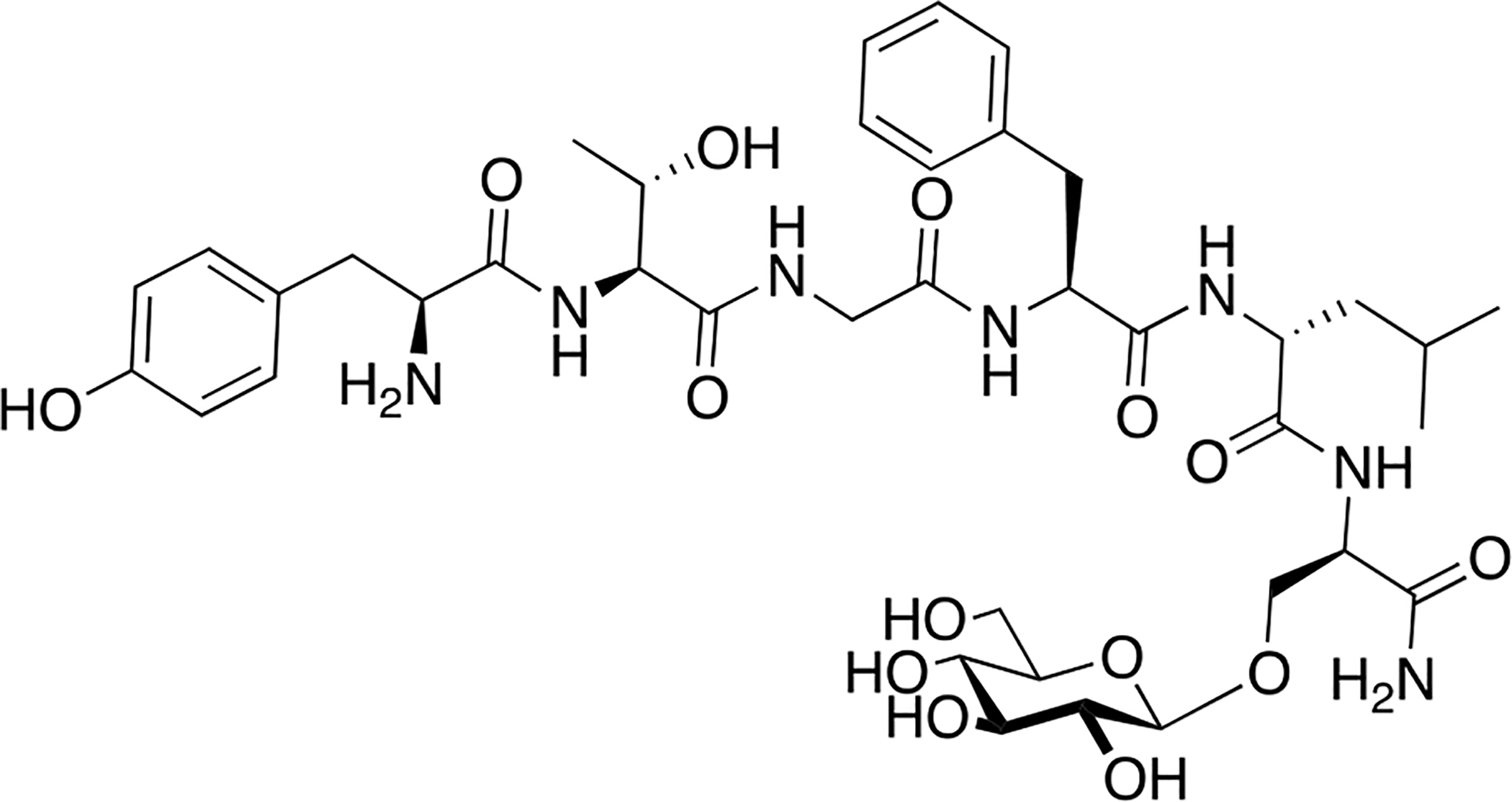
Figure 8.. An Analogue (Roque’s Enkephalin) Containing A Serine Glucoside at the C-Terminus.
Enkephalin glycopeptide containing a C-terminal serine glucoside produced potent analgesia following both i.v. and i.p. administration. (Polt 2000) [80].
Figure 9.
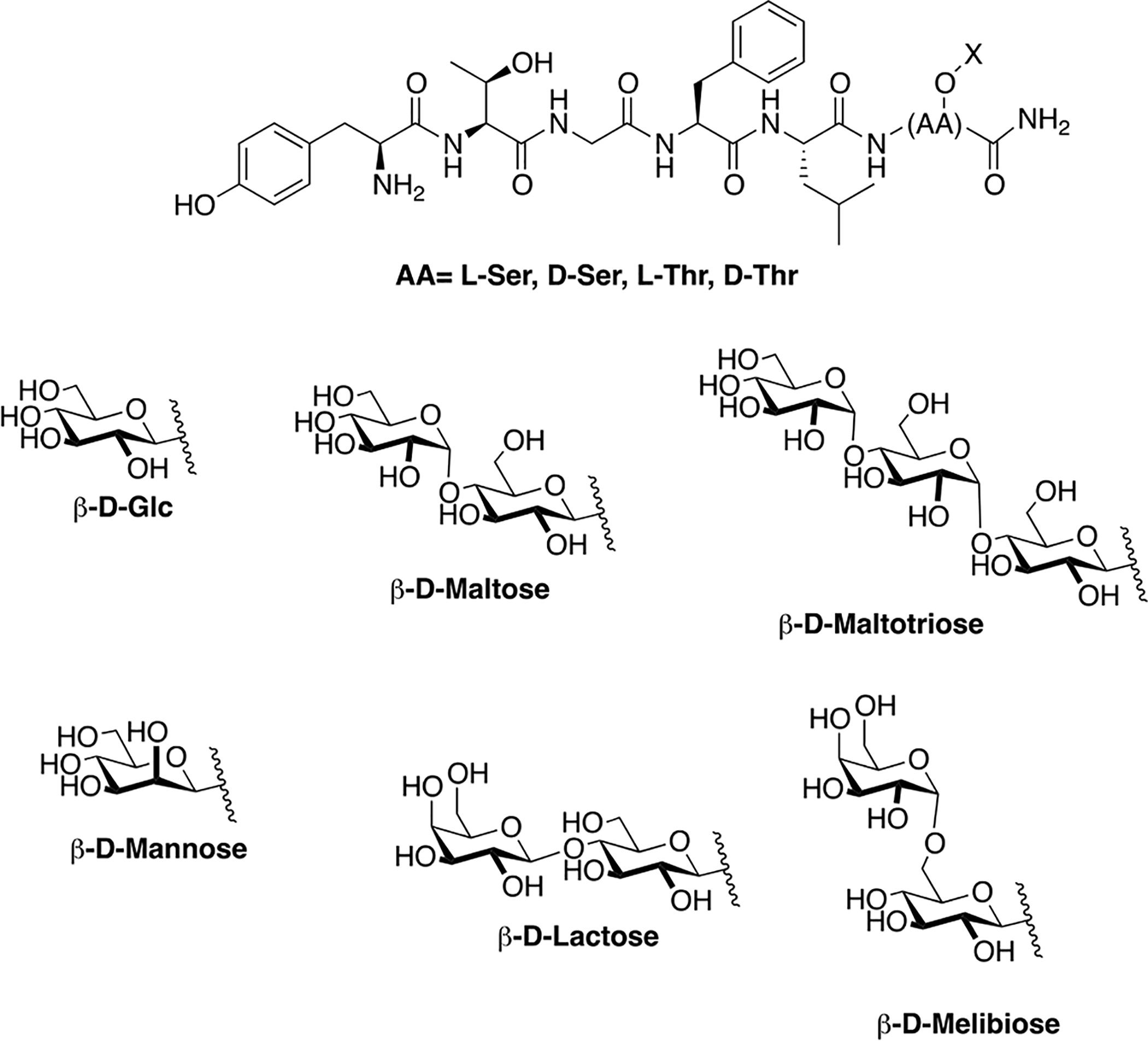
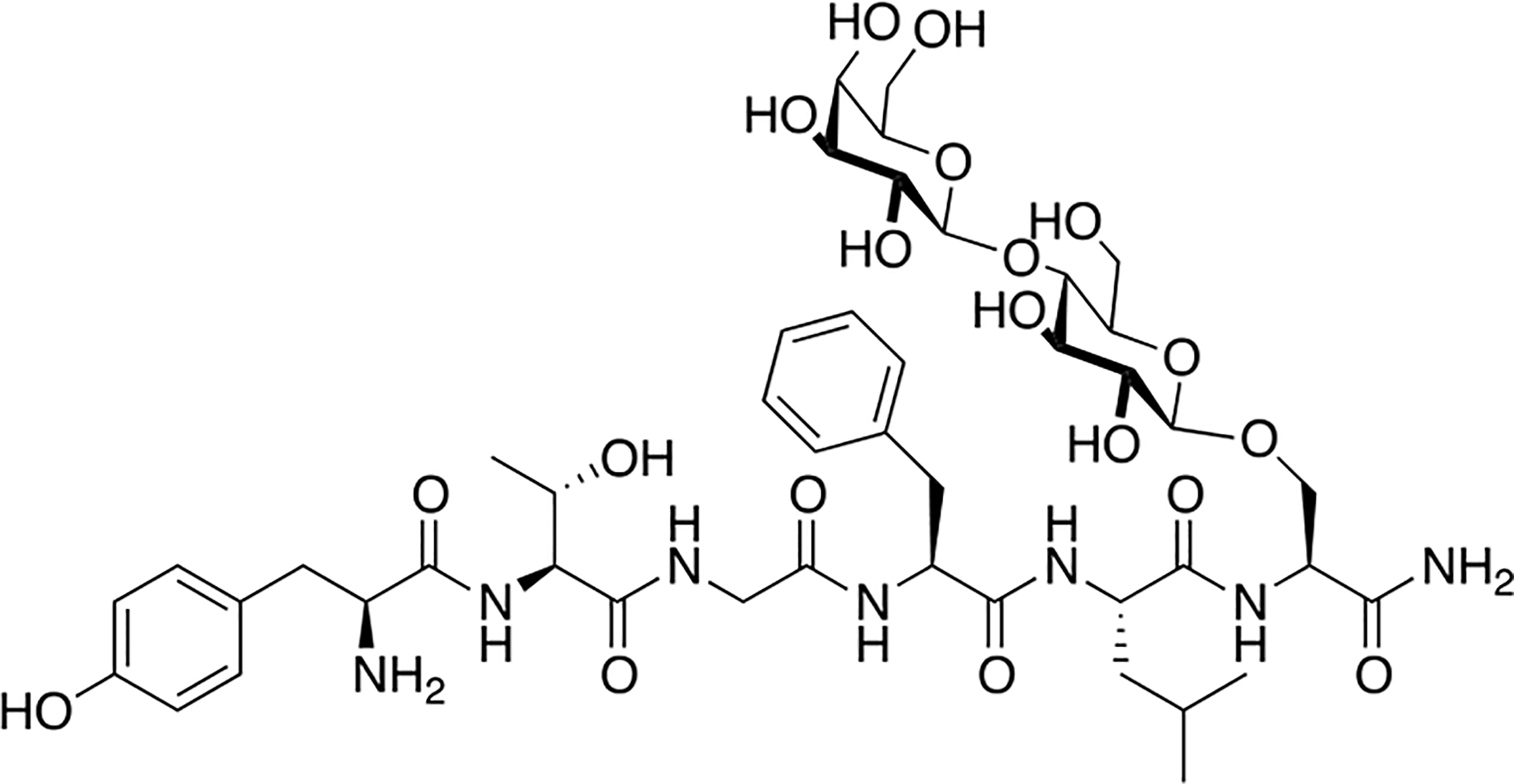
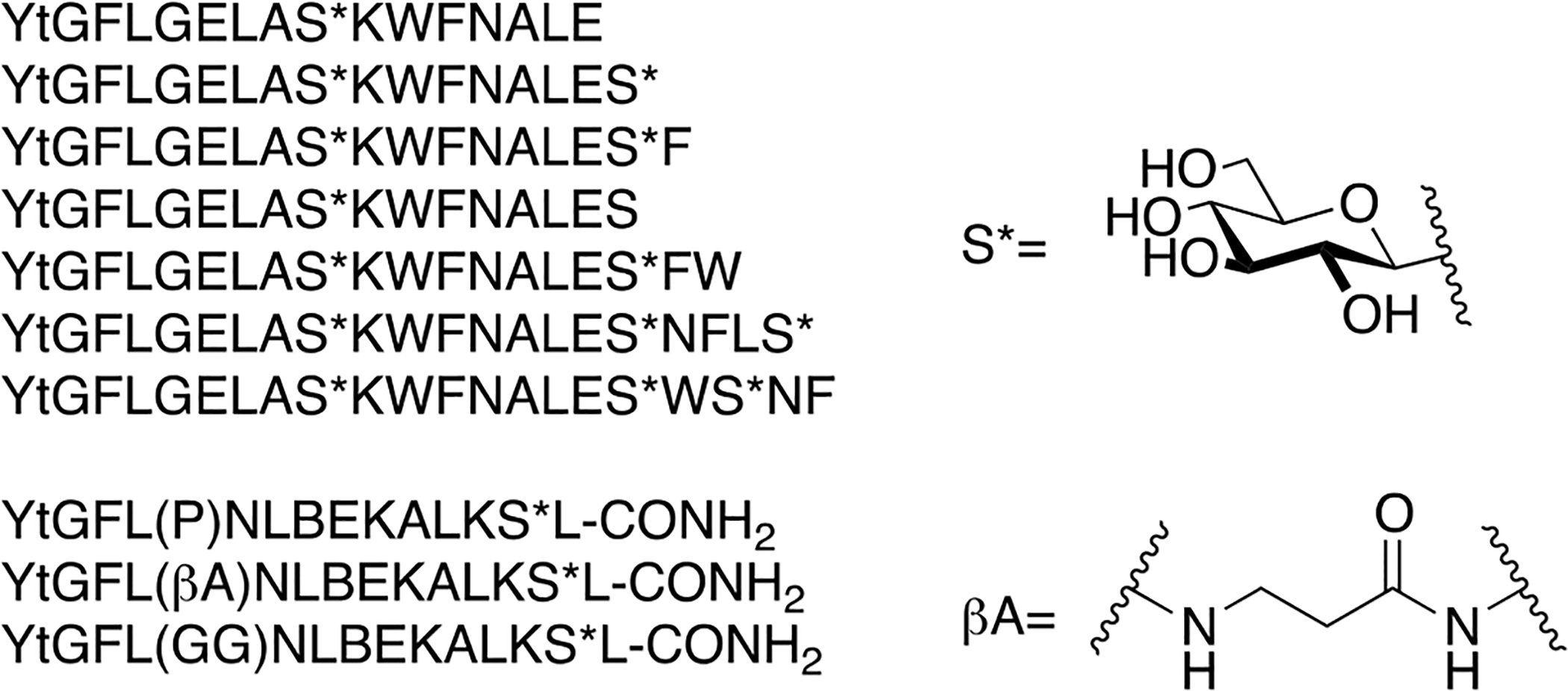
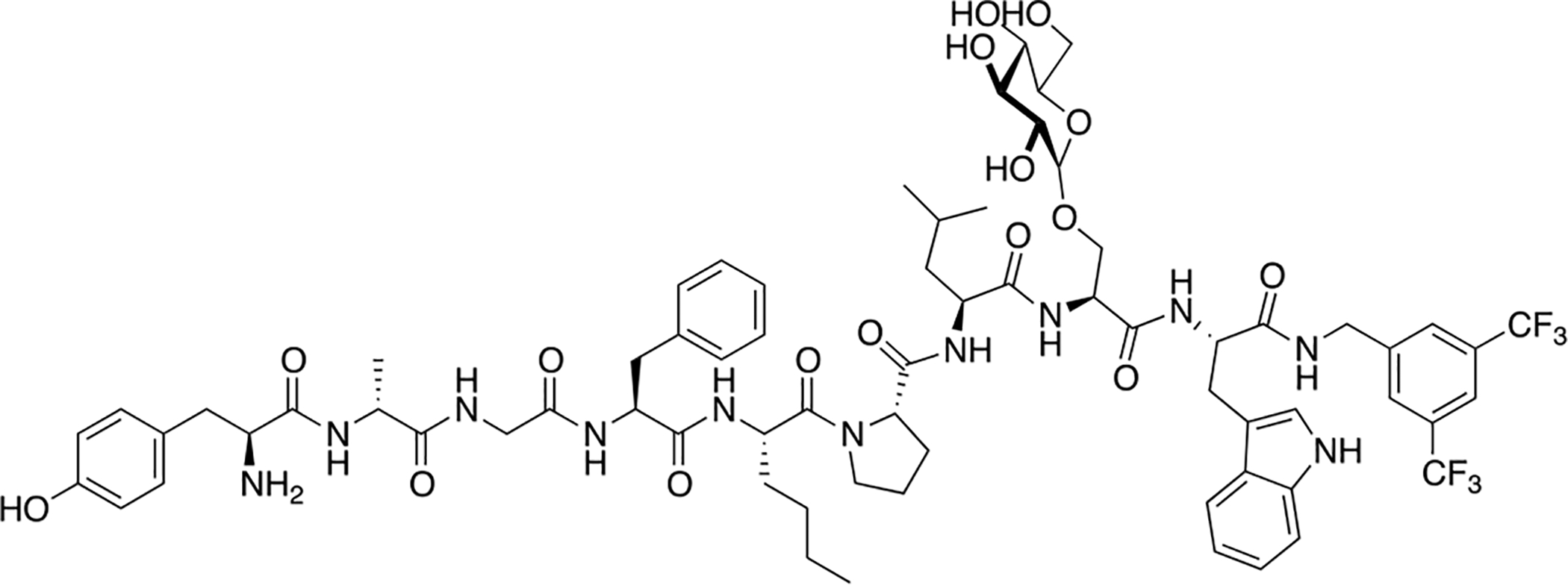
Figure 9.. Enkephalin Inspired Glycopeptides Containing Mono-, Di-, and Trisaccharide Motifs.
Enkephalin glycopeptides containing a variety of mono-, di-, and trisaccharides were synthesized and evaluated for their ability to produce analgesia in vivo by simultaneous agonism of both the mu and delta receptor. The lactoside (MMP2200, or Lactomorphin) was manufactured commercially at 400 g scale in a cGMP compliant fashion by PolyPeptide Labs, and by Lonza, which has since sold its peptide manufacturing facility to PPL. It is still being studied, and is used as a laboratory standard. (Polt 2004) [81].
Figure 10.
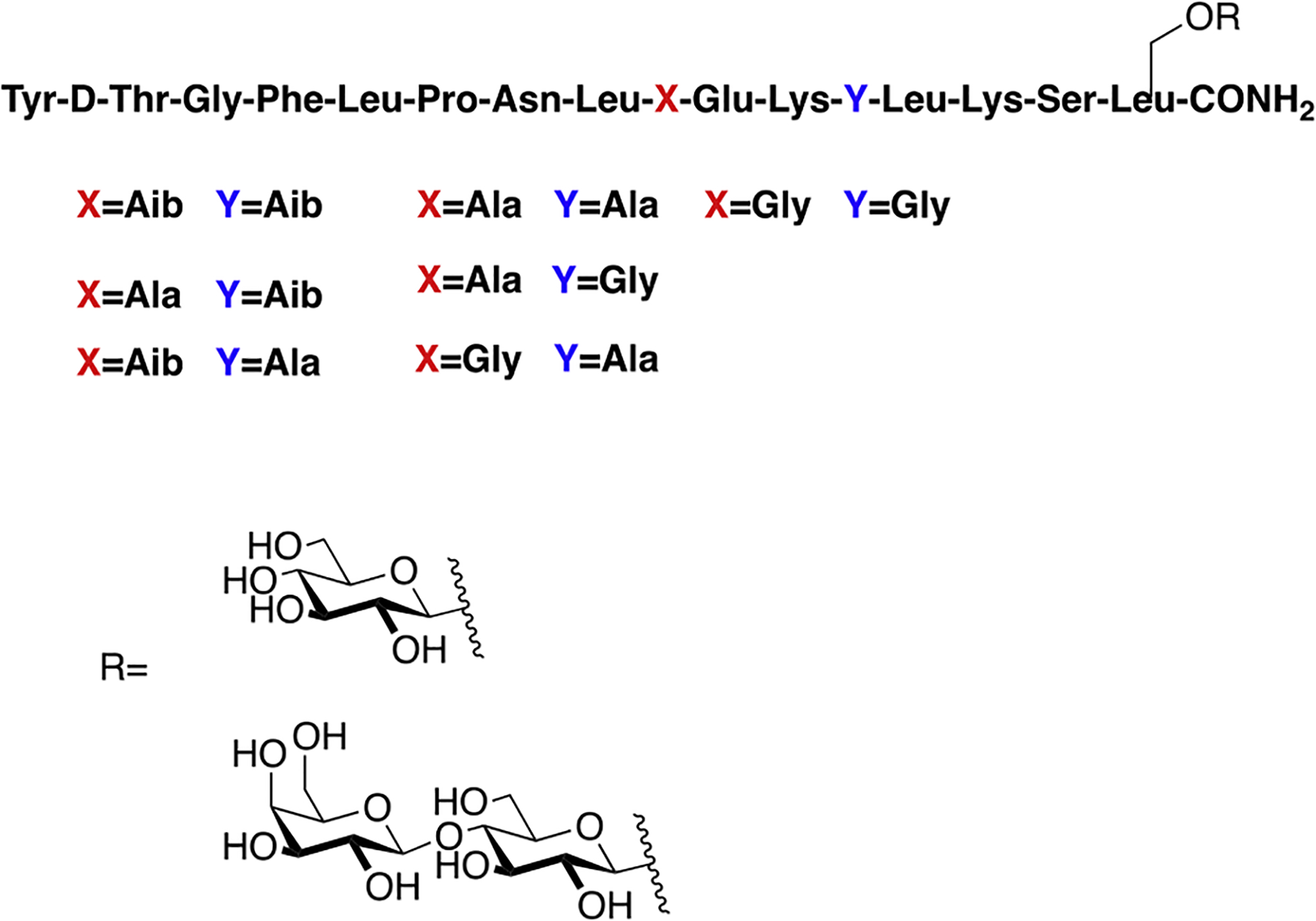
Figure 10.. MMP2200: A Novel Opioid Glycopeptide with Excellent BBB Penetration Properties.
The lactoside MMP2200 produced in Polt’s laboratory was studied by in vivo microdialysis coupled with LC-MS to evaluate the extent of its BBB penetration. The results from these studies showed that MMP2200 entered the brain at low nanomolar concentrations and was still detected in the brain 80 minutes after administration. (Polt 2005) [82].
Figure 11.
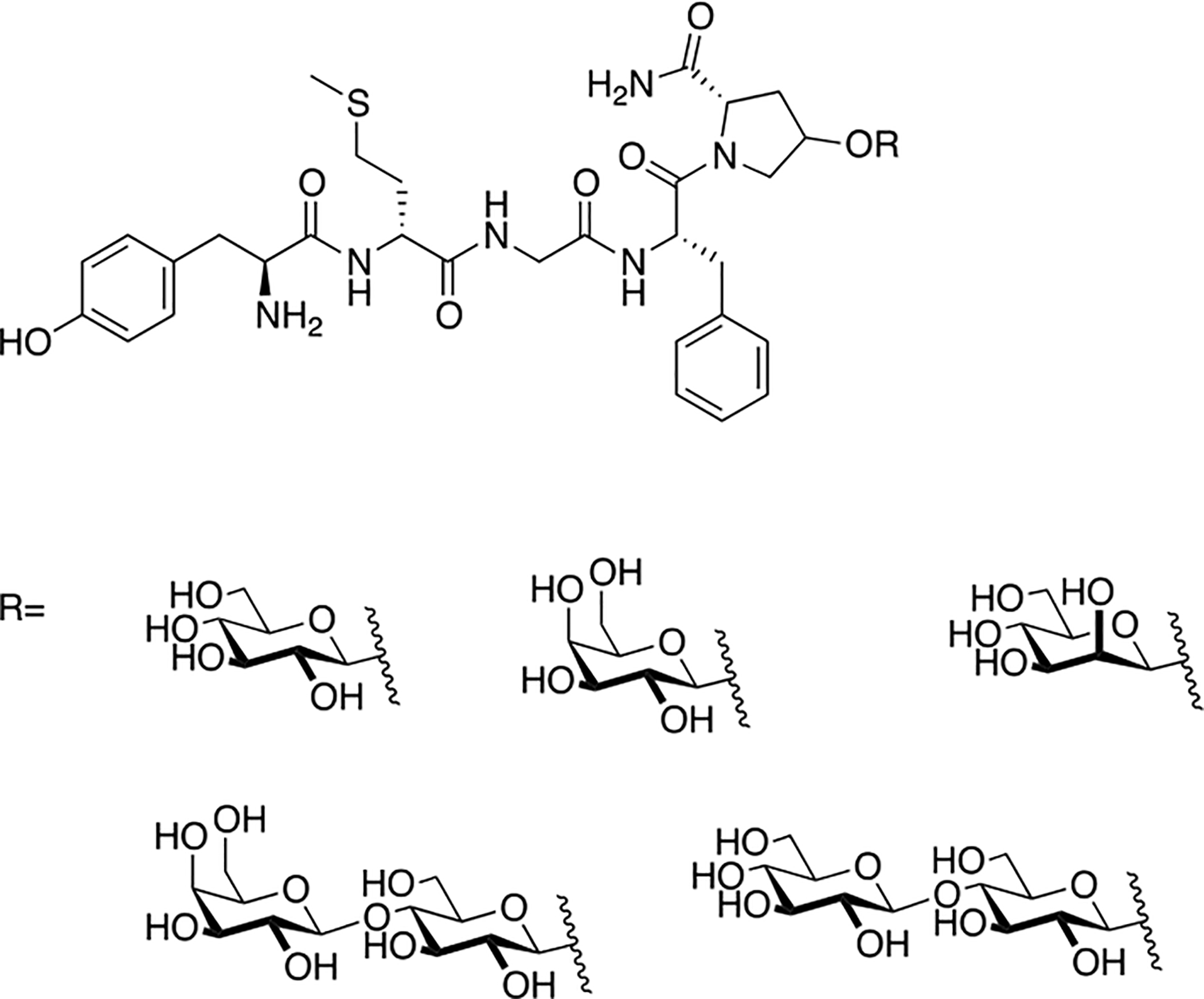
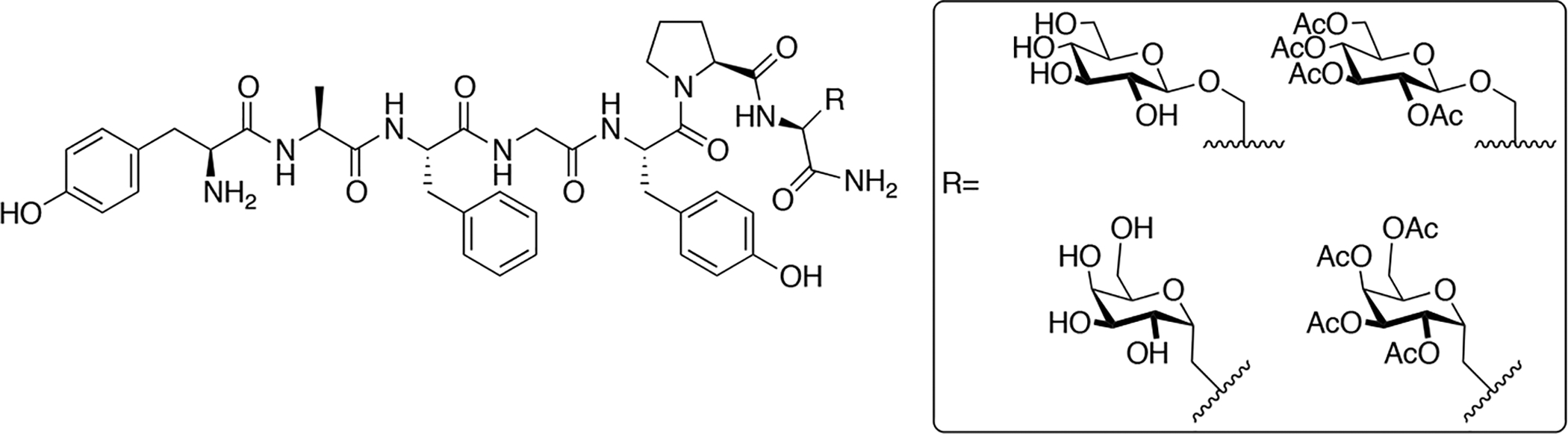
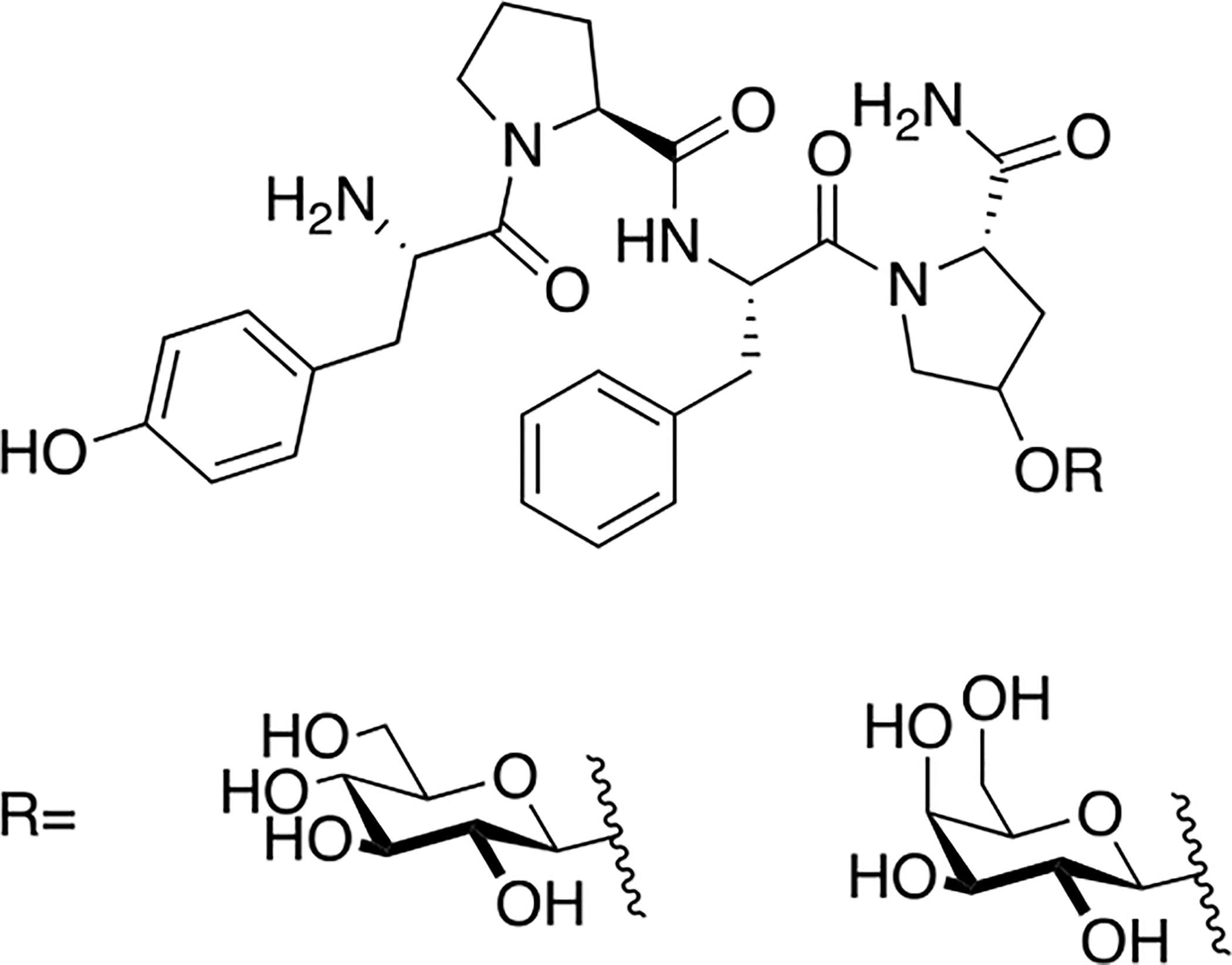
Figure 11.. Enkephalin Glycopeptides with Carbohydrate Moieties O-Linked to Hydroxyproline.
Enkephalin glycopeptides studied by Valencia and Rodriguez in the 1980s were later synthesized and evaluated for their activity in vitro. Additional analogues containing different carbohydrate moieties were also examined. The mannosylated analogue in particular exhibited desirable transport properties and had a better in vivo profile than morphine. (Valencia 2017) [83].
Figure 12.
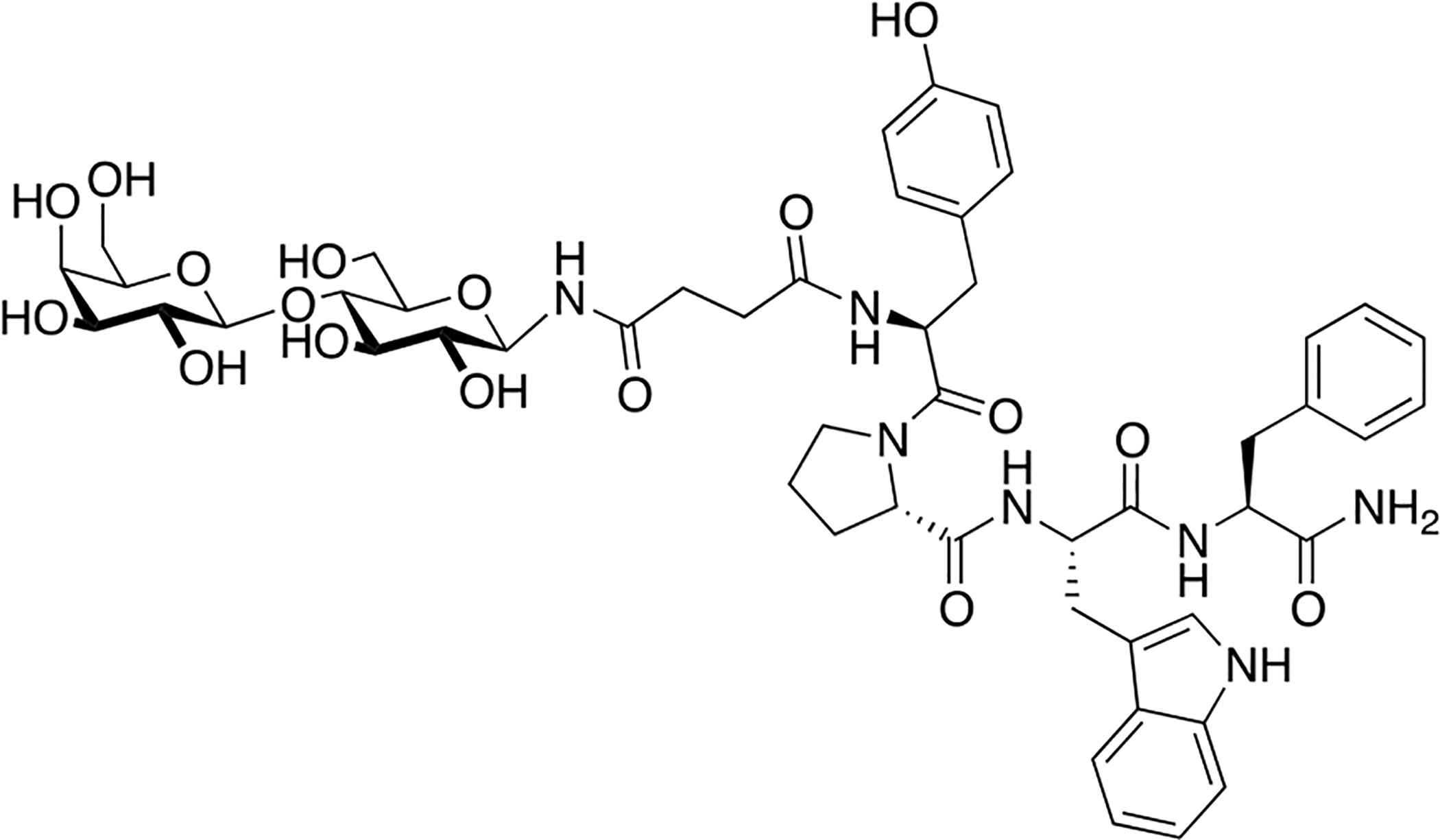
Figure 12.. An Orally Active Endomporphin-1 Glycopeptide.
A novel endomorphin glycopeptide containing a lactose moiety at the N-terminus interestingly showed only slight reductions in biological activity in both receptor binding and functional activity experiments. This analogue was highly stable both in vitro and in vivo and was found to be orally active. (Varamini and Toth 2013) [85].
Figure 13.
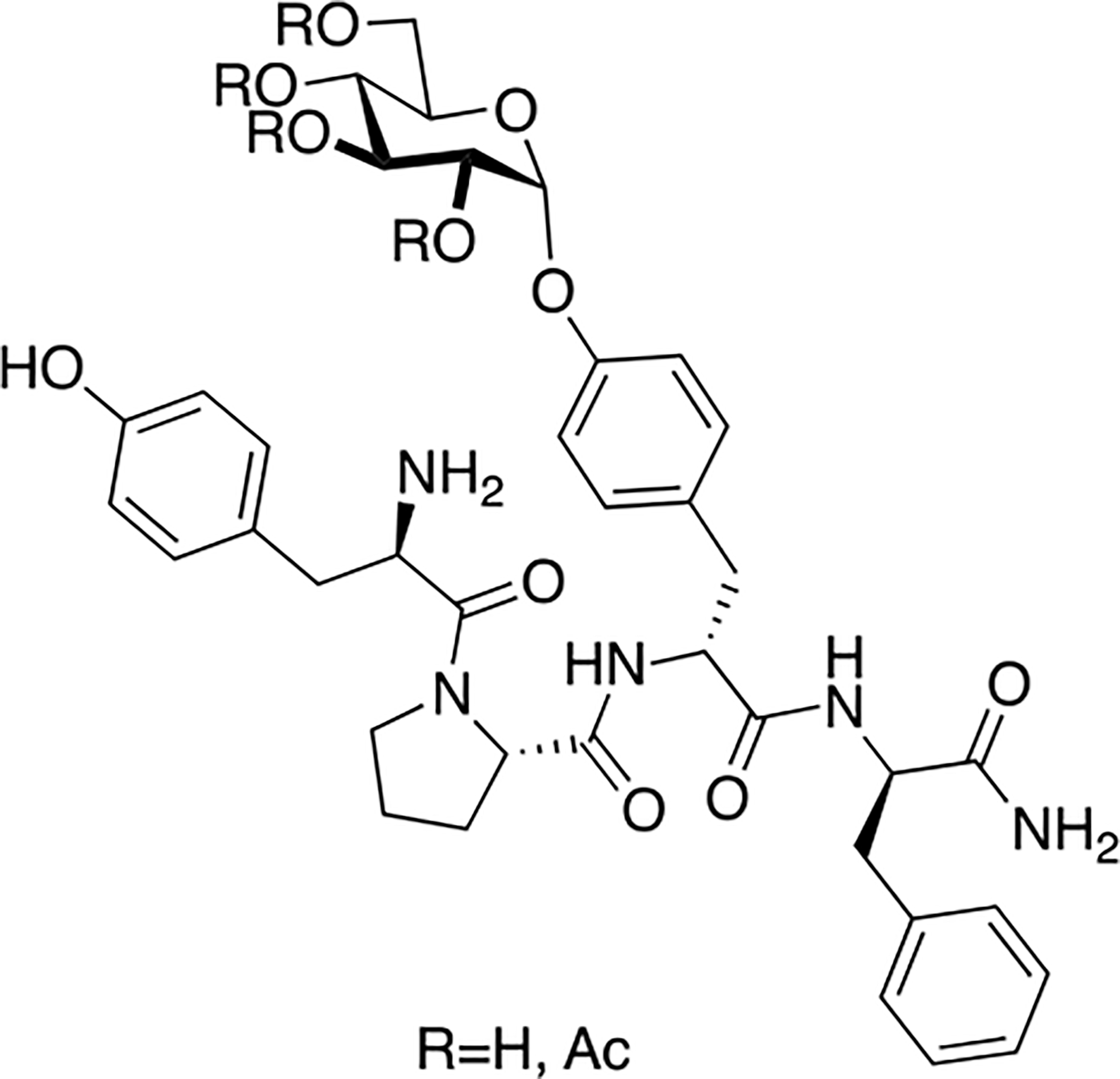
Figure 13.. Phenolic Endomorphin Glycopeptides.
Endomorphin glycopeptides containing carbohydrate moieties linked through the phenolic oxygen of a tyrosine residue was found to act centrally in vivo and penetrate the BBB. (Olczack 2013) [86].
Figure 14.
Figure 14.. Amphipathic Glycopeptides Related to β-Endorphin.
Dhanasekaran of the Polt’s lab investigated the conformation of a number of glycosylated endorphin analogues by 2D NMR and circular dichroism in various media. (Polt 2005) [87].
Figure 15.
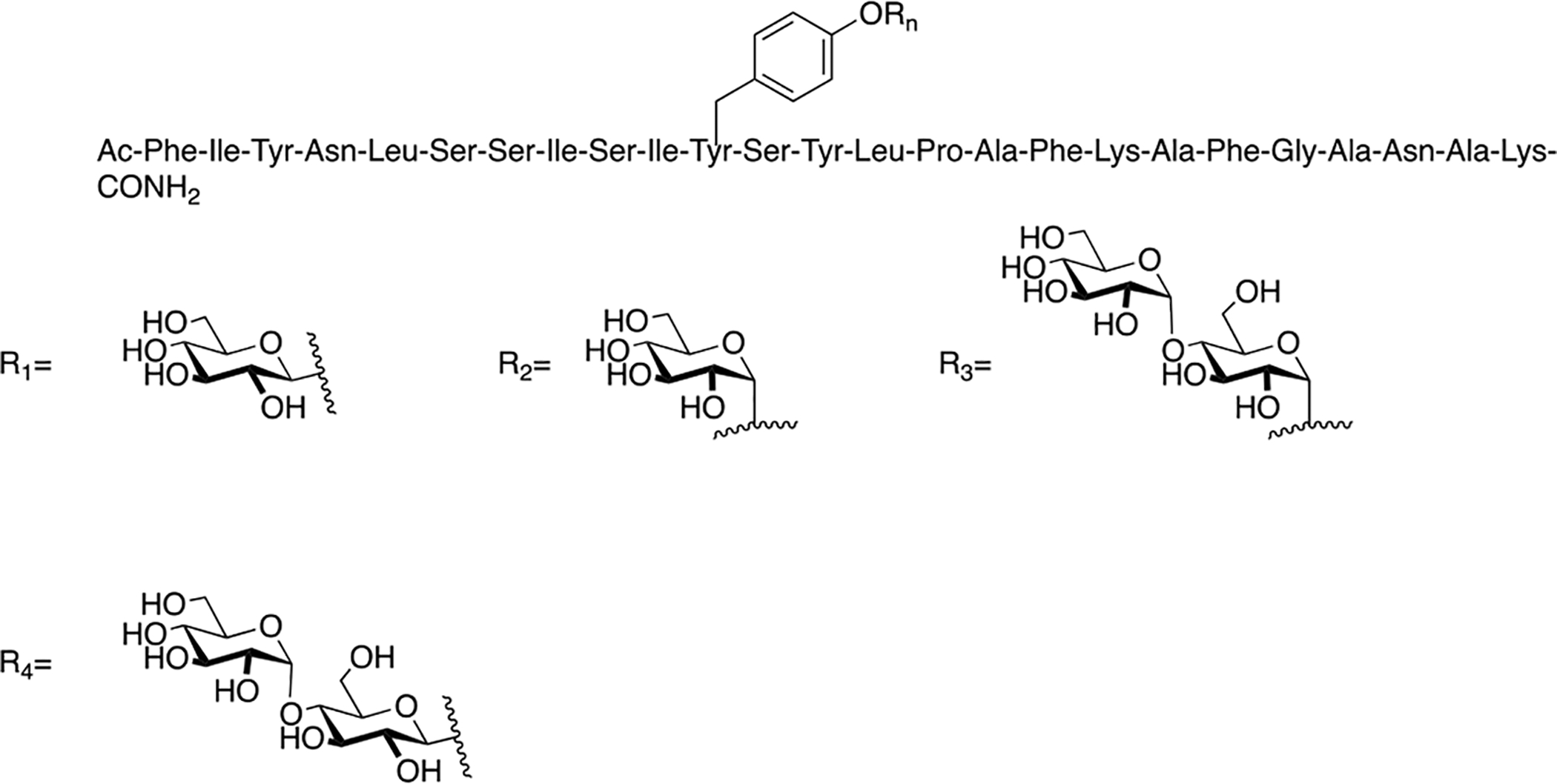
Figure 15.. β-Endorphin Inspired Amphipathic Glycopeptides.
Glycopeptides related to β-endorphin were synthesized and studied for their biological activity and transport properties. One of the key features of these particular glycopeptides is their varying degrees of amphipathicity. Glycopeptides performed significantly better than their un-glycosylated analogues in both in vitro functional assays and in vivo studies (Polt 2014) [89].
Figure 16.
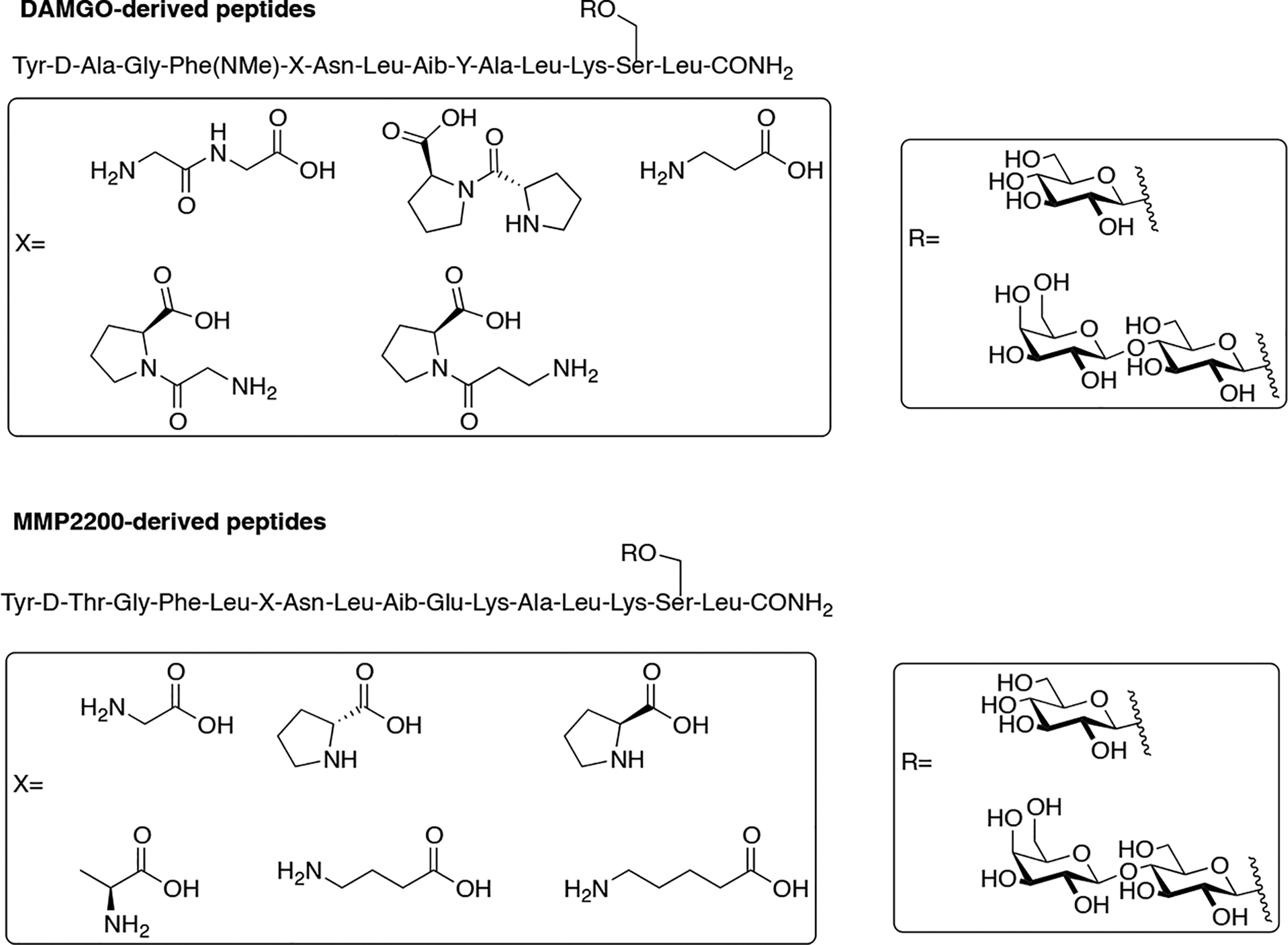
Figure 16.. Glycopeptides Related to the μ-Selective Opioid Agonist DAMGO.
DAMGO-derived glycopeptides were evaluated for their activity in vivo. Variation in the amphipathic character of the glycopeptide shifted its biological activity in a predictable manner. (Polt 2007) [90].
Figure 17.
Figure 17.. Amphipathic Glycopeptides Based DAMGO and DTLET.
Highly amphipathic glycopeptides related to DAMGO and DTLET were synthesized and studied for their in vivo antinociception. These glycopeptides contained various flexible and rigid linkers separating the message and address segments. As seen with the previous study on amphipathic β-endorphin glycopeptides, the un-glycosylated analogues did not perform as well as their glycosylated counterparts. (Polt 2015) [91].
Figure 18.
Figure 18.. Dermorphin and Deltorphin Inspired Glycopeptides.
Dermorphin and deltorphin glycopeptides were active analgesic agents in vivo following both i.v and subcutaneous administration. This suggests these glycopeptides can successfully penetrate the BBB (Salvadori 1995) [92].
Figure 19.
Figure 19.. Novel O- and C-Linked Dermorphin Glycopeptides.
Dermorphin glycopeptides containing both O- and C-linked carbohydrate moieties were evaluated in vitro and in vivo. Stability studies showed that the glycopeptide analogues were more stable compared to the un-glycosylated control compounds. Penetration studies revealed that the C-linked galactosylated glycopeptide exhibited the most efficient BBB penetration. (Rocchi 1999) [93, 94].
Figure 20.
Figure 20.. A Novel Dermorphin/Deltorphin Inspired Glycopeptide with Reduced Side Effects.
BBI-11008 is a δ-selective agonist with antinociceptive effects in models of acute and chronic pain and shows an improved side effect profile compared to morphine and fentanyl. BBI-11008 was also able to induce antinociception in a model of acute thermal pain following oral administration. (Bilsky and Polt 2020) [95]
Figure 21.
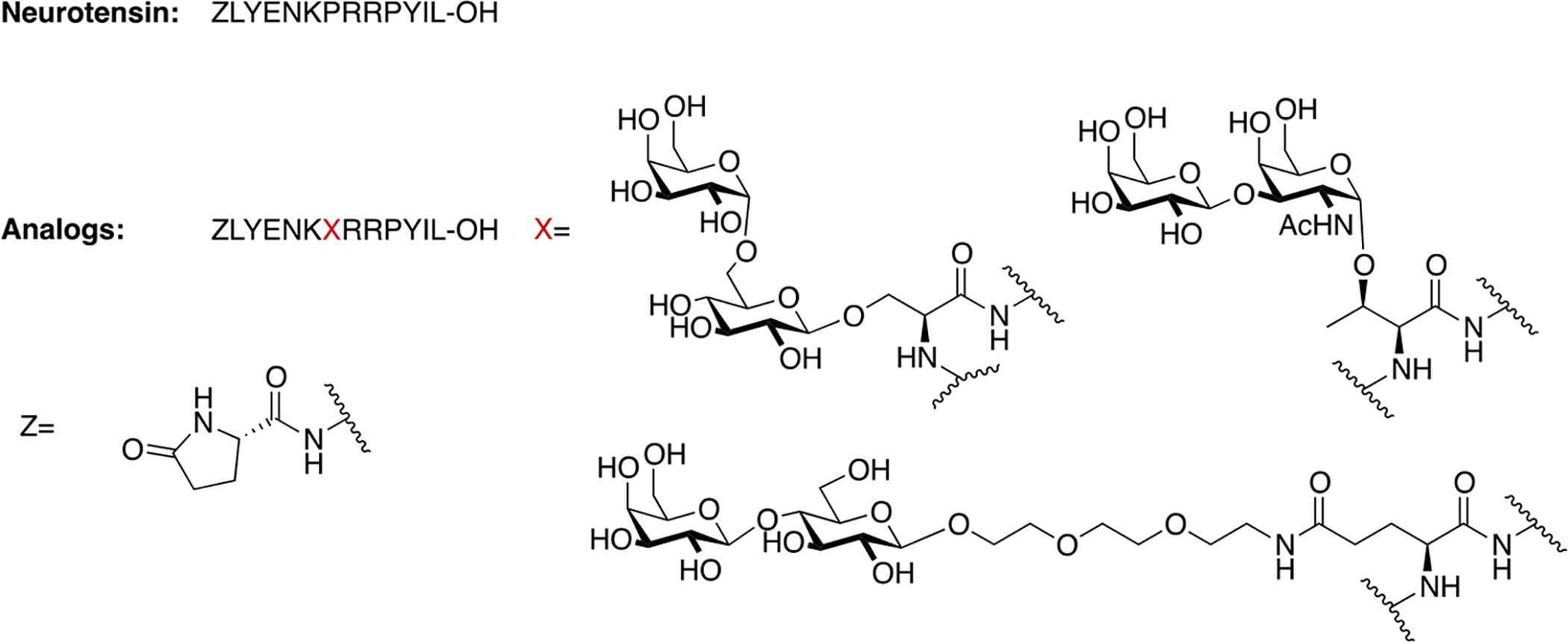
Figure 21.. Novel Neurotensin Glycopeptides with Anticonvulsant Activity.
Neurotensin glycopeptides were evaluated for their anticonvulsant activity in vivo. Satisfyingly, the glycopeptide analogues were active anticonvulsant agents at sub-picomolar concentrations. (Lee 2009) [96].
Figure 22.
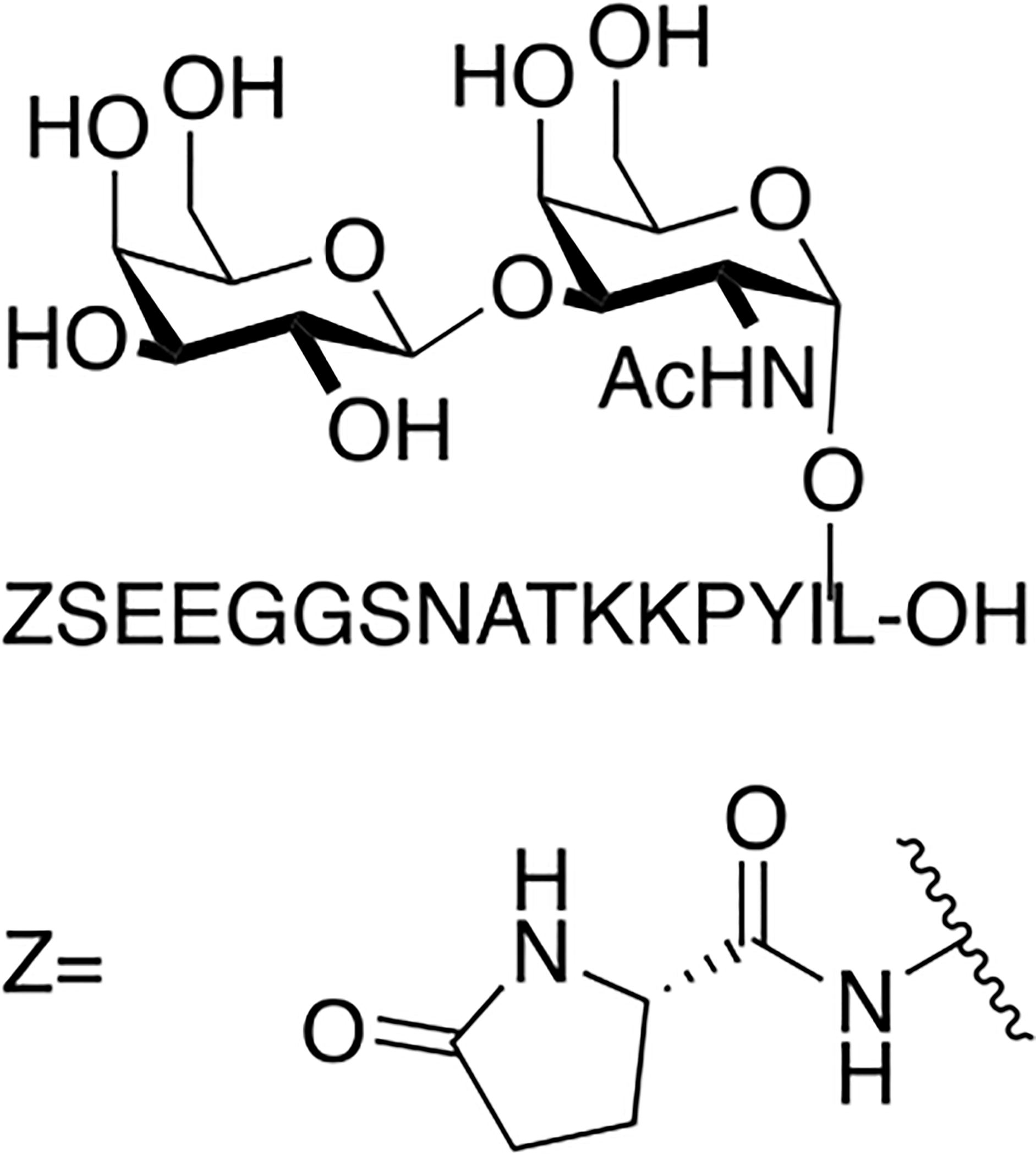
Figure 22.. Naturally Occurring Glycopeptide Contulakin G.
Contulakin G was synthesized using standard Fmoc-based SPPS. It was evaluated for its activity at the neurotensin1 receptor and compared to the receptor’s native ligand, neurotensin. Contulakin G was a weak antagonist at the neurotensin1 receptor and was less potent than neurotensin. (Lee 2015) [100].
Figure 23.
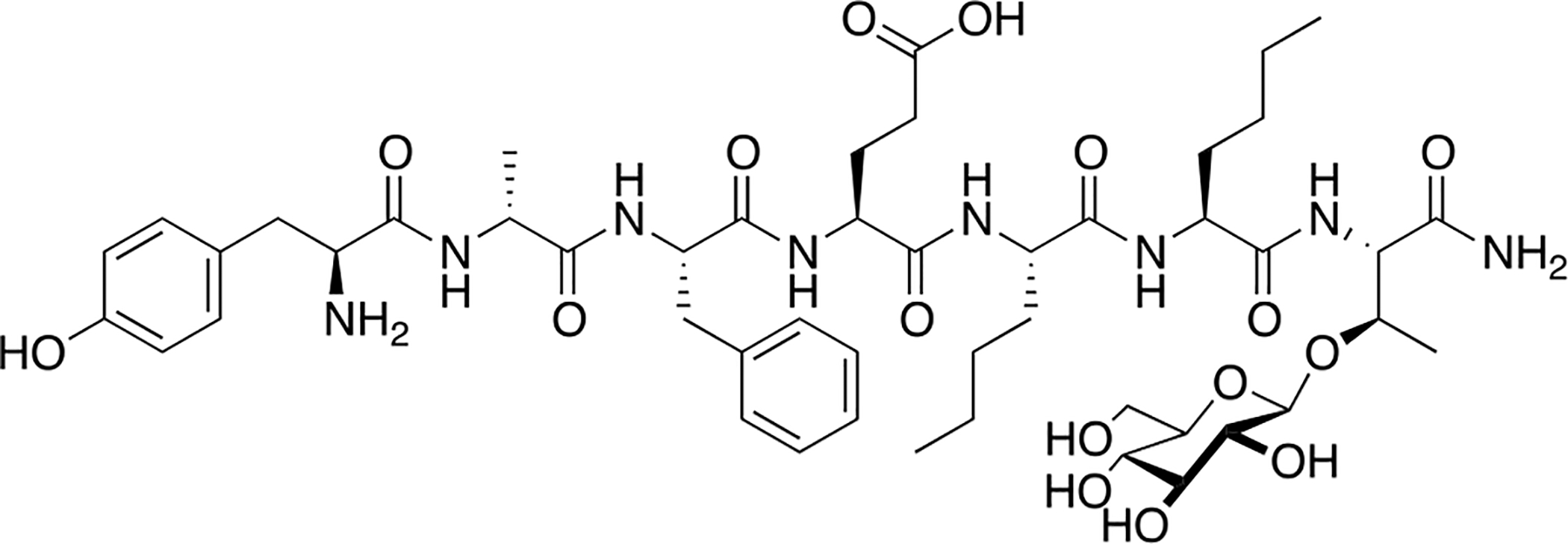
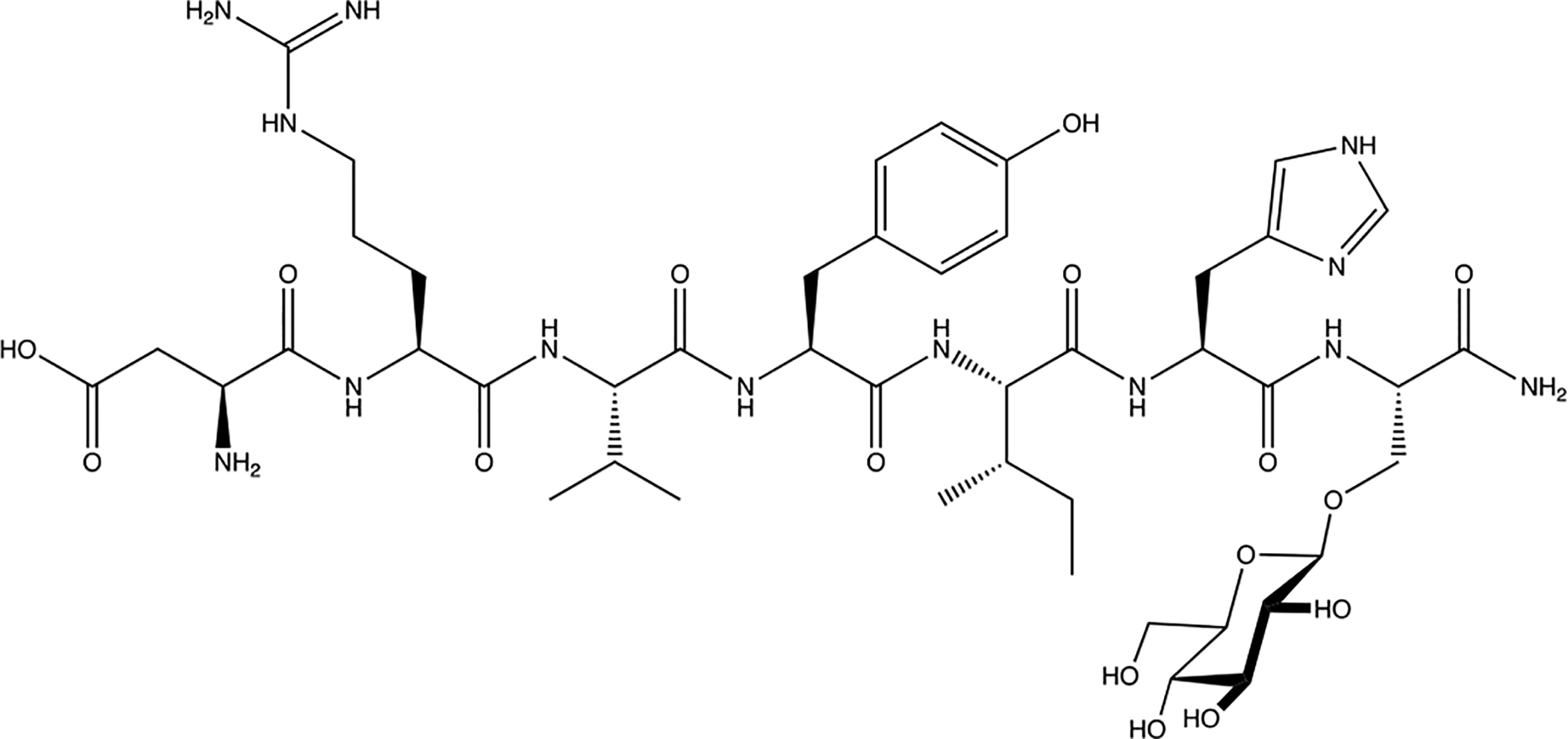
Figure 23.. PNA5:
PN5 is a glycosylated Ang-1–7 analogue with protective effects in vascular cognitive impairment, enhanced PK properties in vivo, and improved BBB permeability (Hay et al 2019) [103]
Figure 24.
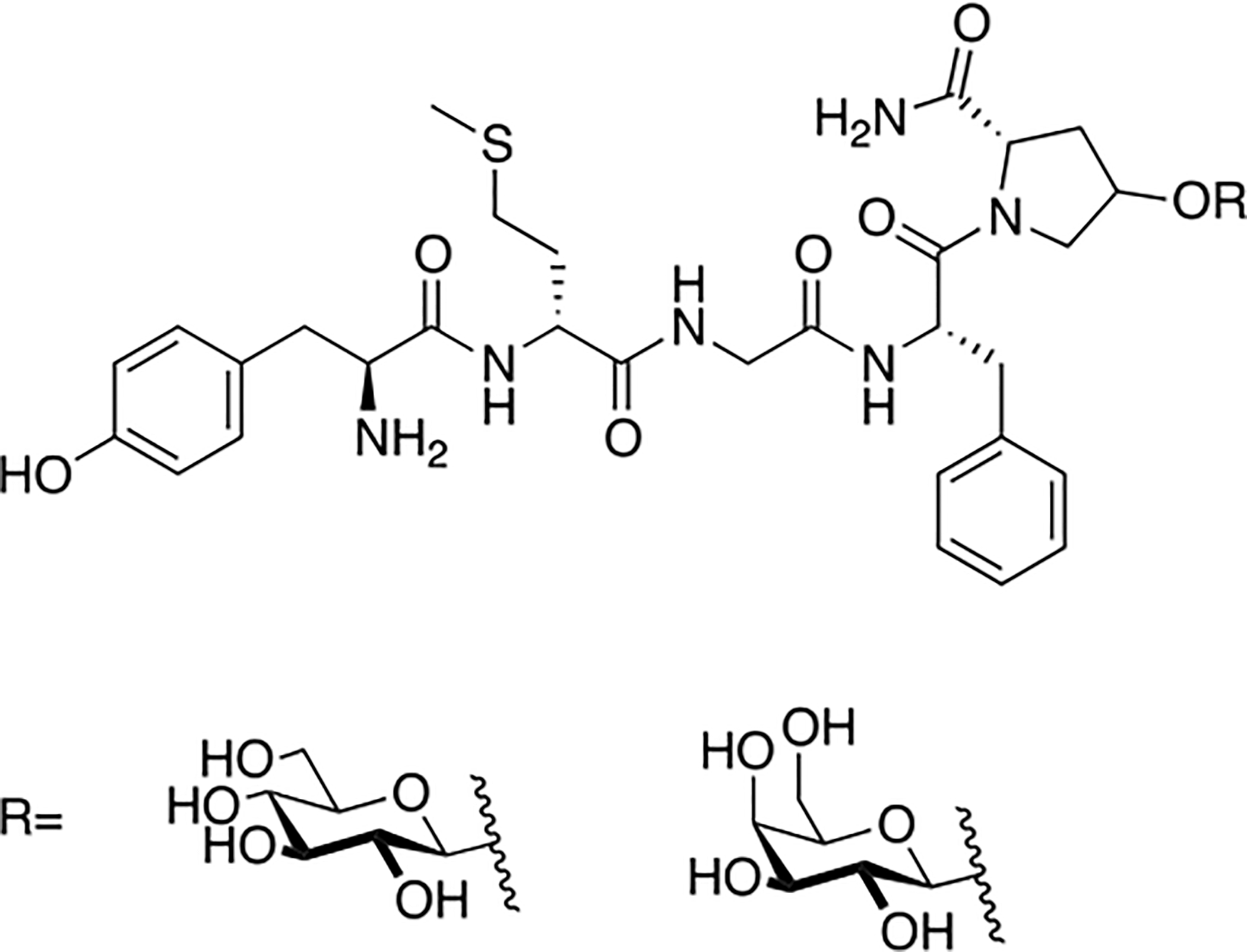
Figure 24.. Glycopeptides Related to Morphiceptin.
Morphiceptin glycopeptides containing either glucosylated or galactosylated hydroxyproline moieties were less potent than morphine in vivo. Interestingly, this is the opposite result of incorporating a carbohydrate moiety into opioid peptides. This indicates that morphiceptin adopts a different bioactive conformation than opioid peptides do. (Valencia 1990) [123].
Figure 25.
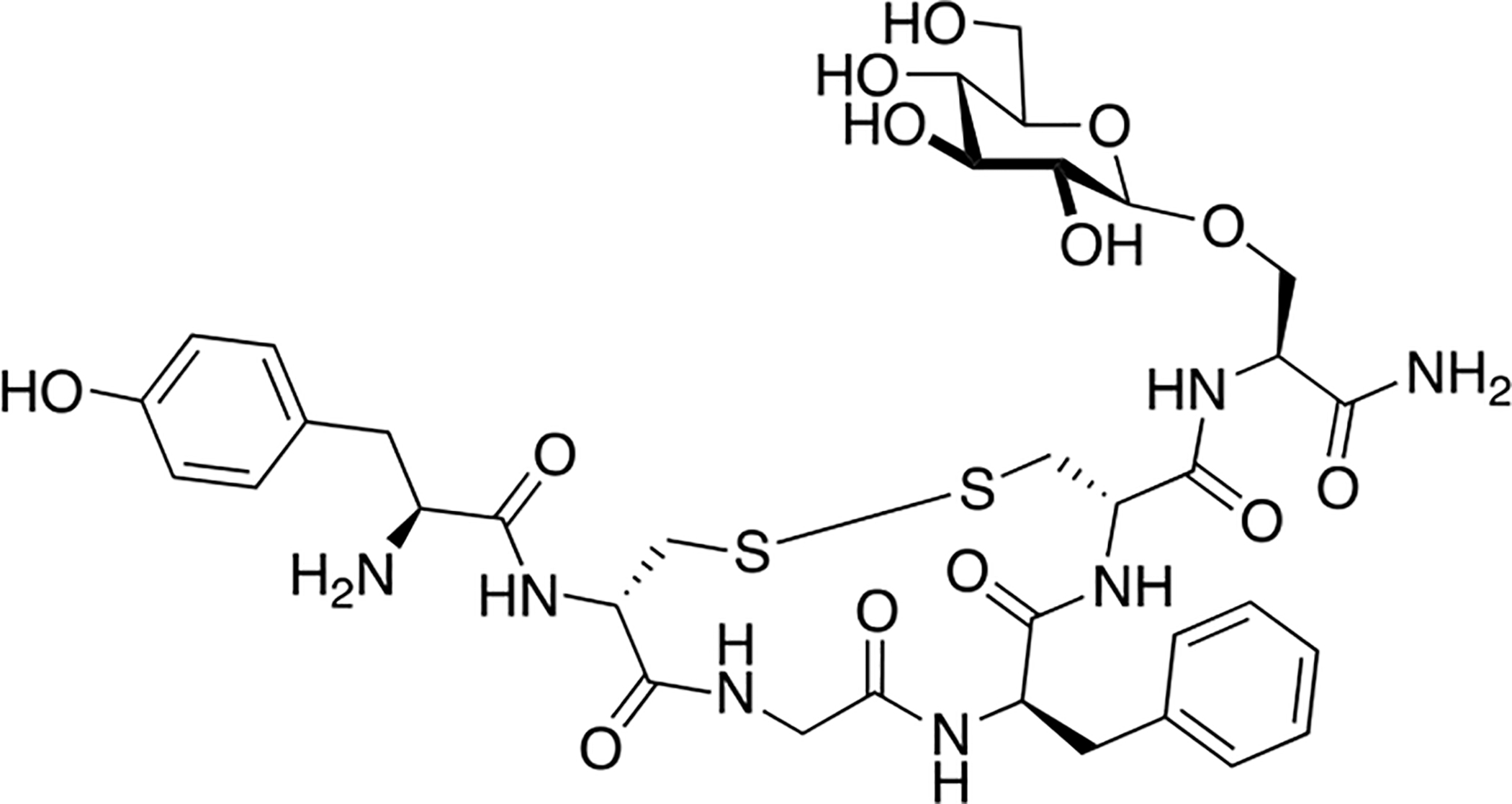
Figure 25.. Vasopressin Glycopeptides Containing Serine Glucosides and Galactosides.
Vasopressin glycopeptides were synthesized and evaluated for their antidiuretic activity in vivo. The glycopeptide analogues did not produce the desired activity, which was believed to be the result of unfavorable conformations induced by the carbohydrate moiety. (Khilberg 1996) [124].
Figure 26.
Figure 26.. N/OFQ-Derived Glycopeptides.
Glycopeptides related to the N/OFQ peptide were studied for the antinociceptive properties in vivo. The analogues containing a carbohydrate closer to the C-terminus exhibited similar binding and functional activity to native N/OFQ, whereas glycopeptides with a carbohydrate closer to the N-terminus showed reductions in biological activity. (Valencia 2011) [125].
Figure 27.
Figure 27.. Glycopeptides Derived from a Fragment of Glycogenin.
Synthetic glycogenin fragments were prepared to examine the substrate acceptor specificity of native glycogenin. (Jansson 1995) [127].
Figure 28.
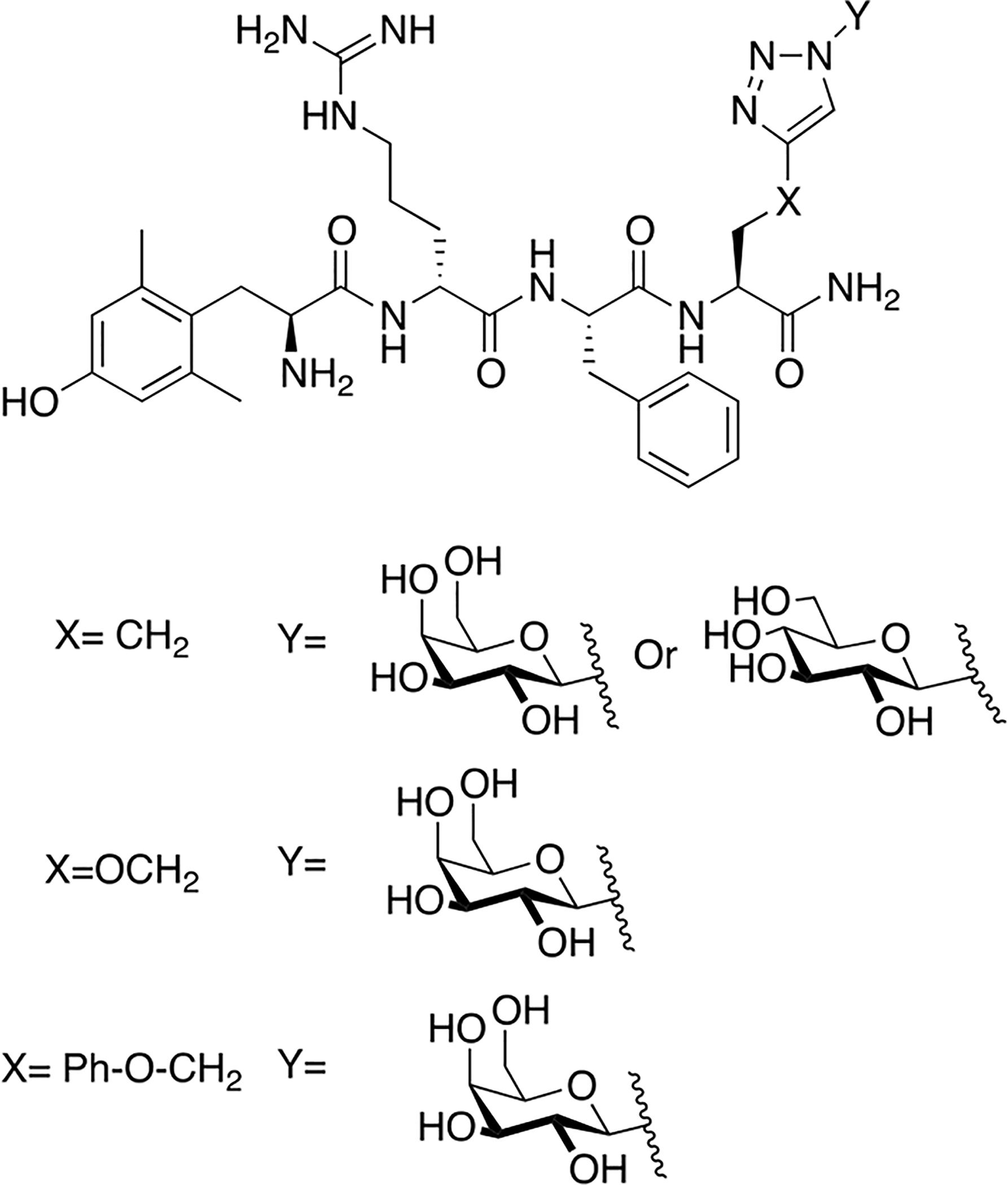
Figure 28.. Triazole-Containing Opioid Glycopeptides Related to DALDA and Dmt1-DALDA.
Several novel glycopeptides related to DALDA and Dmt1-DALADA containing carbohydrates linked through triazole moieties were synthesized and studied for the antinociceptive activity in vivo. The glycopeptide analogues exhibited antinociceptive activity, and the galactoside was specifically selected to be studied for its transport properties in caco-2 cells. It showed similar transport properties to native Dmt1-DALADA (Schiller 2014) [131].
Figure 29.
Figure 29.. Glycopeptides Related to the Bifunctional Opioid Peptide TY027.
A bifunctional glycopeptide with agonist activity at the opioid receptors and antagonist activity at the NK-1 receptor exhibited exceptional stability in rat plasma but performed slightly better than the un-glycosylated control in vitro. (Hruby 2009) [132].
Figure 30.
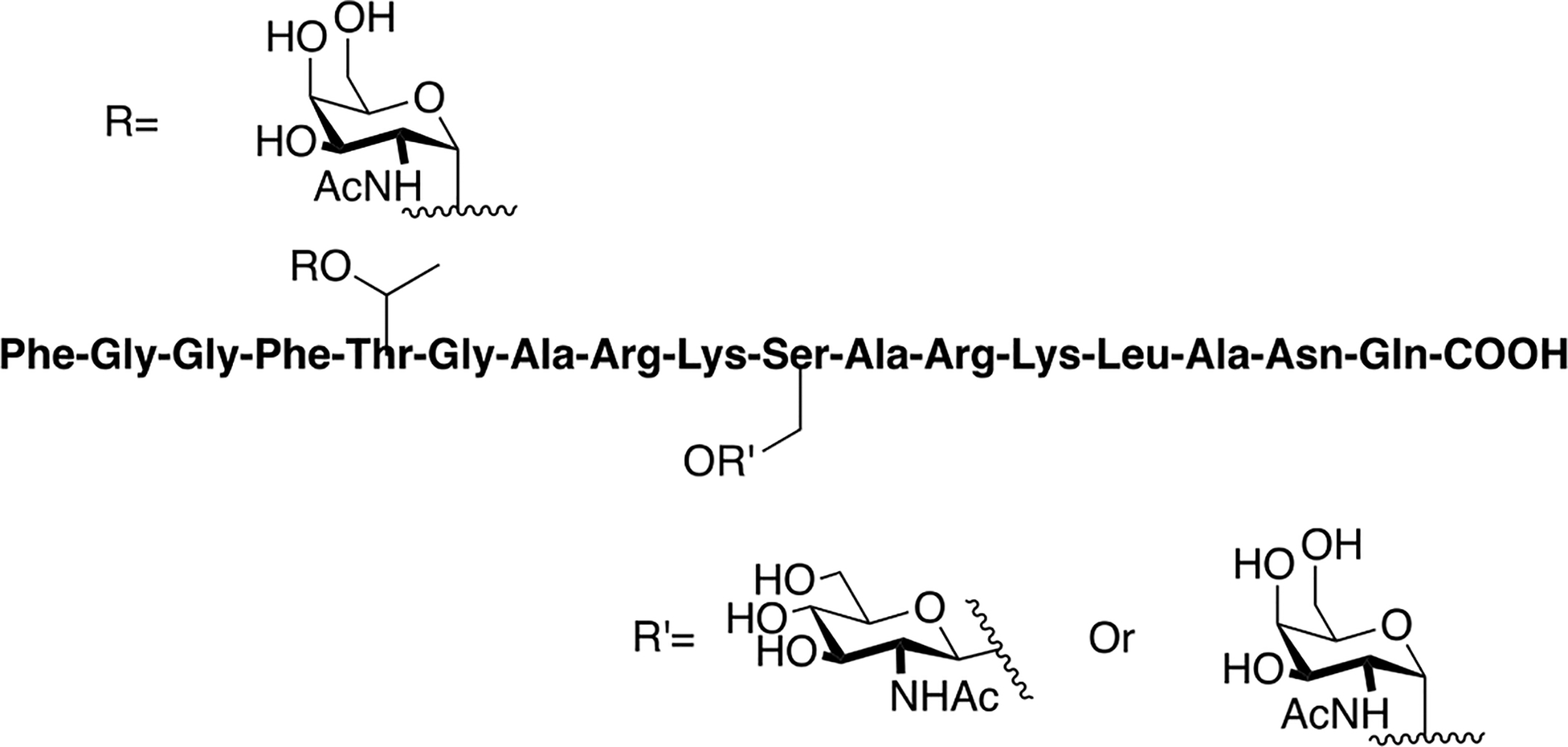
Figure 30.. VIP Glycopeptides.
Glycopeptides related to the vasoactive intestinal peptide (VIP) were glycosylated at several different positions to determine the sequence-dependent effect of glycosylation on biological activity. (Dangoor 2009) [135].
Figure 31.
Figure 31.. O-linked Calcitonin Glycopeptides.
Glycosylated calcitonin analogues were synthesized and evaluated for their hypocalcemic activity in vivo. (Toma 2001) [136].
Figure 32.
Figure 32.. Glycopeptides Related to GLP-1.
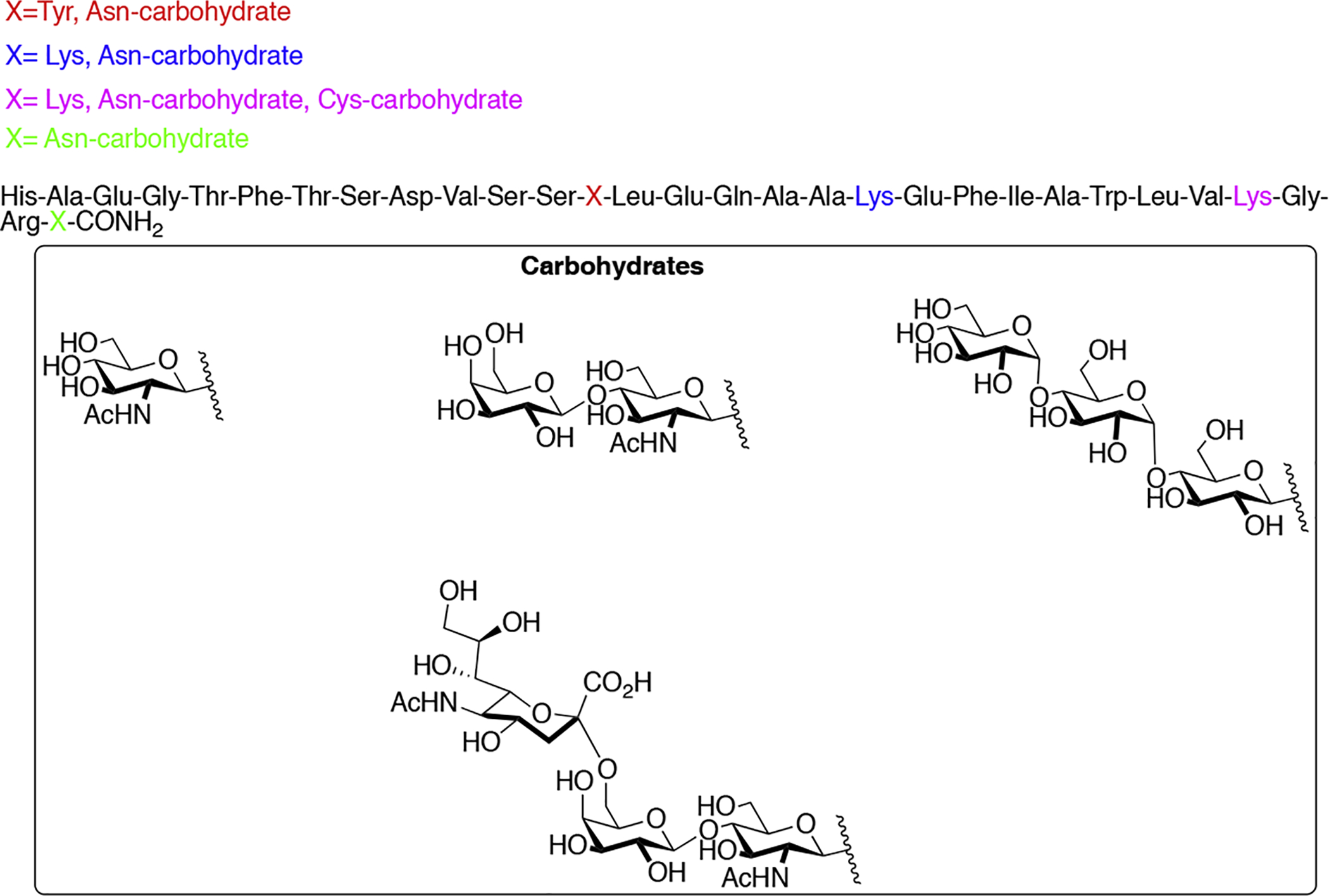
N-linked glycopeptide analogues of GLP-1 were synthesized using a combined SPPS and enzymatic approach. They exhibited improved binding activity, functional activity, and stability in vitro. (Kondo 2009) [138].

References

    1. Hruby VJ; Cai M Design of Peptide and Peptidomimetic Ligands with Novel Pharmacological Activity Profiles. Annu. Rev. Pharmacol. Toxicol, 2013, 53, 557–580. - PMC - PubMed
    1. Fosgerau K; Hoffmann T Peptide Therapeutics: Current Status and Future Directions. Drug Discov. Today, 2015, 20 (1), 122–128. - PubMed
    1. Hruby VJ Designing Peptide Receptor Agonists and Antagonists. Nat. Rev. Drug Discov, 2002, 1 (11), 847–858. - PubMed
    1. Werner HM; Horne WS Folding and Function in α/β-Peptides: Targets and Therapeutic Applications. Curr. Opin. Chem. Biol, 2015, 28, 75–82. - PMC - PubMed
    1. Cromm PM; Spiegel J; Grossmann TN Hydrocarbon Stapled Peptides as Modulators of Biological Function. ACS Chem. Biol, 2015, 10 (6), 1362–1375. - PubMed

Publication types

MeSH terms