Comparative Study
. 2020 Sep 5;12(16):15962-15977.
doi: 10.18632/aging.103725.

Genetic variation between long-lived versus short-lived bats illuminates the molecular signatures of longevity

Affiliations
Comparative Study

Genetic variation between long-lived versus short-lived bats illuminates the molecular signatures of longevity

Zixia Huang et al. Aging (Albany NY). .

Abstract

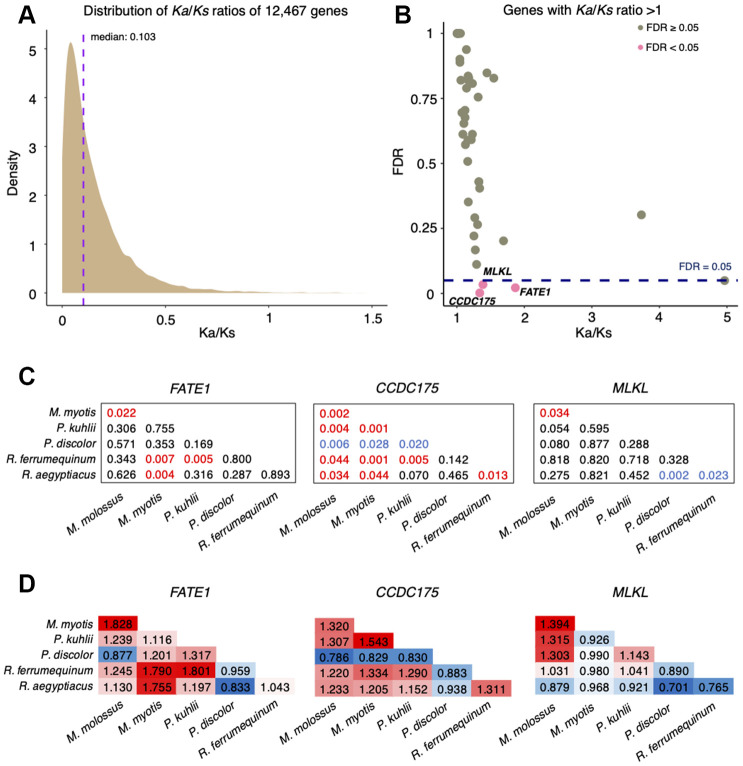
Bats are the longest-lived mammals given their body size with majority of species exhibiting exceptional longevity. However, there are some short-lived species that do not exhibit extended lifespans. Here we conducted a comparative genomic and transcriptomic study on long-lived Myotis myotis (maximum lifespan = 37.1 years) and short-lived Molossus molossus (maximum lifespan = 5.6 years) to ascertain the genetic difference underlying their divergent longevities. Genome-wide selection tests on 12,467 single-copy genes between M. myotis and M. molossus revealed only three genes (CCDC175, FATE1 and MLKL) that exhibited significant positive selection. Although 97.96% of 12,467 genes underwent purifying selection, we observed a significant heterogeneity in their expression patterns. Using a linear mixed model, we obtained expression of 2,086 genes that may truly represent the genetic difference between M. myotis and M. molossus. Expression analysis indicated that long-lived M. myotis exhibited a transcriptomic profile of enhanced DNA repair and autophagy pathways, compared to M. molossus. Further investigation of the longevity-associated genes suggested that long-lived M. myotis have naturally evolved a diminished anti-longevity transcriptomic profile. Together with observations from other long-lived species, our results suggest that heightened DNA repair and autophagy activity may represent a universal mechanism to achieve longevity in long-lived mammals.

Keywords: autophagy; bats; comparative genomics; longevity; transcriptomics.


Conflict of interest statement

CONFLICTS OF INTEREST: The authors declare that there are no conflicts of interest.

Figures

Figure 1
Figure 1
Analysis of Ka/Ks substitution rates of 12,467 single-copy genes between M. myotis and M. molossus. (A) Distribution of Ka/Ks ratios of 12,467 single-copy genes. To better visualize the distribution, six genes with Ka/Ks > 1.5 were not included in this plot. (B) Genes with Ka/Ks > 1. Three genes highlighted in red show significant positive selection (Ka/Ks > 1; FDR < 0.05 Fisher’s exact test). (C) Significance (FDR) of Ka/Ks ratios of FATE1, CCDC175 and MLKL between 6 bat species through pairwise comparisons. The red values indicate significant positive selection while the blue values indicate significant purifying selection. The black values indicate no selection. (D) Ka/Ks ratios of FATE1, CCDC175 and MLKL between 6 bat species through pairwise comparisons. The red values indicate Ka/Ks ratios > 1 while the blue values indicate Ka/Ks ratios < 1.
Figure 2
Figure 2
Comparisons of M. myotis and M. molossus blood transcriptomes. (A) Spearman’s correlation coefficients between M. myotis and M. molossus blood transcriptomes based on expression levels of 10,635 single-copy genes. We excluded 1,832 genes that were neither expressed in M. myotis nor M. molossus. (B) Differential gene expression analysis between M. myotis and M. molossus blood transcriptomes. Genes with FDR < 0.05 were considered differentially expressed genes (DEGs).
Figure 3
Figure 3
Gene expression variation analysis. (A) Evaluation of gene expression variance using a linear mixed model. Residual variance represents the contribution from uncharacterized variables. (B) Overlap of differentially expressed genes (blue) and the genes with at least 80% of expression variation resulted from ‘species’ (grey). (C) GO terms that were enriched by 1,060 genes that had higher expression in M. molossus. (D) GO terms that were enriched by 1,026 genes that had higher expression in M. myotis.
Figure 4
Figure 4
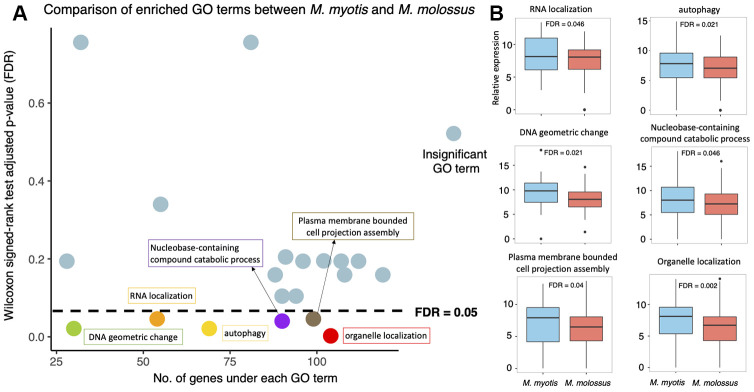
Expression analysis of the 20 GO terms between M. myotis and M. molossus. (A) Differential expression analysis of GO terms enriched by 2,086 genes that showed >80% interspecific expression variation. Differentially expressed GO terms were determined by comparing gene expression under each GO term using Wilcoxon signed-rank test (paired mode; one-tailed test). GO terms with FDR < 0.05 were considered differentially expressed. (B) Distribution of gene expression under each of 6 differentially expressed GO terms between M. myotis and M. molossus.
Figure 5
Figure 5
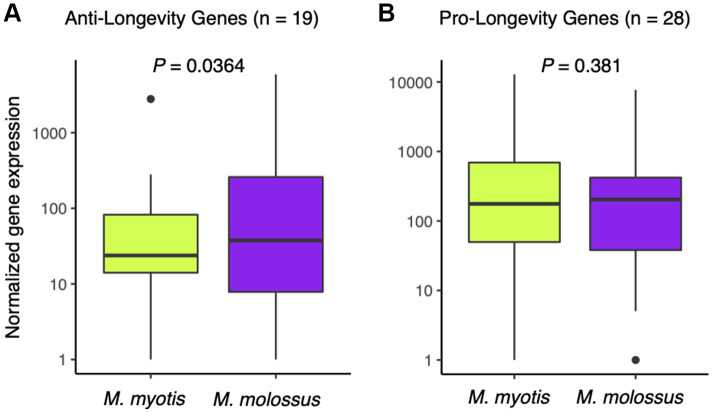
Expression analysis of anti- and pro-longevity genes between M. myotis and M. molossus. (A) Comparison of anti-longevity gene expression (n = 19) between M. myotis and M. molossus using Wilcoxon signed-rank test (paired mode, one-tailed test). (B) Comparison of pro-longevity gene expression (n = 28) between M. myotis and M. molossus using Wilcoxon signed-rank test (paired mode, one-tailed test).

References

    1. George JC, Bada J, Zeh J, Scott L, Brown SE, O'Hara T, Suydam R. Age and growth estimates of bowhead whales (Balaena mysticetus) via aspartic acid racemization. Can J Zool. 1999; 77:571–580. 10.1139/z99-015 - DOI
    1. Austad SN. Methusaleh’s zoo: how nature provides us with clues for extending human health span. J Comp Pathol. 2010. (Suppl 1); 142:S10–21. 10.1016/j.jcpa.2009.10.024 - DOI - PMC - PubMed
    1. Austad SN, Fischer KE. Mammalian aging, metabolism, and ecology: evidence from the bats and marsupials. J Gerontol. 1991; 46:B47–53. 10.1093/geronj/46.2.b47 - DOI - PubMed
    1. Podlutsky AJ, Khritankov AM, Ovodov ND, Austad SN. A new field record for bat longevity. J Gerontol A Biol Sci Med Sci. 2005; 60:1366–68. 10.1093/gerona/60.11.1366 - DOI - PubMed
    1. Foley NM, Hughes GM, Huang Z, Clarke M, Jebb D, Whelan CV, Petit EJ, Touzalin F, Farcy O, Jones G, Ransome RD, Kacprzyk J, O’Connell MJ, et al.. Growing old, yet staying young: the role of telomeres in bats’ exceptional longevity. Sci Adv. 2018; 4:eaao0926. 10.1126/sciadv.aao0926 - DOI - PMC - PubMed

Publication types