Review
. 2020 Jul 14;12(7):1888.
doi: 10.3390/cancers12071888.

Relevance of Regulatory T Cells during Colorectal Cancer Development

Affiliations
Review

Relevance of Regulatory T Cells during Colorectal Cancer Development

Jonadab E Olguín et al. Cancers (Basel). .

Abstract

In recent years, there has been a significant increase in the study of own and foreign human factors favoring the development of different types of cancer, including genetic and environmental ones. However, the fact that the immune response plays a fundamental role in the development of immunity and susceptibility to colorectal cancer (CRC) is much stronger. Among the many cell populations of the immune system that participate in restricting or favoring CRC development, regulatory T cells (Treg) play a major role in orchestrating immunomodulation during CRC. In this review, we established concrete evidence supporting the fact that Treg cells have an important role in the promotion of tumor development during CRC, mediating an increasing suppressive capacity which controls the effector immune response, and generating protection for tumors. Furthermore, Treg cells go through a process called "phenotypic plasticity", where they co-express transcription factors that promote an inflammatory profile. We reunited evidence that describes the interaction between the different effector populations of the immune response and its modulation by Treg cells adapted to the tumor microenvironment, including the mechanisms used by Treg cells to suppress the protective immune response, as well as the different subpopulations of Treg cells participating in tumor progression, generating susceptibility during CRC development. Finally, we discussed whether Treg cells might or might not be a therapeutic target for an effective reduction in the morbidity and mortality caused by CRC.

Keywords: animal models; clinical trial; colorectal cancer; phenotypic plasticity; regulatory T cells.


Conflict of interest statement

The authors declare no conflict of interest.

Figures

Figure 1
Figure 1
Natural regulatory T (Treg) cells and their main suppressive mechanisms. (A) Metabolic disruption of IL-2 caused by an increased expression of CD25 (high-affinity IL-2 receptor) in Treg cells, also caused by the release of extracellular adenosine. (B) Secretion of cytokines such as IL-10, TGF-β, and IL-35. (C) Manipulation of antigens presenting cells for a tolerant phenotype. (D) Secretion of granzyme and perforin.
Figure 2
Figure 2
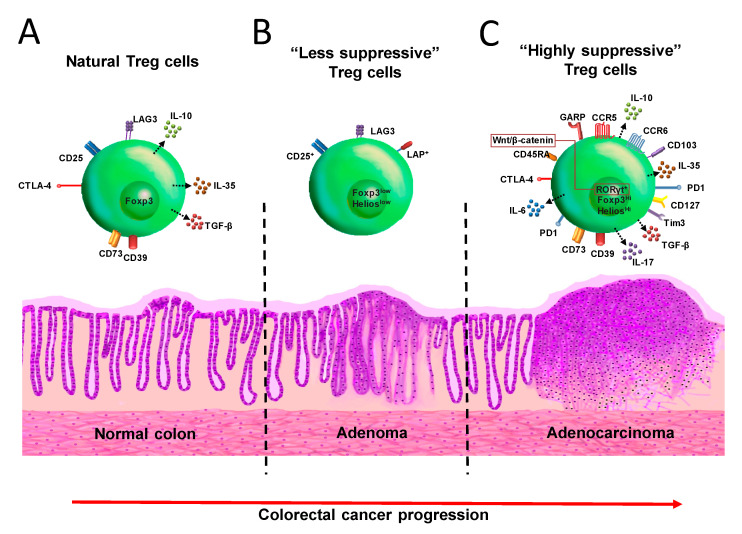
Phenotype of Treg cells in the progression of CRC. As mentioned in the text, adenomas are the precursors of CRC, arising from the adenoma-carcinoma sequence. (A) When the intestinal tissue has a normal condition, natural Treg cells display a regular phenotype, but the genetic, epigenetic, and mainly the immunological alterations that end in the formation of adenomas, modify the phenotype in Treg cells, which confers different roles, depending of the grade of alterations during CRC. We included these subpopulations of Treg cells in 2 groups: (B) “less suppressive” Treg cells which are associated with an immunological protection against tumor formation, and (C) “Highly suppressive” Treg cells, whose phenotype is associated with tumor progression and a poor protective immune response against CRC.
Figure 3
Figure 3
Different molecules and cells either promoting or inhibiting Treg cell activities during CRC. (A) As described in the text, some cells, such as mast cells, T cells, and TAMs, are involved in the induction of Treg cell population during CRC development. Additionally, the same tumor microenvironment produces molecules to induce a more suppressive population of Treg cells. (B) On the other hand, cells such as NK, CD4, and CD8 T cells, are involved in the inhibition of the suppressor capacity of Treg cells during CRC.

References

    1. Wang M., Yin B., Wang H.Y., Wang R.F. Current advances in T-cell-based cancer immunotherapy. Immunotherapy. 2014;6:1265–1278. doi: 10.2217/imt.14.86. - DOI - PMC - PubMed
    1. Yang Y. Cancer immunotherapy: Harnessing the immune system to battle cancer. J. Clin. Investig. 2015;125:3335–3337. doi: 10.1172/JCI83871. - DOI - PMC - PubMed
    1. Rosenberg S.A., Yannelli J.R., Yang J.C., Topalian S.L., Schwartzentruber D.J., Weber J.S., Parkinson D.R., Seipp C.A., Einhorn J.H., White D.E. Treatment of patients with metastatic melanoma with autologous tumor-infiltrating lymphocytes and interleukin 2. J. Natl. Cancer Inst. 1994;86:1159–1166. doi: 10.1093/jnci/86.15.1159. - DOI - PubMed
    1. Niccolai E., Taddei A., Prisco D., Amedei A. Gastric cancer and the epoch of immunotherapy approaches. World J. Gastroenterol. 2015;21:5778–5793. doi: 10.3748/wjg.v21.i19.5778. - DOI - PMC - PubMed
    1. Berrien-Elliott M.M., Romee R., Fehniger T.A. Improving natural killer cell cancer immunotherapy. Curr. Opin. Organ Transplant. 2015;20:671–680. doi: 10.1097/MOT.0000000000000243. - DOI - PMC - PubMed

LinkOut - more resources