


Reproducibility and Validity of a Food Frequency Questionnaire for Dietary Assessment in Adolescents in a Self-Reported Way
- PMID: 32674463
- PMCID: PMC7400888
- DOI: 10.3390/nu12072081
Reproducibility and Validity of a Food Frequency Questionnaire for Dietary Assessment in Adolescents in a Self-Reported Way
Abstract
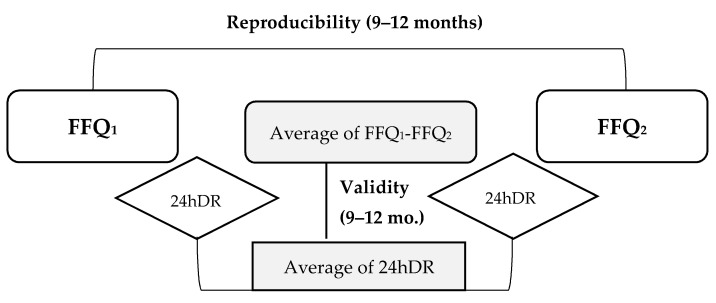
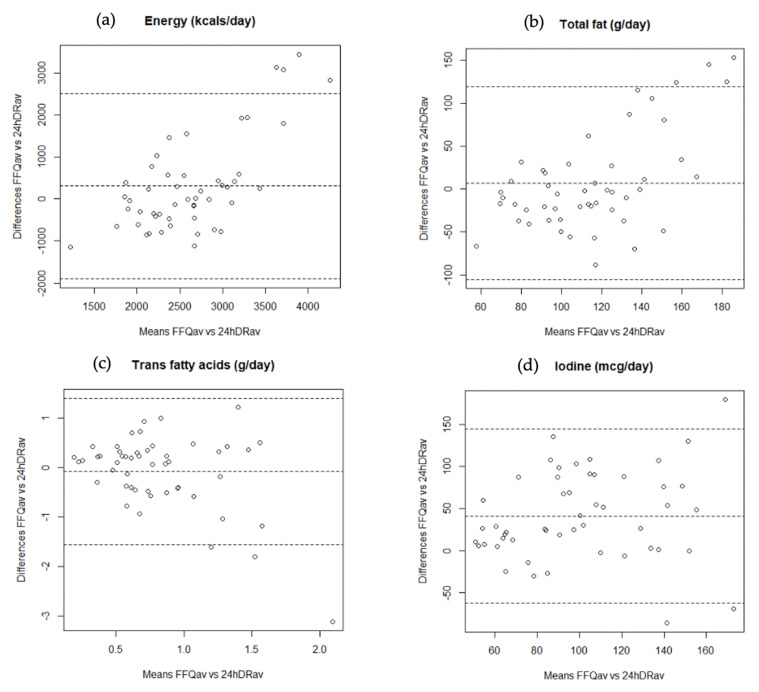
Tools to assess diet in a reliable and efficient way are needed, particularly in children and adolescents. In this study, we assess the reproducibility and validity of a semiquantitative food frequency questionnaire (FFQ) among adolescents in Spain. We analyzed data of 51 male adolescents aged 15-17 years from a prospective birth cohort study. Participants answered the FFQ twice in a self-administered way over a 12-month period. Reproducibility was assessed by comparing nutrient and food intakes from the FFQs, and validity by comparing nutrient intakes from the average of two FFQs and the average of two 24-Hour Dietary Recalls obtained in the period. Pearson correlation coefficients were calculated. The average of reproducibility correlation coefficients for food group intakes was 0.33, with the highest correlation for vegetable intake (r = 0.81); and the average for nutrient intake was 0.32, with the highest coefficients for α- and β-carotene (r = 0.65). Validity correlation coefficients ranged from 0.07 for carbohydrates to 0.53 for dietary fiber. The average of the validity correlation coefficients was r = 0.32. This study suggests that our FFQ may be a useful tool for assessing dietary intake of most nutrient and food groups among Spanish male adolescents in a self-administered way, despite reproducibility and, particularly validity, being low for some nutrients and food groups.
Keywords: Mediterranean country; adolescent; diet; dietary food record; food frequency questionnaire; nutrient intake; reproducibility; validity.
Conflict of interest statement
The authors declare no conflict of interest and the funders had no role in the design of the study; in the collection, analyses, or interpretation of data; in the writing of the manuscript; or in the decision to publish the results.
Figures
References
-
- Lipsky L.M., Haynie D.L., Liu D., Chaurasia A., Gee B., Li K., Iannotti R.J., Simons-Morton B. Trajectories of eating behaviors in a nationally representative cohort of U.S. adolescents during the transition to young adulthood. Int. J. Behav. Nutr. Phys. Act. 2015;12:138. doi: 10.1186/s12966-015-0298-x. - DOI - PMC - PubMed
-
- NCD Risk Factor Collaboration (NCD-RisC) Worldwide trends in body-mass index, underweight, overweight and Obesity from 1975 to 2016: A pooled analysis of 2416 population-based measurement studies in 128.9 million children, adolescents, and adults. Lancet. 2017;390(Suppl. 10113):2627–2642. doi: 10.1016/S0140-6736(17)32129-3. - DOI - PMC - PubMed
