


From slippery slopes to steep hills: Contrasting landscapes of economic growth and public spending for health
- PMID: 32674847
- PMCID: PMC7335632
- DOI: 10.1016/j.socscimed.2020.113171
From slippery slopes to steep hills: Contrasting landscapes of economic growth and public spending for health
Abstract
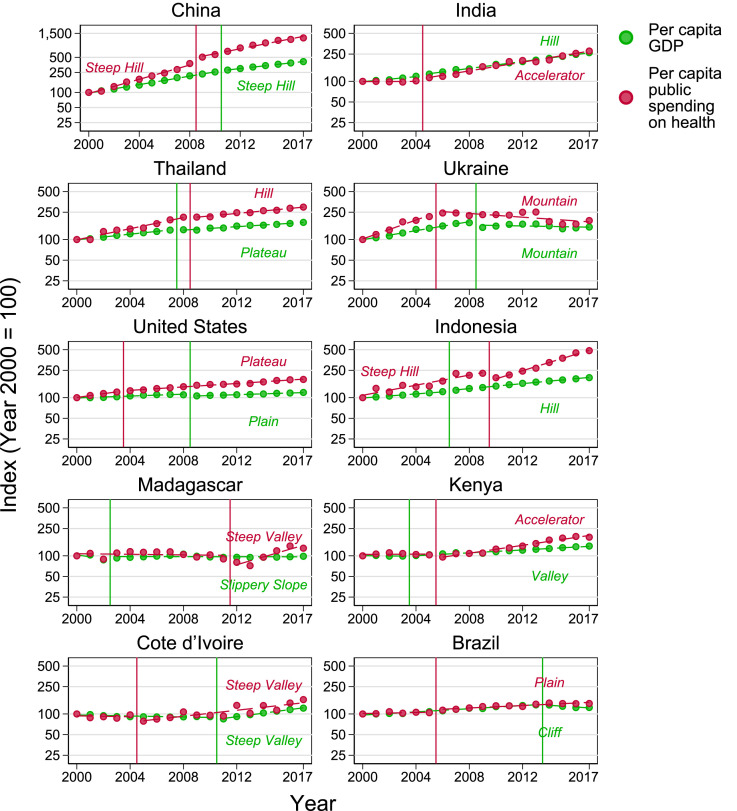
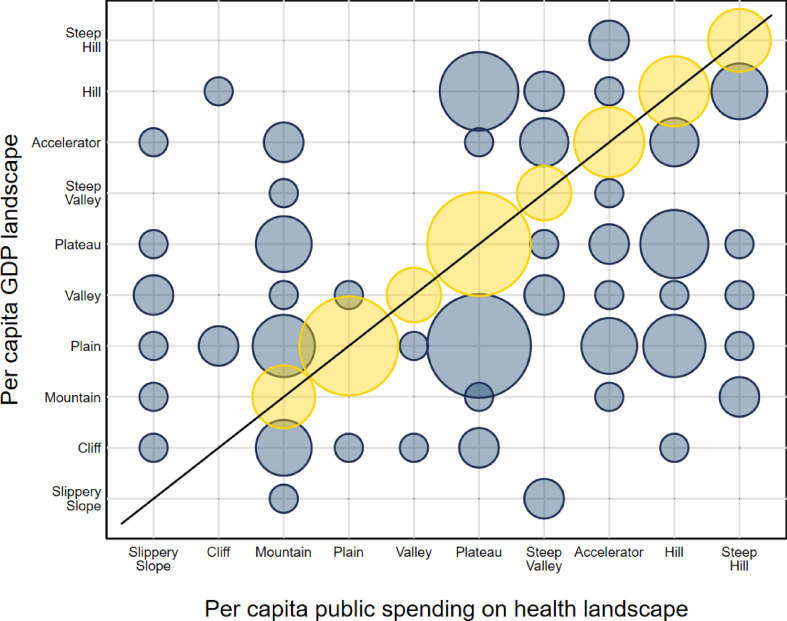
Identifying ways to increase public spending on health is critical for the achievement of universal health coverage. While policymakers and donors often look at available options for increasing public spending for health in the medium-term, examining trends and drivers of past growth can help countries elucidate important lessons and to anticipate changes in the future. This note analyzes trends in inflation-adjusted per capita public spending for health vis-à-vis economic growth within and across a sample of 150 countries over the 2000-2017 period. Since 2000, per capita public spending for health across low- and middle-income countries has more than doubled. Less than one-fifth of this increase, however, resulted from a higher priority for health in government budgets. The remainder was largely due to conducive macroeconomic conditions such as economic growth and increases in total public spending. Furthermore, across most countries, a single time trend does not adequately capture the evolution either of economic growth or of per capita public spending on health. Instability in growth rates is large for both indicators, revealing distinct episodic patterns.
Keywords: Economic growth; Health care financing; National government health expenditure; Public expenditure.
Copyright © 2020. Published by Elsevier Ltd.
Figures
References
-
- African Union . 2001. pp. 24–27.http://www.un.org/ga/aids/pdf/abuja_declaration.pdf (Abuja Declaration on HIV/AIDS, Tuberculosis, and Other Related Infectious Diseases, African Summit on HIV/AIDS, Tuberculosis, and Other Related Infectious Diseases). April: Abuja, Nigeria.
-
- Global Burden of Disease Health Financing Collaborator Network Past, present, and future of global health financing: a review of development assistance, government, out- of-pocket, and other private spending on health for 195 countries, 1995–2050. Lancet. 2019 doi: 10.1016/S0140-6736(19)30841-4. - DOI - PMC - PubMed
-
- International Monetary Fund . 2020. World Economic Outlook, April 2020: the Great Lockdown.https://www.imf.org/en/Publications/WEO/Issues/2020/04/14/weo-april-2020
-
- Kutzin J. Anything goes on the path to universal health coverage? No. Bull. World Health Organization, Nov 1. 2012;90(11):867–868. https://www.ncbi.nlm.nih.gov/pmc/articles/PMC3506412/ - PMC - PubMed
-
- Organisation for Economic Co-operation and Development, Eurostat, & World Health Organization . 2011. A System of Health Accounts.https://www.who.int/health-accounts/methodology/sha2011.pdf
MeSH terms
LinkOut - more resources
Full Text Sources
Miscellaneous
