doi: 10.1183/13993003.01400-2020.
Print 2020 Sep.
Socioeconomic correlates of SARS-CoV-2 and influenza H1N1 outbreaks
Affiliations
- PMID: 32675209
- PMCID: PMC7366181
- DOI: 10.1183/13993003.01400-2020
Item in Clipboard
Socioeconomic correlates of SARS-CoV-2 and influenza H1N1 outbreaks
Eur Respir J.
.
Abstract
Geographic disease patterns of the SARS-CoV-2 and the H1N1 influenza pandemics are cross-examined with socioeconomic indices, revealing that the two outbreaks are fundamentally different and that SARS-CoV-2 spread is linked with economic output
Conflict of interest statement
Conflict of interest: J.C. Kaiser has nothing to disclose. Conflict of interest: G.T. Stathopoulos has nothing to disclose.
Figures
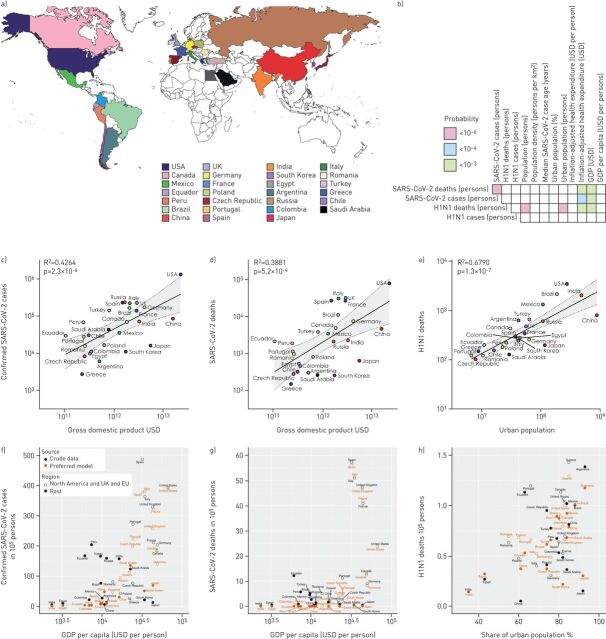
Severe acute respiratory syndrome coronavirus 2 (SARS-CoV-2) and H1N1 influenza pandemics in 27 countries. a) Colour-coded map and legend of the 27 countries analysed on 12 May 2020. b) Heatmap of the correlations observed on 12 May 2020. c–e) Significant bivariate correlations of the SARS-CoV 2 and H1N1 outbreaks with socioeconomic indices. Shown are color-coded raw data points, Pearson's correlation coefficients (R2) and probability values (p), and linear regression lines with 95% confidence intervals (grey zones). GDP: annual gross domestic product. f–h) Crude rates for population-adjusted SARS-CoV-2 deaths and cases and H1N1 deaths in comparison with country-specific rates expected by the preferred general linear model.
References
-
- GBD 2016 Disease and Injury Incidence and Prevalence Collaborators . Global, regional, and national incidence, prevalence, and years lived with disability for 328 diseases and injuries for 195 countries, 1990–2016: a systematic analysis for the Global Burden of Disease Study 2016. Lancet 2017; 390: 1211–1259. doi: 10.1016/S0140-6736(17)32154-2 - DOI - PMC - PubMed
Publication types
MeSH terms
LinkOut - more resources
Full Text Sources
Medical
Miscellaneous