Review
. 2020 Jul;36(4):285-307.
doi: 10.6515/ACS.202007_36(4).20200619A.

2020 Focused Update of the 2012 Guidelines of the Taiwan Society of Cardiology for the Management of ST-Segment Elevation Myocardial Infarction

Affiliations
Review

2020 Focused Update of the 2012 Guidelines of the Taiwan Society of Cardiology for the Management of ST-Segment Elevation Myocardial Infarction

Yi-Heng Li et al. Acta Cardiol Sin. 2020 Jul.

Abstract

One of the major missions of the Taiwan Society of Cardiology is to publish practice guidelines that are suitable for local use in Taiwan. The ultimate purpose is to continuously improve cardiovascular health care from the implementation of the recommendations in the guidelines. Despite recent improvement of medical care, patients with ST-segment elevation myocardial infarction (STEMI) still carry a high morbidity and mortality. There have been many changes in the concepts of STEMI diagnosis and treatment in recent years. The 2020 focused update of the 2012 guidelines of the Taiwan Society of Cardiology for the management of STEMI is an amendment of the 2012 guidelines based on the newest published scientific data. The recommendations in this focused update provide the diagnosis and treatment strategy for STEMI that should be generally implemented in Taiwan. Nevertheless, guidelines never completely replace clinical judgment and medical decision still should be determined individually.

Keywords: Acute myocardial infarction; Guideline; Taiwan.


Figures
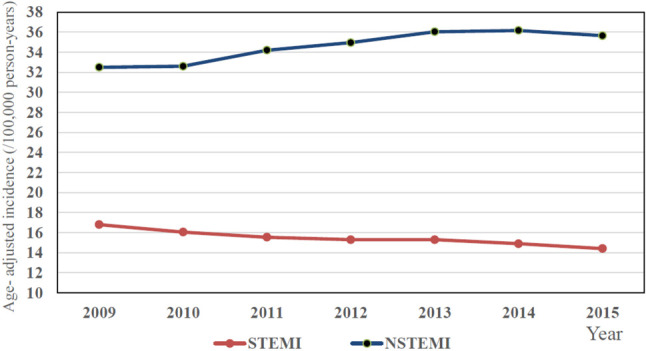
Figure 1
Figure 1
The recent trends of decreasing incidence of STEMI and increasing incidence of NSTEMI in Taiwan. NSTEMI, non ST-segment elevation myocardial infarction; STEMI, ST-segment elevation myocardial infarction. Adapted from reference .
Figure 2
Figure 2
The detailed recommendations of using high sensitivity cardiac troponin assay to diagnose and rule out acute myocardial infarction. ACS, acute coronary syndrome; ECG, electrocardiography; hs-cTn, high sensitivity cardiac troponin. Adapted from reference 3.
Figure 3
Figure 3
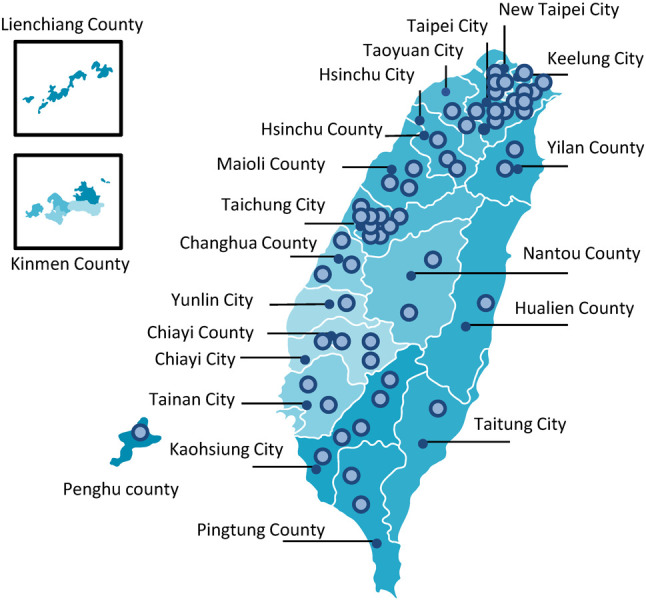
Distribution of hospitals that provide 24-hour primary PCI service in Taiwan. Fibrinolysis is only suggested in special occasions, including special pandemic infection or islands without PCI available hospitals. PCI, percutaneous coronary intervention.
Figure 4
Figure 4
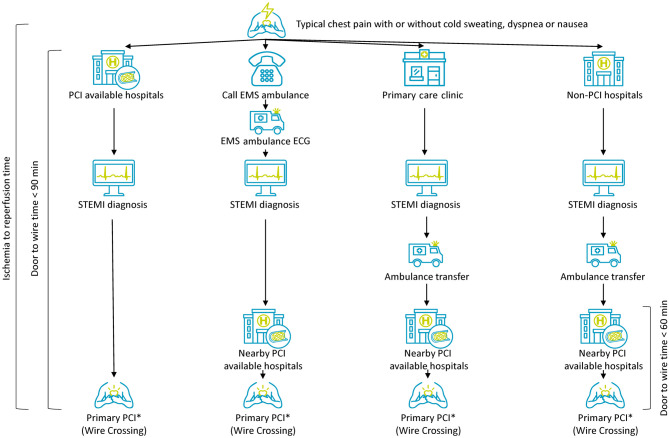
Recommended transportation pathways and door-to-wire time for primary PCI from different places of patient presentation. PCI, percutaneous coronary intervention; STEMI, ST-segment elevation myocardial infarction. ECG, electrocardiography; EMS, emergency medical service.
Figure 5
Figure 5
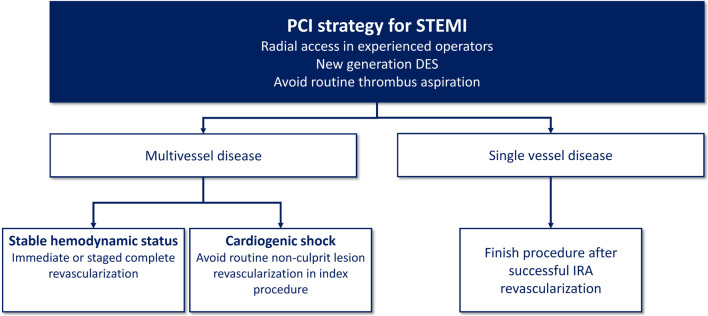
Recommended PCI strategy for STEMI in Taiwan. DES, drug-eluting stent; IRA, infarct-related artery; PCI, percutaneous coronary intervention; STEMI, ST-segment elevation myocardial infarction.
Figure 6
Figure 6
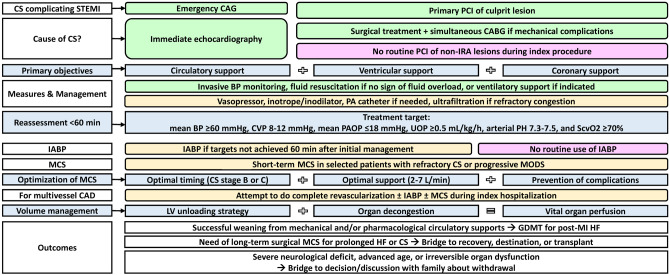
Evidence-based algorithm for evaluation and management of cardiogenic shock complicating AMI. The recommendations were mainly based on the latest reviews and international guidelines. Class I, II, III recommendations were depicted with light green, light yellow, and pink colors, respectively. AMI, acute myocardial infarction; BP, blood pressure; CABG, coronary artery bypass grafting surgery; CAD, coronary artery disease; CAG, coronary angiography; CS, cardiogenic shock; CVP, central venous pressure; GDMT, guideline-directed medical therapy; HF, heart failure; IABP, intra-aortic balloon pumping; IRA, infarct-related artery; LV, left ventricular; MCS, mechanical circulatory support; MODS, multiple organ dysfunction syndrome; PAOP, pulmonary artery obstructive pressure; PCI, percutaneous coronary intervention; ScvO2, central venous oxygen saturation; STEMI, ST-segment elevation myocardial infarction; UOP, urine output.
Figure 7
Figure 7
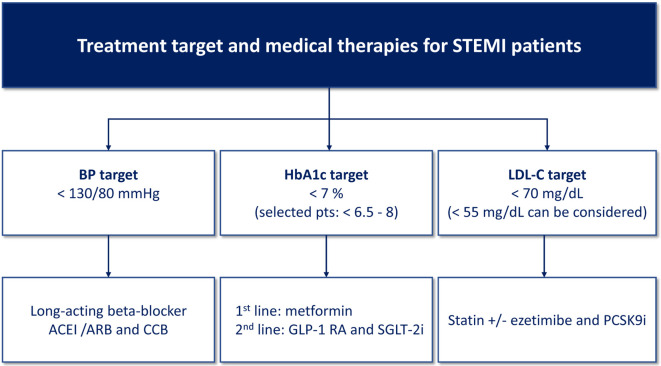
Recommended treatment targets and medical therapies for STEMI patients. ACEI, angiotensin converting enzyme inhibitor; ARB, angiotensin receptor blocker; BP, blood pressure; CCB, calcium channel blocker; GLP-1 RA, glucagon-like peptide-1 receptor agonist; LDL-C, low-density lipoprotein cholesterol; PCSK9i, proprotein convertase subtilisin/kexin type 9 inhibitor; SGLT-2i, sodium/glucose co-transporter 2 inhibitor.

References

    1. Lee CH, Fang CC, Tsai LM, et al. Patterns of acute myocardial infarction in Taiwan from 2009 to 2015. Am J Cardiol. 2018;122:1996–2004. - PubMed
    1. Li YH, Yeh HI, Tsai CT, et al. 2012 Guidelines of the Taiwan Society of Cardiology (TSOC) for the management of ST-segment elevation myocardial infarction. Acta Cardiol Sin. 2012;28:63–89.
    1. Li YH, Wang YC, Wang YC, et al. 2018 Guidelines of the Taiwan Society of Cardiology, Taiwan Society of Emergency Medicine and Taiwan Society of Cardiovascular Interventions for the management of non ST-segment elevation acute coronary syndrome. J Formos Med Assoc. 2018;117:766–790. - PubMed
    1. Lee CH, Cheng CL, Kao Yang YH, et al. Trends in the incidence and management of acute myocardial infarction from 1999 to 2008: get with the guidelines performance measures in Taiwan. J Am Heart Assoc. 2014;3:pii:e001066. - PMC - PubMed
    1. Yin WH, Lu TH, Chen KC, et al. The temporal trends of incidence, treatment, and in-hospital mortality of acute myocardial infarction over 15 years in a Taiwanese population. Int J Cardiol. 2016;209:103–113. - PubMed

LinkOut - more resources