. 2020 Jun 27:2020:5692829.
doi: 10.1155/2020/5692829. eCollection 2020.

Effect of Interleukin-17 in the Activation of Monocyte Subsets in Patients with ST-Segment Elevation Myocardial Infarction

Affiliations

Effect of Interleukin-17 in the Activation of Monocyte Subsets in Patients with ST-Segment Elevation Myocardial Infarction

Montserrat Guadalupe Garza-Reyes et al. J Immunol Res. .

Abstract

Interleukin- (IL-) 17 is increased in acute myocardial infarction (AMI) and plays a key role in inflammatory diseases through its involvement in the activation of leukocytes. Here, we describe for the first time the effect of IL-17 in the migration and activation of monocyte subsets in patients during ST-segment elevation myocardial infarction (STEMI) and post-STEMI. We analyzed the circulating levels of IL-17 in patient plasma. A gradual increase in IL-17 was found in STEMI and post-STEMI patients. Additionally, IL-17 had a powerful effect on the recruitment of CD14++CD16+/CD14+CD16++ monocytes derived from patients post-STEMI compared with the monocytes from patients with STEMI, suggesting that IL-17 recruits monocytes with inflammatory activity post-STEMI. Furthermore, IL-17 increased the expression of TLR4 on CD14 + CD16 - and CD14++CD16+/CD14+CD16++ monocytes post-STEMI and might enhance the response to danger-associated molecular patterns post-STEMI. Moreover, IL-17 induced secretion of IL-6 from CD14++CD16- and CD14++CD16+/CD14+CD16++ monocytes both in STEMI and in post-STEMI, which indicates that IL-17 has an effect on the secretion of proinflammatory cytokines from monocytes during STEMI and post-STEMI. Overall, we demonstrate that in STEMI and post-STEMI, IL-17 is increased and induces the migration and activation of monocyte subsets, possibly contributing to the inflammatory response through TLR4 and IL-6 secretion.


Conflict of interest statement

The authors declare that no competing interests exist.

Figures
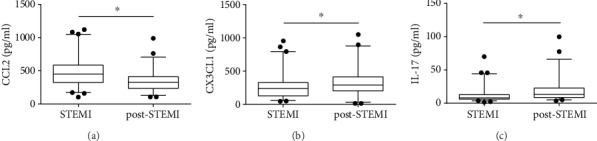
Figure 1
Figure 1
Circulating cytokines during STEMI and post-STEMI. Patient plasma was obtained during STEMI and post-STEMI, and the circulating levels of (a) CCL2, (b) CX3CL1, and (c) IL-17 were assessed. The concentrations of the cytokines in the plasma were determined by a multiplex assay. n = 65.
Figure 2
Figure 2
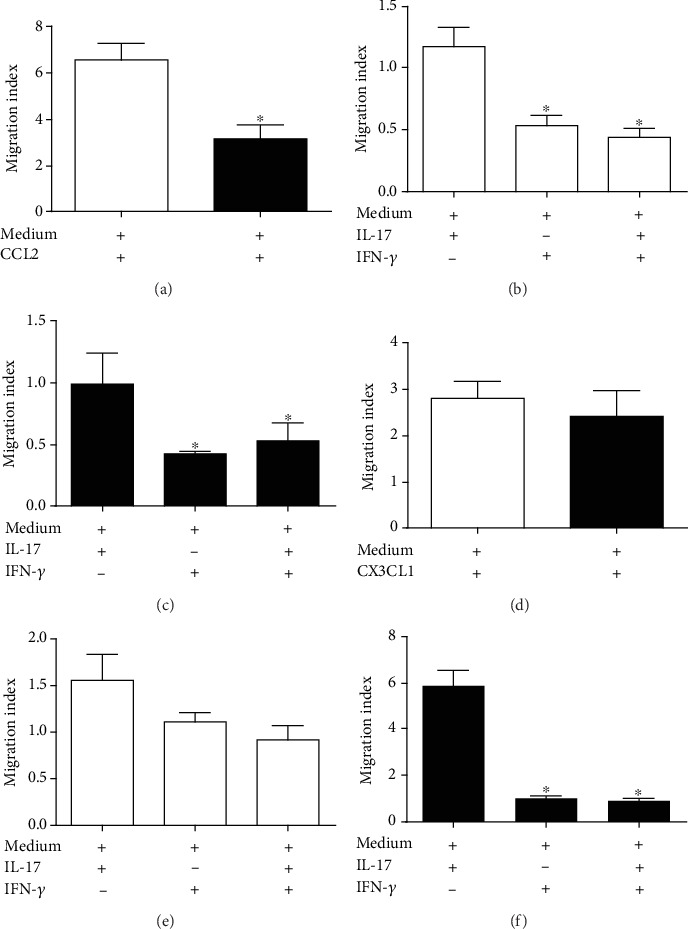
Monocytes transmigrate across a human umbilical vein endothelial cell monolayer in response to IL-17. A sample of 3 × 10⁵ (a–c) CD14++CD16 or (d–f) CD14++CD16+/CD14+CD16++ monocytes was added to the upper surface of monolayers of human umbilical vein endothelial cells (HUVECs) previously treated with IL-17, IFN-γ, or IL-17/IFN-γ; culture medium alone was used as a negative control. The monocytes were allowed to transmigrate across the HUVEC monolayers in the presence of CCL2, CX3CL1, or culture medium for 3 hours. All data are presented as the migration index, which relates the number of cells that migrated in response to the indicated stimulus to the number of cells that migrated in response to the negative control. White column: STEMI: black column: post-STEMI; n = 11. p < 0.05.
Figure 3
Figure 3
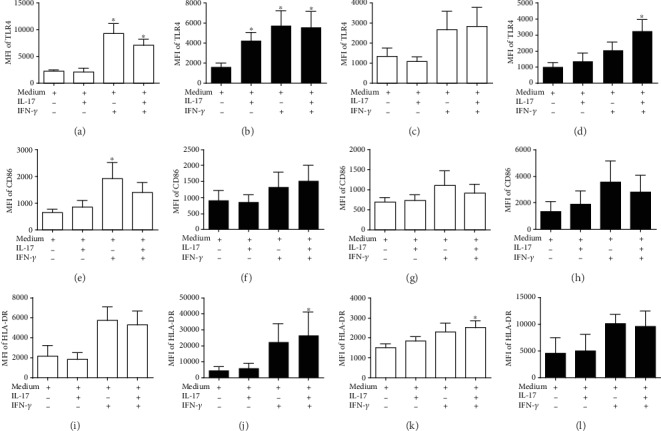
Expression of surface markers on monocytes stimulated with IL-17. Human CD14++CD16 and CD14++CD16+/CD14+CD16++ monocytes were treated with IL-17, IFN-γ, which was used as a positive control, IL-17/IFN-γ, or culture medium alone, which was used as a negative control, for 24 hours. Human CD14++CD16 in STEMI: (a) TLR4, (e) CD86, and (i) HLA-DR. Human CD14++CD16in post-STEMI: (b) TLR4, (f) CD86, and (j) HLA-DR. Human CD14++CD16+/CD14+CD16++ monocytes in STEMI: (c) TLR4, (g) CD86, and (k) HLA-DR. CD14++CD16+/CD14+CD16++ monocytes post-STEMI: (d) TLR4, (h) CD86, and (l) HLA-DR. Expression levels of TLR4, CD86, and HLA-DR are expressed as MFI. White column: STEMI; black column: post-STEMI; n = 11. p < 0.05.
Figure 4
Figure 4
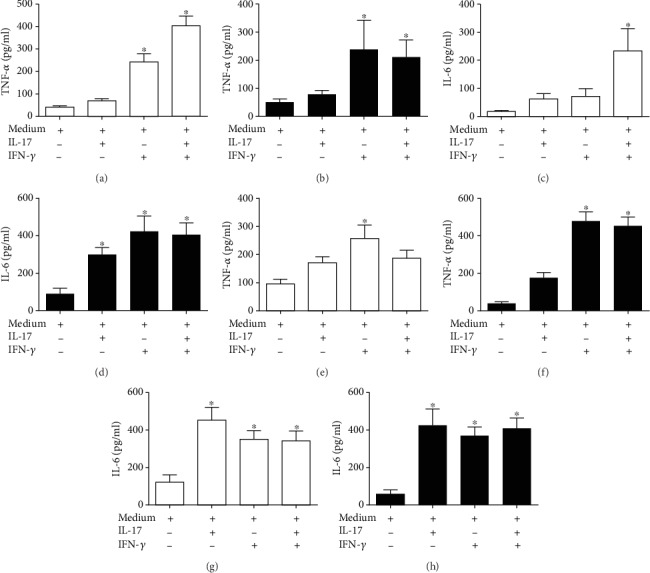
IL-17 induces the secretion of proinflammatory cytokines in monocyte subsets. Human CD14++CD16 or CD14++CD16+/CD14+CD16++ monocytes were treated with IL-17, IFN-γ, which was used as a positive control, IL-17/IFN-γ, or culture medium alone, which was used as a negative control, for 24 hours. Human CD14++CD16in STEMI: (a) TNF-α and (c) IL-6. Human CD14++CD16in post-STEMI: (b) TNF-α and (d) IL-6. Human CD14++CD16+/CD14+CD16++ monocytes in STEMI: (e) TNF-α and (g) IL-6. CD14++CD16+/CD14+CD16++ monocytes post-STEMI: (f) TNF-α and (h) IL-6. Concentrations of TNF-α and IL-6 in the culture supernatants were determined by ELISA. White column: STEMI; black column: post-STEMI; n = 11. p < 0.05.

References

    1. Anderson J. L., Morrow D. A. Acute myocardial infarction. New England Journal of Medicine. 2017;376(21):2053–2064. doi: 10.1056/NEJMra1606915. - DOI - PubMed
    1. Frangogiannis N. G. The inflammatory response in myocardial injury, repair, and remodelling. Nature Reviews Cardiology. 2014;11(5):255–265. doi: 10.1038/nrcardio.2014.28. - DOI - PMC - PubMed
    1. Prabhu S. D., Frangogiannis N. G. The biological basis for cardiac repair after myocardial infarction. Nature Reviews Cardiology. 2016;119(1):91–112. doi: 10.1161/CIRCRESAHA.116.303577. - DOI - PMC - PubMed
    1. Tsujioka H., Imanishi T., Ikejima H., et al. Impact of heterogeneity of human peripheral blood monocyte subsets on myocardial salvage in patients with primary acute myocardial infarction. Journal of the American College of Cardiology. 2009;54(2):130–138. doi: 10.1016/j.jacc.2009.04.021. - DOI - PubMed
    1. Berg K. E., Ljungcrantz I., Andersson L., et al. Elevated CD14 CD16 monocytes predict cardiovascular events. Circulation: Cardiovascular Genetics. 2012;5(1):122–131. doi: 10.1161/CIRCGENETICS.111.960385. - DOI - PubMed