


Factors associated with mammography use: A side-by-side comparison of results from two national surveys
- PMID: 32677744
- PMCID: PMC7476827
- DOI: 10.1002/cam4.3128
Factors associated with mammography use: A side-by-side comparison of results from two national surveys
Abstract
Background: Mammography use is affected by multiple factors that may change as public health interventions are implemented. We examined two nationally representative, population-based surveys to seek consensus and identify inconsistencies in factors associated with mammography use in the entirety of the US population, and by black and white subgroups.
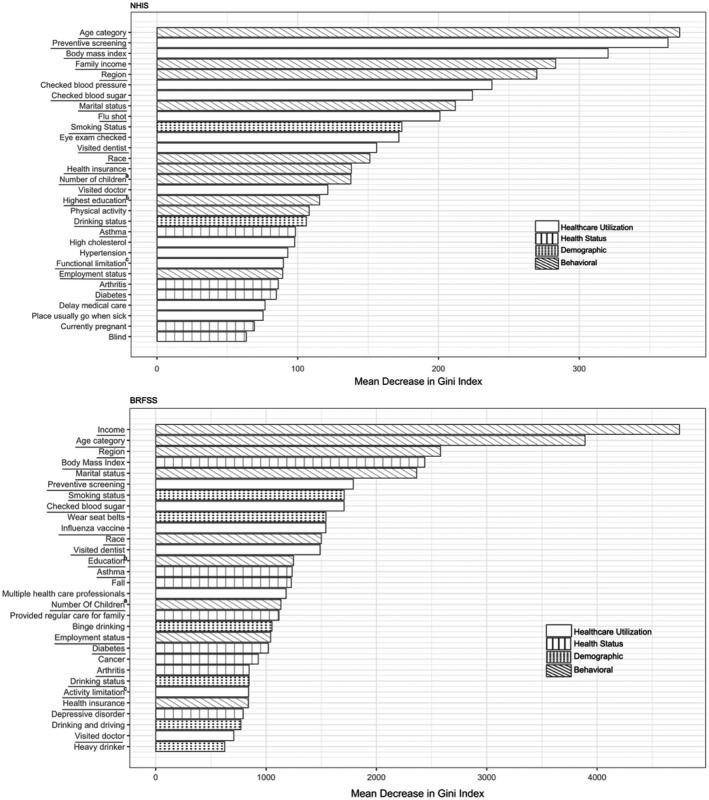
Methods: Self-reported mammography use in the past year was extracted for 12 639 and 169 116 women aged 40-74 years from the 2016 National Health Interview Survey (NHIS) and the 2016 Behavioral Risk Factor Surveillance System (BRFSS), respectively. We applied a random forest algorithm to identify the risk factors of mammography use and used a subset of them in multivariable survey logistic regressions to examine their associations with mammography use, reporting predictive margins and effect sizes.
Results: The weighted prevalence of past year mammography use was comparable across surveys: 54.31% overall, 54.50% in white, and 61.57% in black in NHIS and 53.24% overall, 56.97% in white, and 62.11% in black in BRFSS. Overall, mammography use was positively associated with black race, older age, higher income, and having health insurance, while negatively associated with having three or more children at home and residing in the Western region of the US. Overweight and moderate obesity were significantly associated with increased mammography use among black women (NHIS), while severe obesity was significantly associated with decreased mammography use among white women (BRFSS).
Conclusion: We found higher mammography use among black women than white women, a change in the historical trend. We also identified high parity as a risk factor for mammography use, which suggests a potential subpopulation to target with interventions aimed at increasing mammography use.
Keywords: National health interview survey; behavioral risk factor surveillance system; breast cancer screening; mammography use; predictive margins; random forest.
© 2020 The Authors. Cancer Medicine published by John Wiley & Sons Ltd.
Conflict of interest statement
We have no conflict of interest to disclose, and there is no financial support for this work that could have influenced our findings.
Figures
References
-
- Institute National Cancer . Cancer Stat Facts: Female Breast Cancer. https://seer.cancer.gov/statfacts/html/breast.html. Accessed April 27, 2020.
-
- Centers for Disease Control and Prevention . Healthy People. https://www.cdc.gov/nchs/healthy_people/index.htm. Accessed April 27, 2020.
-
- Bryan L, Westmaas L, Alcaraz K, Jemal A. Cigarette smoking and cancer screening underutilization by state: BRFSS 2010. Nicotine Tob Res. 2014;16(9):1183‐1189. - PubMed
Publication types
MeSH terms
Grants and funding
LinkOut - more resources
Full Text Sources
Medical
Miscellaneous
