


External quality assessment (EQA) of Neisseria gonorrhoeae antimicrobial susceptibility testing in primary laboratories in Germany
- PMID: 32677988
- PMCID: PMC7366306
- DOI: 10.1186/s12879-020-05234-w
External quality assessment (EQA) of Neisseria gonorrhoeae antimicrobial susceptibility testing in primary laboratories in Germany
Abstract
Background: Worldwide, an increase in antimicrobial resistance (AMR) of Neisseria gonorrhoeae has been observed. Until now, no protocol for an external quality assessment (EQA) has been available for Germany. The German gonococcal resistance network (GORENET) performed an EQA of primary laboratories in Germany in order to assess quality of antibiotic susceptibility testing, to gain information about laboratory procedures and to assess the impact of these procedures on test results.
Methods: Laboratories assessed drug susceptibility to cefixime, ceftriaxone, azithromycin, penicillin and ciprofloxacin for five N. gonorrhoeae strains, using their standard laboratory protocols. Minimal inhibitory concentrations (MICs) were compared to World Health Organisation (WHO) consensus results (or, if not available, reference laboratory results), while deviation by +/- one doubling dilution was accepted. Data on laboratory procedures were collected via a standardised questionnaire. Generalized linear models and conditional inference trees (CTREE) were used to assess relationships between laboratory procedures and testing outcomes.
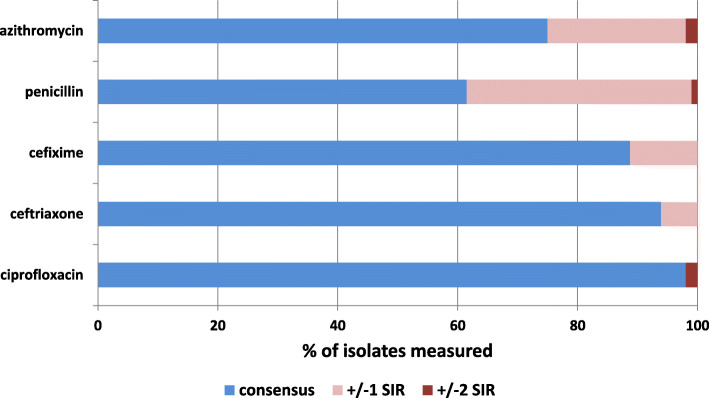
Results: Twenty-one primary laboratories participated in the EQA in June 2018. 96% of ciprofloxacin MICs were reported within accepted deviations, as well as 88% for cefixime, 85% for ceftriaxone, 79% for penicillin and 70% for azithromycin. The use of interpretation standards and general laboratory procedures like agar base, incubation settings or the use of control strains strongly differed between laboratories. In statistical analysis, incubation time of cultures < 24 h was associated with correct measurements. Additionally, a 5% CO2 concentration was associated with correct results regarding azithromycin compared to 3%. CTREE analysis showed that incubation time, humidity and CO2 concentration had the greatest influence on the average deviation from consensus results.
Conclusions: In conclusion, we report the development of a protocol for N. gonorrhoeae antimicrobial susceptibility testing in Germany. While testing results were in accordance with the expected consensus results in 70-96%, depending on the antibiotic agent, laboratory methodology was heterogeneous and may significantly affect the testing quality. We therefore recommend the development of a standard operating procedure (SOP) for N. gonorrhoeae susceptibility testing in Germany.
Keywords: AMR; Antimicrobial resistance; EQA; Neisseria gonorrhoeae; Susceptibility testing.
Conflict of interest statement
KJ is member of the BMC Infectious Diseases editorial board. The authors declare that they have no competing interests.
Figures


References
-
- World Health Organisation . Global action plan to control the spread and impact of antimicrobial resistance in Neisseria gonorrhoeae. 2012.
-
- European Centre for Disease Prevention and Control . Response plan to control and manage the threat of multidrug-resistant gonorrhoea in Europe. 2012.
MeSH terms
Substances
Grants and funding
LinkOut - more resources
Full Text Sources
Medical
Molecular Biology Databases
