. 2020 Jul 16;10(1):11720.
doi: 10.1038/s41598-020-68656-1.

Specialized adaptations allow vent-endemic crabs (Xenograpsus testudinatus) to thrive under extreme environmental hypercapnia

Affiliations

Specialized adaptations allow vent-endemic crabs (Xenograpsus testudinatus) to thrive under extreme environmental hypercapnia

Garett J P Allen et al. Sci Rep. .

Abstract

Shallow hydrothermal vent environments are typically very warm and acidic due to the mixing of ambient seawater with volcanic gasses (> 92% CO2) released through the seafloor making them potential 'natural laboratories' to study long-term adaptations to extreme hypercapnic conditions. Xenograpsus testudinatus, the shallow hydrothermal vent crab, is the sole metazoan inhabitant endemic to vents surrounding Kueishantao Island, Taiwan, where it inhabits waters that are generally pH 6.50 with maximum acidities reported as pH 5.50. This study assessed the acid-base regulatory capacity and the compensatory response of X. testudinatus to investigate its remarkable physiological adaptations. Hemolymph parameters (pH, [HCO3-], [Formula: see text], [NH4+], and major ion compositions) and the whole animal's rates of oxygen consumption and ammonia excretion were measured throughout a 14-day acclimation to pH 6.5 and 5.5. Data revealed that vent crabs are exceptionally strong acid-base regulators capable of maintaining homeostatic pH against extreme hypercapnia (pH 5.50, 24.6 kPa [Formula: see text]) via HCO3-/Cl- exchange, retention and utilization of extracellular ammonia. Intact crabs as well as their isolated perfused gills maintained [Formula: see text]tensions below environmental levels suggesting the gills can excrete CO2 against a hemolymph-directed [Formula: see text] gradient. These specialized physiological mechanisms may be amongst the adaptations required by vent-endemic animals surviving in extreme conditions.


Conflict of interest statement

The authors declare no competing interests.

Figures
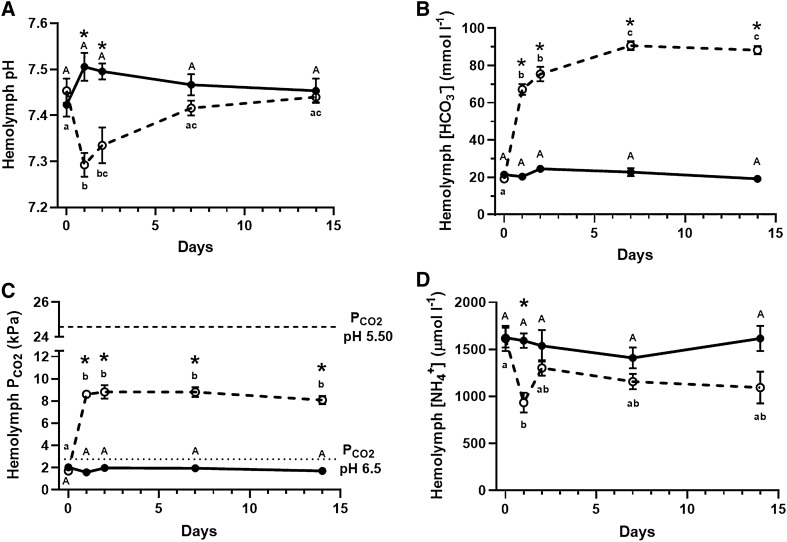
Figure 1
Figure 1
Hemolymph acid–base parameters of Xenograpsus testudinatus acclimated over a 14-day period to seawater acidified to either pH 6.50 (2.7 kPa PCO2; closed circles) or pH 5.50 (24.6 kPa PCO2; open circles). Changes in extracellular pH (A; N = 6), HCO3 (B; N = 6), PCO2 (C; N = 6), and [NH4+] (D; N = 5–7) were measured from pre-branchial hemolymph after 0, 1, 2, 7, and 14 days of acclimation. Environmental PCO2 levels are indicated by dashed lines to indicate the presence of inwardly directed PCO2 gradients (C). Asterisks denote significance based upon acclimation pH. Upper-case letters denote time-dependent differences within pH 6.50 exposed crabs whereas lower-case letters denote time-dependent differences within pH 5.50 exposed crabs. Data presented as means ± S.E.M, p < 0.05.
Figure 2
Figure 2
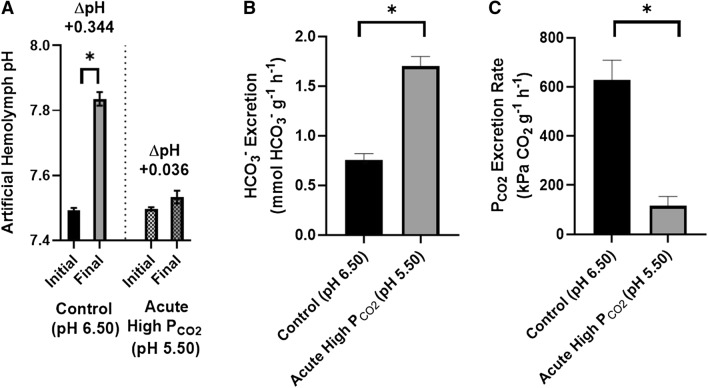
Capacity of isolated perfused gill 5 of pH 6.50 acclimated Xenograpsus testudinatus to alter pH (A), PCO2 (B), and HCO3 (C) of artificial hemolymph-like saline following a single gill passage. Gills were first exposed to pH 6.50 (2.7 kPa PCO2) to determine their transport capacity under the acclimated condition. Gills were subsequently exposed acutely to pH 5.50 (24.6 kPa PCO2) to observe changes in transport capacity. Degree of hemolymph alkalization by the gill is represented as ΔpH (A). Positive HCO3 and PCO2 excretion rates infer the molecule is lost to the environment as indicated by a lesser presence in the perfusate as compared to initial amounts within perfusion saline. Asterisks denote significance between initial and final pH or significant differences in transport rates depending on pH exposure. Data presented as means ± S.E.M, p < 0.05, N = 6 for all data points.
Figure 3
Figure 3
Whole animal metabolic rate (A) and ammonia excretion rates (B) were measured to indicate shifts in the crab’s metabolism in response to acidification over a 14-day time course acclimation to either pH 6.50 (2.7 kPa PCO2; open circles) or pH 5.50 (24.6 kPa PCO2; closed circles). Metabolic rate (A) was determined as the rate of oxygen consumption per body mass per time (µg O2 g−1 h−1) using closed-system respirometry (N = 6–9). Ammonia excretion rates (B) were determined as based on accumulation of ammonia within ambient water per body mass per time (µmol NH4+ g−1 h−1; N = 6–9). Asterisks denote significance based upon acclimation pH. Upper-case letters denote time-dependent differences within pH 6.50 exposed crabs whereas lower-case letters denote time-dependent differences within pH 5.50 exposed crabs. Data presented as means ± S.E.M, p < 0.05.

References

    1. Spiess FN, et al. East pacific rise: hot springs and geophysical experiments. Science. 1980;207:1421–1433. - PubMed
    1. Hall-Spencer JM, et al. Volcanic carbon dioxide vents show ecosystem effects of ocean acidification. Nature. 2008;454:96–99. - PubMed
    1. Lin Y-S, et al. Fates of vent CO2 and its impact on carbonate chemistry in the shallow-water hydrothermal field offshore Kueishantao Islet, NE Taiwan. Mar. Chem. 2019;210:1–12.
    1. Lu S-Y, Shen C-H, Chiau W-Y. Zoning strategies for marine protected areas in Taiwan: case study of Gueishan Island in Yilan County, Taiwan. Mar. Policy. 2014;48:21–29.
    1. Nicholls RJ, et al. Stabilization of global temperature at 1.5 degrees C and 2.0 degrees C: implications for coastal areas. Philos. Trans. A Math. Phys. Eng. Sci. 2018;376(2119):20160448. - PMC - PubMed

Publication types