Review
. 2020 Sep;25(9):1604-1613.
doi: 10.1016/j.drudis.2020.07.008. Epub 2020 Jul 15.

Learning from history: do not flatten the curve of antiviral research!

Affiliations
Review

Learning from history: do not flatten the curve of antiviral research!

Tesia Bobrowski et al. Drug Discov Today. 2020 Sep.

Abstract

Here, we explore the dynamics of the response of the scientific community to several epidemics, including Coronavirus Disease 2019 (COVID-19), as assessed by the numbers of clinical trials, publications, and level of research funding over time. All six prior epidemics studied [bird flu, severe acute respiratory syndrome (SARS), swine flu, Middle East Respiratory Syndrome (MERS), Ebola, and Zika] were characterized by an initial spike of research response that flattened shortly thereafter. Unfortunately, no antiviral medications have been discovered to date as treatments for any of these diseases. By contrast, the HIV/AIDS pandemic has garnered consistent research investment since it began and resulted in drugs being developed within 7 years of its start date, with many more to follow. We argue that, to develop effective treatments for COVID-19 and be prepared for future epidemics, long-term, consistent investment in antiviral research is needed.


Figures

None
Graphical abstract
Figure 1
Figure 1
Total number of clinical trials launched per outbreak as the function of time during the first 24 weeks after the outbreak start date. The start date of each epidemic is defined as the date when authorities, such as the WHO, started listing data on the number of cases. Time is normalized for each outbreak according to this start date (week 0). We used the deposition dates and numbers of clinical trials as recorded in ClinicalTrials.gov. Abbreviations: COVID-19, coronavirus 2019; MERS, Middle East respiratory syndrome; SARS, severe acute respiratory syndrome.
Figure 2
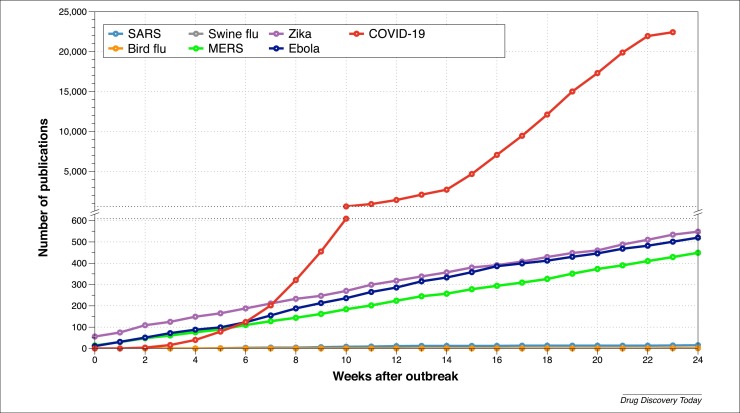
Figure 2
The evolution of the number of publications during the first 24 weeks after their respective outbreak start dates. The start date of epidemic is defined as the date when authorities, such as the WHO, started listing data on the number of cases. Time is normalized for each outbreak according to this start date (week 0). The data on publications include both peer-reviewed papers and preprints. The data were obtained from PubMed, BioRxiv, MedRxiv, ArXiv, and ChemRxiv. Abbreviations: COVID-19, coronavirus 2019; MERS, Middle East respiratory syndrome; SARS, severe acute respiratory syndrome.
Figure 3
Figure 3
Cumulative number of publications and clinical trials over time for SARS in comparison with the global number of cases/deaths (log scale). Start date of epidemic is defined as the date when authorities such as the WHO started listing data on the number of cases. The data correspond to the first 3 months after severe acute respiratory syndrome (SARS) outbreak. The number of cases and deaths were obtained from the WHO and the number of publications from PubMed. In 2003, ArXiv was the only preprint server available and no preprints were published during the first 3 months of SARS epidemic. The search was based on the keywords ‘SARS’, ‘Severe Acute Respiratory Syndrome’, and ‘SARS-CoV’. No clinical trials for SARS were deposited on ClinicalTrials.gov during the first 3 months after the outbreak.
Figure 4
Figure 4
Cumulative number of publications and clinical trials over time for coronavirus 2019 (COVID-19) compared with the global number of cases/deaths (log scale). The start date of the epidemic is defined as the date when authorities, such as the WHO, started listing data on the number of cases. The data on cases and deaths were obtained from Johns Hopkins Coronavirus Resource Center website. Peer-reviewed publications were obtained via PubMed. Data on the number of preprints were obtained from BioRxiv, MedRxiv, ArXiv, and ChemRxiv. We used the deposition dates and numbers of clinical trials as recorded in ClinicalTrials.gov
Figure 5
Figure 5
Number of publications (a) and funding (b) for antiviral research over time. Funding data were extracted from NIH RePORTER. The number of publications on antiviral drug research was obtained via PubMed. In both cases, the search was based on the co-occurrence of the keywords ‘antiviral’, ‘drug’, and ‘research’. The start date of each epidemic is depicted as a vertical dashed line. Abbreviations: COVID-19, coronavirus 2019; MERS, Middle East respiratory syndrome; NIH, National Institutes of Health; SARS, severe acute respiratory syndrome.
Figure 6
Figure 6
Relative search interest in diseases from January 2004 to the present day. Disease search terms are listed in the legend. Data were obtained from Google Trends (https://trends.google.com/trends/). The start date of each epidemic is depicted as a vertical dashed line. The search interest is normalized on a scale from 0 to 100. Abbreviations: COVID-19, coronavirus 2019; MERS, Middle East respiratory syndrome; SARS, severe acute respiratory syndrome.
Figure 7
Figure 7
Cumulative number of publications and clinical trials (a) over the past decades for HIV compared with the global number of cases/deaths (b) as well as the approved drugs developed over this time period (c). The count of clinical trials starts in 1999, whereas other metrics begin in 1993. The dates and numbers of clinical trials were obtained from ClinicalTrials.gov. The dates correspond to the time each trial was deposited to the server and do not reflect the actual study completion date (i.e., some studies might have been conducted before 1999). The numbers of people living with HIV and of deaths were obtained from WHO and UNAIDS annual reports. No reports were available before 1993. WHO and UNAIDS data for 2019 are not yet available. The timeline of appearance of US Food and Drug Administration (FDA)-approved anti-HIV treatments is highlighted. Abbreviations: COVID-19, coronavirus disease 2019; MERS, Middle East respiratory syndrome; NIH, National Institutes of Health; SARS, severe acute respiratory syndrome.

References

    1. Centers for Disease Control and Prevention Achievements in Public Health, 1900-1999, Control of Infectious Diseases. MMWR. 1999;48:621–629.
    1. Maslow J.N. The cost and challenge of vaccine development for emerging and emergent infectious diseases. Lancet Glob. Health. 2018;6:e1266–e1267. - PMC - PubMed
    1. Thunström L., et al. The benefits and costs of using social distancing to flatten the curve for COVID-19. J. Benefit Cost Anal. 2020:1–27. doi: 10.1017/bca.2020.12. - DOI
    1. Sands P., et al. The neglected dimension of global security — a framework for countering infectious-disease crises. N. Engl. J. Med. 2016;374:1281–1287. - PubMed
    1. Simon R. Coronavirus social-distancing forces painful choices on small businesses. Wall Street J. 2020;(March) https://www.wsj.com/articles/coronavirus-social-distancing-forces-painfu... (accessed March 23, 2020)

MeSH terms

Substances

LinkOut - more resources