Review
. 2020 Jul 15;9(7):617.
doi: 10.3390/antiox9070617.

Nuclear Factor-Erythroid 2-Related Factor 2 (Nrf2) and Mitochondrial Dynamics/Mitophagy in Neurological Diseases

Affiliations
Review

Nuclear Factor-Erythroid 2-Related Factor 2 (Nrf2) and Mitochondrial Dynamics/Mitophagy in Neurological Diseases

Tae-Cheon Kang. Antioxidants (Basel). .

Abstract

Mitochondria play an essential role in bioenergetics and respiratory functions for cell viability through numerous biochemical processes. To maintain mitochondria quality control and homeostasis, mitochondrial morphologies change rapidly in response to external insults and changes in metabolic status through fusion and fission (so called mitochondrial dynamics). Furthermore, damaged mitochondria are removed via a selective autophagosomal process, referred to as mitophagy. Although mitochondria are one of the sources of reactive oxygen species (ROS), they are themselves vulnerable to oxidative stress. Thus, endogenous antioxidant defense systems play an important role in cell survival under physiological and pathological conditions. Nuclear factor-erythroid 2-related factor 2 (Nrf2) is a redox-sensitive transcription factor that maintains redox homeostasis by regulating antioxidant-response element (ARE)-dependent transcription and the expression of antioxidant defense enzymes. Although the Nrf2 system is positively associated with mitochondrial biogenesis and mitochondrial quality control, the relationship between Nrf2 signaling and mitochondrial dynamics/mitophagy has not been sufficiently addressed in the literature. This review article describes recent clinical and experimental observations on the relationship between Nrf2 and mitochondrial dynamics/mitophagy in various neurological diseases.

Keywords: Alzheimer’s disease; Huntington’s disease; Parkinson’s disease; cerebrovascular disease; epilepsy; mitochondrial fission; mitochondrial fusion.


Conflict of interest statement

The author declare that the research was conducted in the absence of any commercial or financial relationships that could be construed as a potential conflict of interest.

Figures
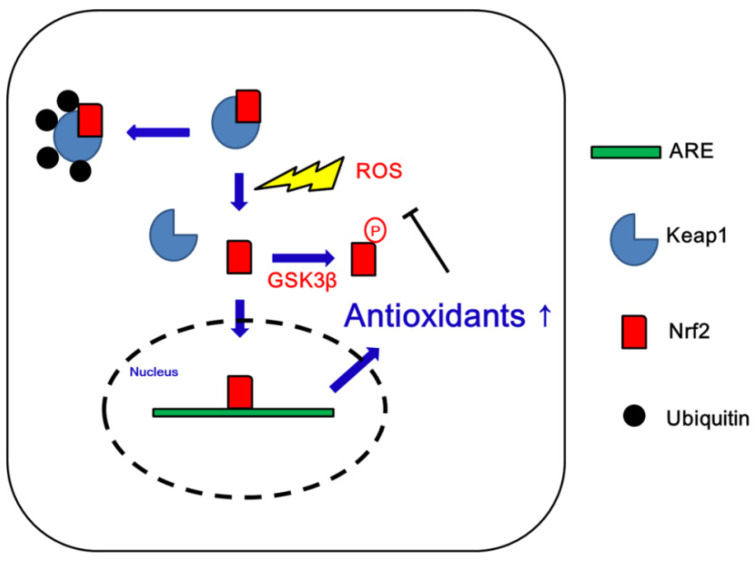
Figure 1
Figure 1
Schematic depiction of the regulation of Nrf2 in a normal cell. Abbreviations: ARE, antioxidant response element; GSK3β, glycogen synthase kinase 3β; Keap1, Kelch-like ECH-associated protein 1; Nrf2, nuclear factor-erythroid 2-related factor 2; ROS, reactive oxygen species.
Figure 2
Figure 2
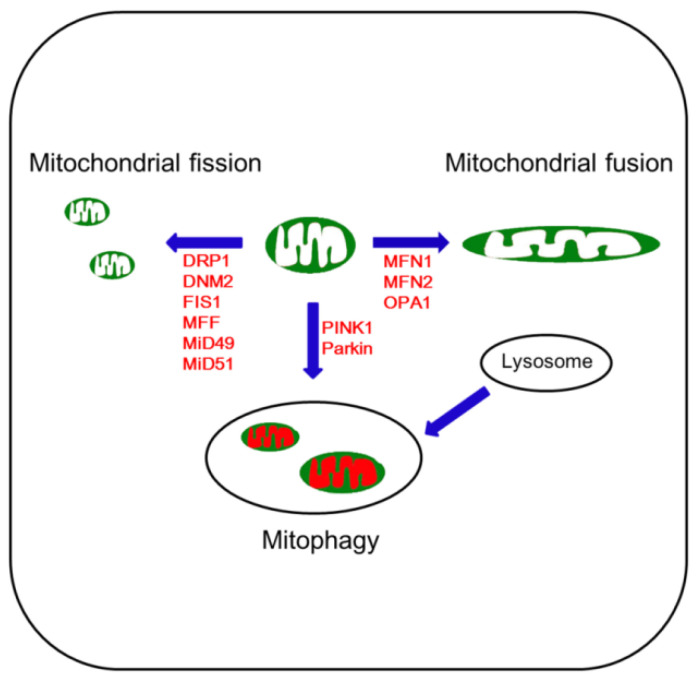
Schematic depiction of mitochondrial dynamics and mitophagy under physiological condition. Abbreviations: DMN2, dynamin-2; DRP1, dynamin-related protein-1; FIS1, fission protein 1 protein; MFF, mitochondrial fission factor; MFN1, mitofusin 1; MFN2, mitofusin 2; Mid49, mitochondrial dynamic proteins of 49; MiD51, mitochondrial dynamic proteins of 51; OPA1, optic atrophy 1; PINK1, phosphatase and tensin homolog (PTEN)-induced kinase 1.
Figure 3
Figure 3
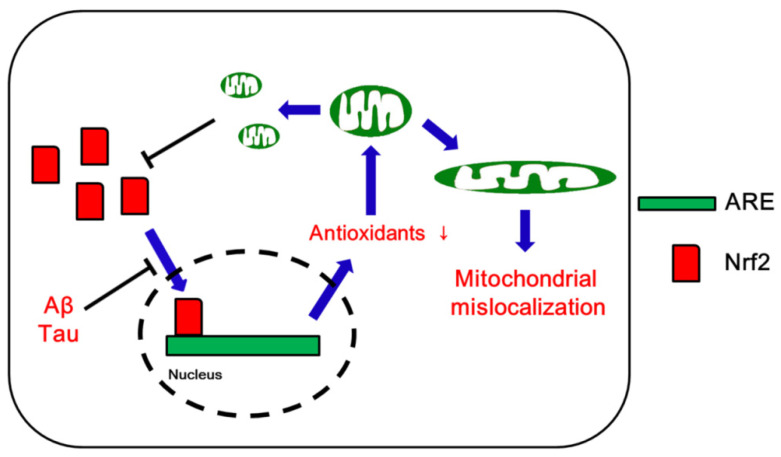
Schematic depiction of likely roles of Nrf2 in mitochondrial dynamics in Alzheimer’s disease (AD).
Figure 4
Figure 4
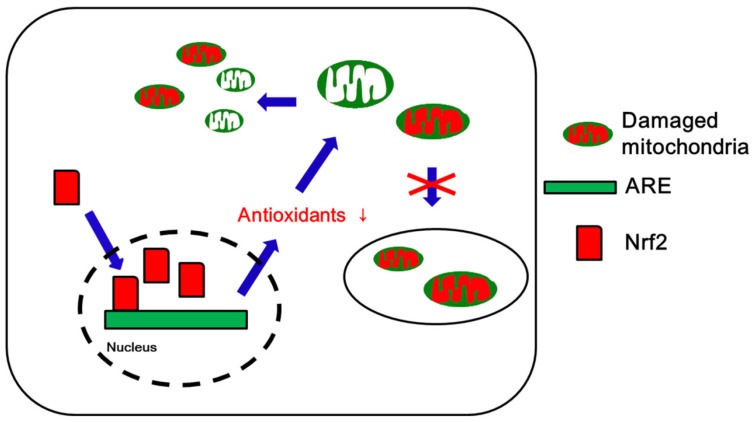
Schematic depiction of likely roles of Nrf2 in mitochondrial dynamics in Parkinson’s disease (PD).
Figure 5
Figure 5
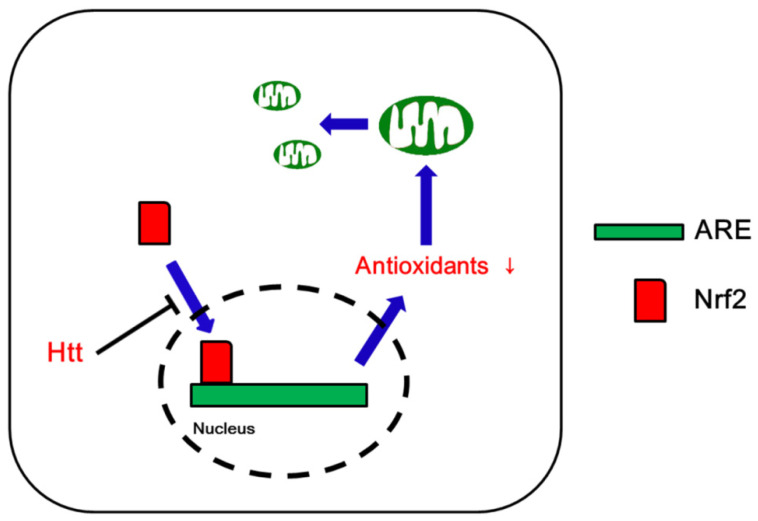
Schematic depiction of likely roles of Nrf2 in mitochondrial dynamics in Huntington’s disease (HD).
Figure 6
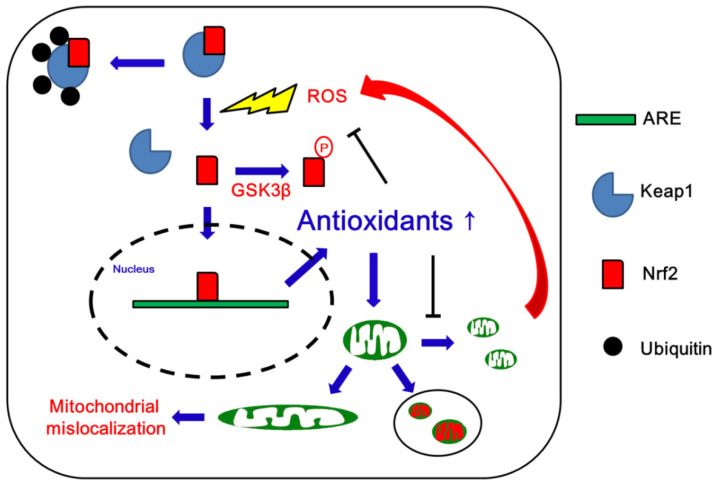
Figure 6
Schematic depiction of Nrf2 and mitochondrial dynamics under physiological conditions. Oxidative stress activates Nrf2-mediated antioxidant defense mechanisms that prevent excessive mitochondrial fission and inhibit further ROS synthesis by mitochondria. In addition, Nrf2 activation facilitates mitophagy. In general, impairments of the Nrf2 system and mitochondrial dynamics/mitophagy may be involved in the pathogenesis of various neurological diseases, even though the precise profiles of Nrf2 and mitochondrial dynamics/mitophagy are distinct in each disease type. However, aberrant mitochondrial elongation may also induce mitochondrial mislocalization leading to neuronal damage in AD and epilepsy.

References

    1. Youle R.J., van der Bliek A.M. Mitochondrial fission, fusion, and stress. Science. 2012;337:1062–1065. doi: 10.1126/science.1219855. - DOI - PMC - PubMed
    1. Amchenkova A.A., Bakeeva L.E., Chentsov Y.S., Skulachev V.P., Zorov D.B. Coupling membranes as energy-transmitting cables. I. Filamentous mitochondria in fibroblasts and mitochondrial clusters in cardiomyocytes. J. Cell Biol. 1988;107:481–495. doi: 10.1083/jcb.107.2.481. - DOI - PMC - PubMed
    1. Skulachev V.P. Mitochondrial filaments and clusters as intracellular power-transmitting cables. Trends Biochem. Sci. 2001;26:23–29. doi: 10.1016/S0968-0004(00)01735-7. - DOI - PubMed
    1. Vafai S.B., Mootha V.K. Mitochondrial disorders as windows into an ancient organelle. Nature. 2012;491:374–383. doi: 10.1038/nature11707. - DOI - PubMed
    1. Pickles S., Vigie P., Youle R.J. Mitophagy and quality control mechanisms in mitochondrial maintenance. Curr. Biol. 2018;28:R170–R185. doi: 10.1016/j.cub.2018.01.004. - DOI - PMC - PubMed

LinkOut - more resources