Review
. 2020 Jul 15;12(7):1915.
doi: 10.3390/cancers12071915.

Humanized Mice Are Precious Tools for Preclinical Evaluation of CAR T and CAR NK Cell Therapies

Affiliations
Review

Humanized Mice Are Precious Tools for Preclinical Evaluation of CAR T and CAR NK Cell Therapies

Rana Mhaidly et al. Cancers (Basel). .

Abstract

Chimeric antigen receptor (CAR) T-cell therapy represents a revolutionary treatment for hematological malignancies. However, improvements in CAR T-cell therapies are urgently needed since CAR T cell application is associated with toxicities, exhaustion, immune suppression, lack of long-term persistence, and low CAR T-cell tumor infiltration. Major efforts to overcome these hurdles are currently on the way. Incrementally improved xenograft mouse models, supporting the engraftment and development of a human hemato-lymphoid system and tumor tissue, represent an important fundamental and preclinical research tool. We will focus here on several CAR T and CAR NK therapies that have benefited from evaluation in humanized mice. These models are of great value for the cancer therapy field as they provide a more reliable understanding of sometimes complicated therapeutic interventions. Additionally, they are considered the gold standard with regard to assessment of new CAR technologies in vivo for safety, efficacy, immune response, design, combination therapies, exhaustion, persistence, and mechanism of action prior to starting a clinical trial. They help to expedite the critical translation from proof-of-concept to clinical CAR T-cell application. In this review, we discuss innovative developments in the CAR T-cell therapy field that benefited from evaluation in humanized mice, illustrated by multiple examples.

Keywords: CAR NK cell; CAR T cell; PDX mouse; cancer therapy; humanized mouse model; in vivo gene therapy; xenograft mouse.


Conflict of interest statement

E.V. is inventor on a patent of the receptor targeted Niv-LVs, which is under license with SANA.

Figures
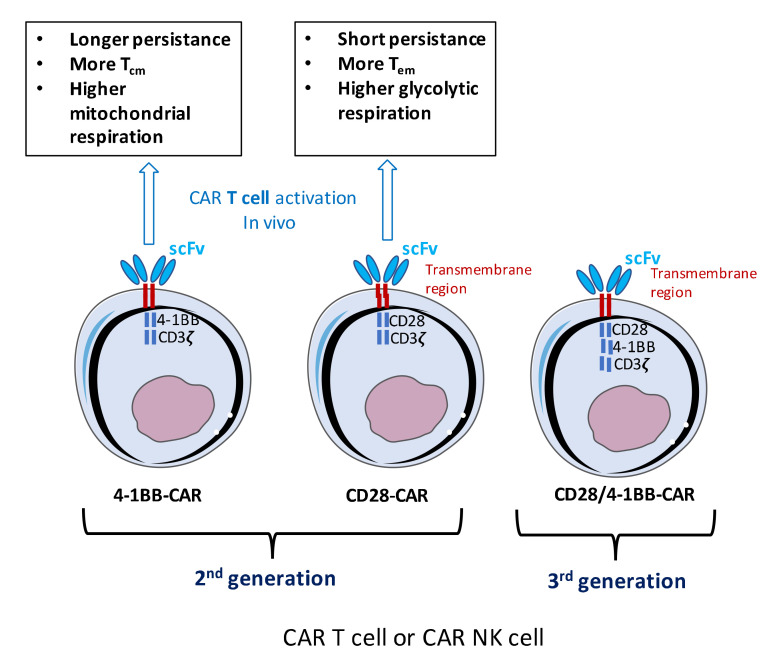
Figure 1
Figure 1
Chimeric antigen receptor (CAR) T cell engineering using different CAR designs and their in vivo persistence. Second-generation CAR T cells containing a CD3 zeta signaling domain, a CD28 or 4-1BB co-stimulatory domain and a scFv that will be displayed at the surface of the T cell for anti-cancer antigen recognition. For the second-generation CARs is indicated their dependence on a metabolic pathway and their persistence in vivo according to the co-stimulatory domain used. The third generation CAR contains 2 co-stimulatory domains.
Figure 2
Figure 2
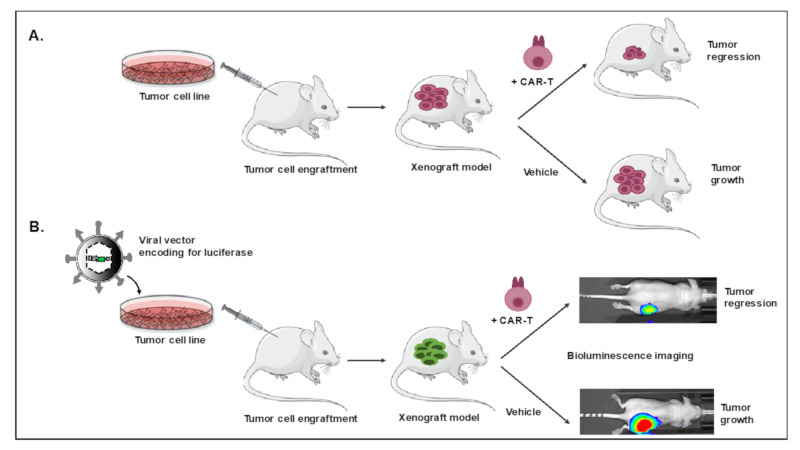
Tumor cell xenografted humanized mice for CAR T cell evaluation. Tumor cell lines not transduced (A) or transduced (B) with a vector encoding for the reporter gene, luciferase, are injected intravenously or subcutaneously into NOD/SCIDγC−/− (NSG) mice. After tumor development, T cells modified with a CAR against a specific antigen on the tumor cells are injected. A follow-up of tumor size via bioluminescence or measurement of tumor size is performed to evaluate CAR T cell efficacy and mice survival is evaluated. At endpoint, CAR T cell infiltration, cytokine release and T cell immune phenotypes (exhaustion markers, persistent T cell markers) are determined.
Figure 3
Figure 3
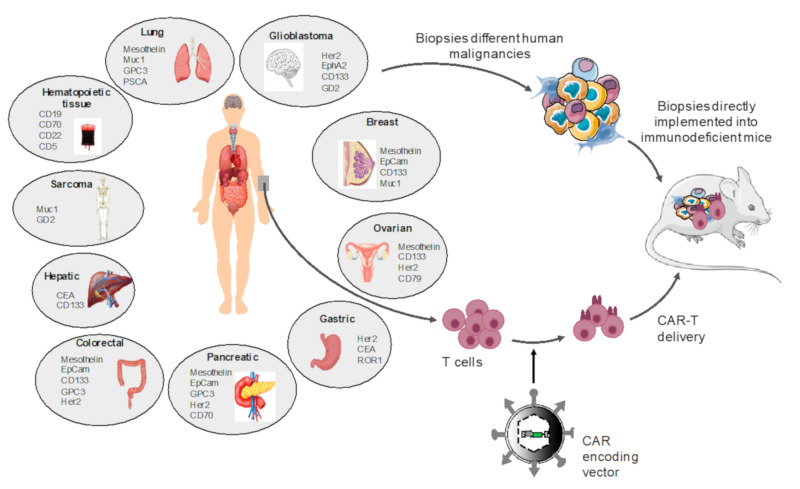
Patient-derived-xenograft mice for CAR T cell evaluation. Patient tumor biopsies are injected into NSG mice and subsequently T cells from the same patient are modified using a vector encoding for a CAR directed against a specific antigen present on the tumor cells and infused in the patient-derived xenograft. A follow-up of tumor size or measurement of subcutaneous tumors is performed to evaluate CAR T cell efficacy and mice survival. At endpoint CAR T cell infiltrations, cytokine release and T cell immune phenotypes (exhaustion markers, persistent T cell markers) are determined. Tumor-associated antigens (TAA) for each specific tumor type are indicated. Note that not all CAR T cells directed against these TAAs were evaluated in PDX models.
Figure 4
Figure 4
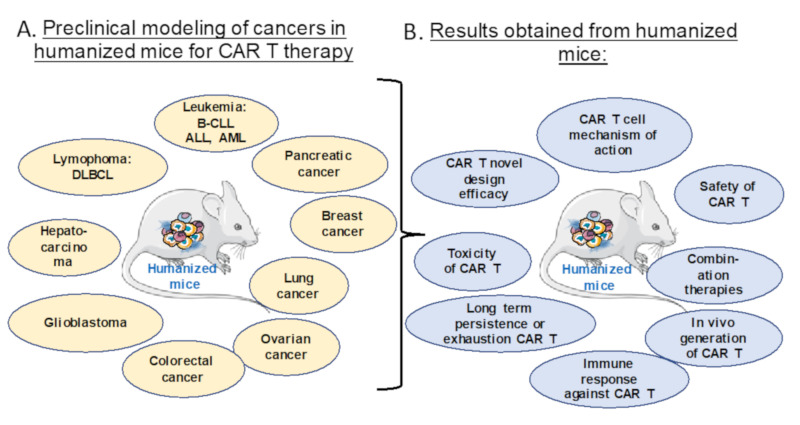
Preclinical modeling of CAR T Cell therapy in humanized cancer mice models. (A) Different humanized mice models for preclinical modeling of different malignancies. (B) The relevant preclinical data for CAR T cell treatment obtained for the indications in (A).
Figure 5
Figure 5
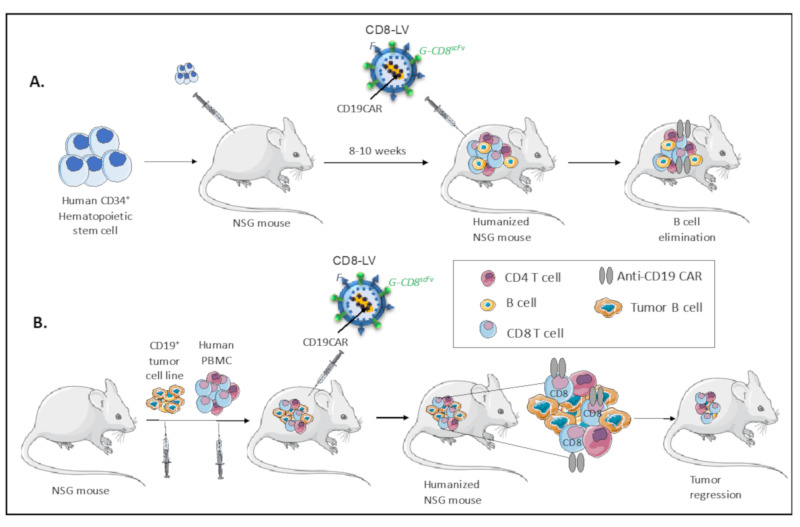
In vivo CAR T cell generation in humanized mice. (A) Cord blood CD34+ cells were injected into NSG mice and humanized for 8-10 weeks before injection of the CD8-targeted (CD8NiV)-LV encoding for a CAR-directed against CD19 present on B cells. Mice were sacrificed at 5-12 weeks for FACS analysis of the immune cells. The CAR expression was revealed exclusively in hCD8 T cells, which were amplified in vivo through contact with CD19+ B cells. Upon contact these gene-modified CD8 T cells were able to eliminate the human B cells in the different hematopoietic tissues (blood, spleen, bone marrow). (B) B cell line xenografted NSG mice, were subsequently infused with human PBMCs. Upon tumor formation and human immune cell reconstitution, the NSG mice were injected with CD8-targeted (CD8NiV)-LV encoding for a CAR-directed against CD19 present on tumor B cells. The CAR expression was revealed exclusively in hCD8 T cells, which were amplified in vivo through contact with CD19+ on the tumor B cells. Upon contact these gene-modified CD8 T cells were able to eliminate the tumor B cells.

References

    1. June C.H., Riddell S.R., Schumacher T.N. Adoptive cellular therapy: A race to the finish line. Sci. Transl. Med. 2015;7 doi: 10.1126/scitranslmed.aaa3643. - DOI - PubMed
    1. Posey A.D., Jr., Schwab R.D., Boesteanu A.C., Steentoft C., Mandel U., Engels B., Stone J.D., Madsen T.D., Schreiber K., Haines K.M., et al. Engineered CAR T Cells Targeting the Cancer-Associated Tn-Glycoform of the Membrane Mucin MUC1 Control Adenocarcinoma. Immunity. 2016;44:1444–1454. doi: 10.1016/j.immuni.2016.05.014. - DOI - PMC - PubMed
    1. Brocker T. Chimeric Fv-zeta or Fv-epsilon receptors are not sufficient to induce activation or cytokine production in peripheral T cells. Blood. 2000;96:1999–2001. doi: 10.1182/blood.V96.5.1999. - DOI - PubMed
    1. Kershaw M.H., Westwood J.A., Parker L.L., Wang G., Eshhar Z., Mavroukakis S.A., White D.E., Wunderlich J.R., Canevari S., Rogers-Freezer L., et al. A phase I study on adoptive immunotherapy using gene-modified T cells for ovarian cancer. Clin. Cancer Res. 2006;12:6106–6115. doi: 10.1158/1078-0432.CCR-06-1183. - DOI - PMC - PubMed
    1. Lamers C.H., Sleijfer S., Vulto A.G., Kruit W.H., Kliffen M., Debets R., Gratama J.W., Stoter G., Oosterwijk E. Treatment of metastatic renal cell carcinoma with autologous T-lymphocytes genetically retargeted against carbonic anhydrase IX: First clinical experience. J. Clin. Oncol. 2006;24:e20–e22. doi: 10.1200/JCO.2006.05.9964. - DOI - PubMed

LinkOut - more resources