Review
. 2020 Sep 8:74:587-606.
doi: 10.1146/annurev-micro-012220-063740. Epub 2020 Jul 17.

A Bacterial Tower of Babel: Quorum-Sensing Signaling Diversity and Its Evolution

Affiliations
Review

A Bacterial Tower of Babel: Quorum-Sensing Signaling Diversity and Its Evolution

Nitzan Aframian et al. Annu Rev Microbiol. .

Abstract

Quorum sensing is a process in which bacteria secrete and sense a diffusible molecule, thereby enabling bacterial groups to coordinate their behavior in a density-dependent manner. Quorum sensing has evolved multiple times independently, utilizing different molecular pathways and signaling molecules. A common theme among many quorum-sensing families is their wide range of signaling diversity-different variants within a family code for different signal molecules with a cognate receptor specific to each variant. This pattern of vast allelic polymorphism raises several questions-How do different signaling variants interact with one another? How is this diversity maintained? And how did it come to exist in the first place? Here we argue that social interactions between signaling variants can explain the emergence and persistence of signaling diversity throughout evolution. Finally, we extend the discussion to include cases where multiple diverse systems work in concert in a single bacterium.

Keywords: cell-cell communication; diversification; evolution; pherotypes; quorum sensing; social evolution.


Figures
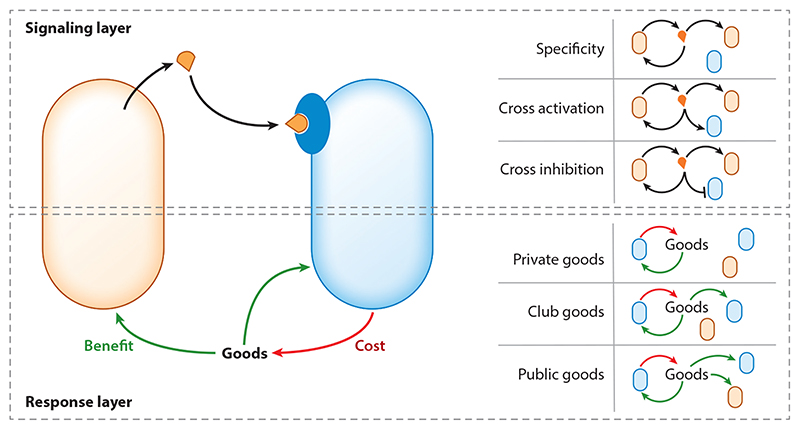
Figure 1
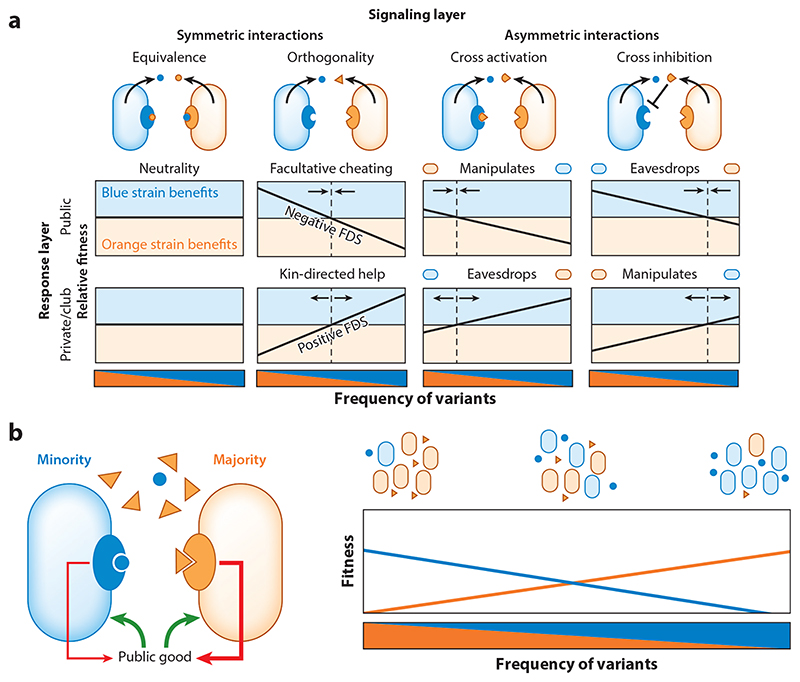
Figure 1. Interactions between signaling variants are composed of two layers: a signaling layer (top) and a response layer (bottom).
The image illustrates the impact of each layer—a signaling bacterium [light orange, also coding for its own receptor (not shown)] can impact the receptor of a different signaling variant [light blue, also coding for its own signal (not shown)]. The responding cell produces a good (green arrows) that can benefit itself or others. Production of goods is costly (red arrows). The right-hand panels illustrate different possible scenarios for interactions at either layer.
Figure 2
Figure 2. Social interactions between QS variants.
(a) The different interactions between signaling variants and the resulting frequency-dependent selection scheme between them depending on whether QS response is cooperative (public goods) or competitive (private or club goods). Production of public goods leads to negative frequency-dependent selection, while private goods lead to positive frequency-dependent selection. Asymmetric interactions lead to manipulation/eavesdropping by modifying the frequency point of equal fitness. Dashed lines indicate the frequency of equal fitness, and arrows represent the direction in which frequency would change due to selection. Blue and orange sections represent a fitness advantage in favor of the blue and orange strains, respectively. (b) A more detailed examination of the case of orthogonal variants with production of public goods. The left-hand illustration demonstrates the cost (red arrows) and benefit (green arrows) when the blue strain is in the minority. The extent of cost payed or benefit gained is represented by line width. The blue minority pays less of a cost because it senses less of its signal. The right-hand graph illustrates the fitness of both strains in relation to their frequency in the population. Fitness is equal at equal frequencies. Abbreviations: FDS, frequency-dependent selection; QS, quorum sensing.
Figure 3
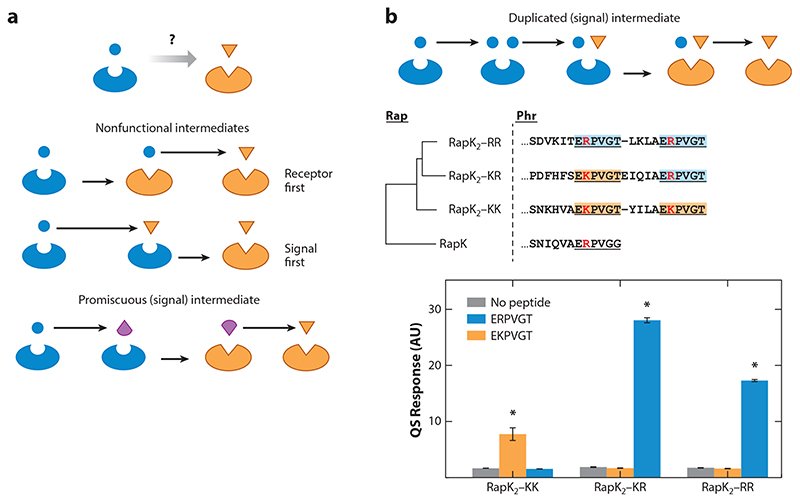
Figure 3. Coevolution of signal and receptor.
(a) Pathways of coevolution—direct through a nonfunctional intermediate and indirect through a promiscuous intermediate. The indirect route may also work through a receptor intermediate (not shown). Arrows represent mutations, and changes in shape and color signify changes in the receptor or signal. (b) Evolution through a duplicated intermediate. A scheme of the evolutionary path (top) and evidence for it in the Rap-Phr system. Three related Rap-Phr systems have a duplicated Phr mature signal with either an arginine or a lysine at the second residue. The phylogenetic tree shows the evolutionary relation between the three receptors and the closely related RapK receptor. The terminal part of the Phr genes is shown for the three divergent systems, and the mature signals are indicated with their variant residues highlighted in red. The bottom panel shows the response of the receptors to the two signal variants. Panel b adapted with permission from Reference 29.
Figure 4
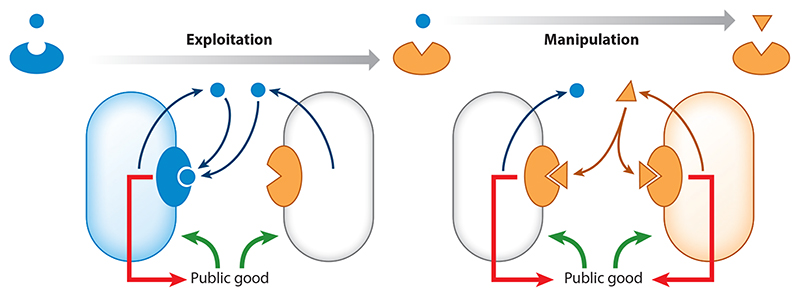
Figure 4. Social evolution of a novel pherotype.
Under the assumption that quorum sensing controls public goods, a new variant can evolve through a nonfunctional intermediate with a mutated receptor. The intermediate exploits its functional ancestral strain but is manipulated by the novel functional strain. Gray arrows indicate mutations. The illustrations below each of these arrows indicate the social interaction between variants, with costs and benefits indicated by red and green arrows, respectively.
Figure 5
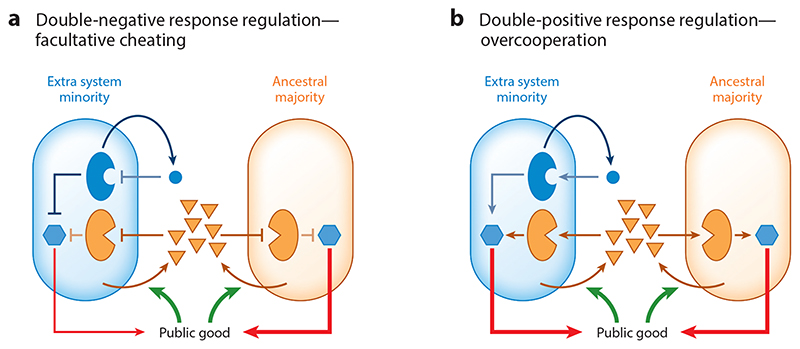
Figure 5. Accumulation of multiple parallel quorum-sensing (QS) systems.
Two architectures of QS regulation of public goods yield different selection on accumulation of parallel systems. (a) In a double-negative architecture, the signal prevents the receptor from inhibiting public goods production. Here, a strain with an additional system would not produce public goods as a minority due to repression by the novel, signal-free receptor. It will therefore cheat its ancestor. Hexagons represent response regulators that control production of public goods and are affected by the receptors. (b) In a double-positive architecture, the signal induces the receptor to activate public goods production. Here, a strain with an additional system will be counterselected as a minority by overcooperation—as a minority, this strain would produce equal or higher amounts of public goods compared to the ancestral majority.

References

    1. Aakre CD, Herrou J, Phung TN, Perchuk BS, Crosson S, Laub MT. Evolving new protein-protein interaction specificity through promiscuous intermediates. Cell. 2015;163(3):594–606. - PMC - PubMed
    1. Allan E, Hussain HA, Crawford KR, Miah S, Ascott ZK, et al. Genetic variation in comC the gene encoding competence-stimulating peptide (CSP) in Streptococcus mutans . FEMS Microbiol Lett. 2007;268(1):47–51. - PubMed
    1. Ansaldi M, Dubnau D. Diversifying selection at the Bacillus quorum-sensing locus and determinants of modification specificity during synthesis of the ComX pheromone. J Bacteriol. 2004;186(1):15–21. - PMC - PubMed
    1. Ansaldi M, Marolt D, Stebe T, Mandic-Mulec I, Dubnau D. Specific activation of the Bacillus quorum-sensing systems by isoprenylated pheromone variants. Mol Microbiol. 2002;44:1561–73. - PubMed
    1. Asfahl KL, Schuster M. Social interactions in bacterial cell-cell signaling. FEMS Microbiol Rev. 2017;41(1):92–107. - PubMed

LinkOut - more resources