


About lipid metabolism in Hermetia illucens (L. 1758): on the origin of fatty acids in prepupae
- PMID: 32680992
- PMCID: PMC7368053
- DOI: 10.1038/s41598-020-68784-8
About lipid metabolism in Hermetia illucens (L. 1758): on the origin of fatty acids in prepupae
Abstract
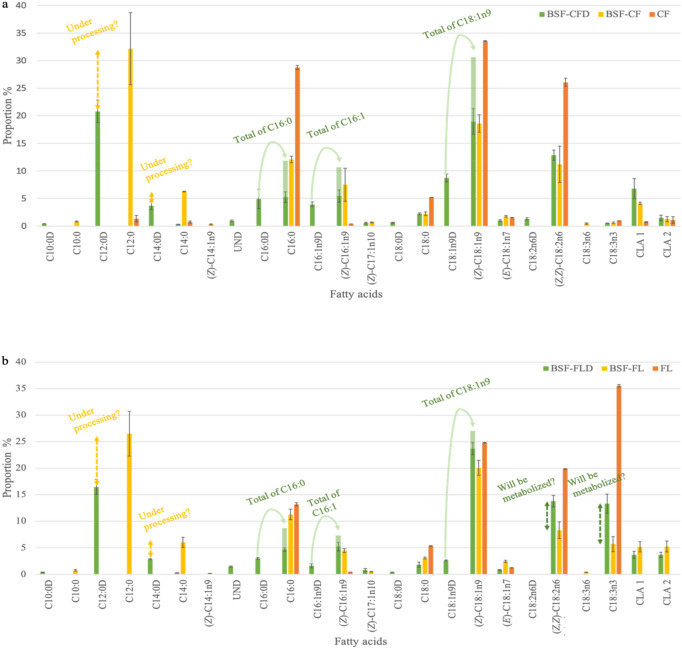
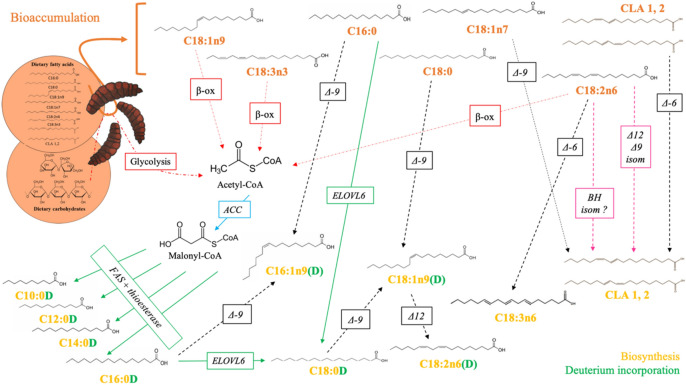
Although increasingly targeted in animal nutrition, black soldier fly larvae or prepupae (BSF, Hermetia illucens L. 1758) require the characterization and modulation of their fatty acid profile to become fully integrated within the feed sector. This improvement will only be possible by the understanding of underlaying biochemical pathways of fatty acid synthesis in BSF. In this study, we hypothesized a labelling of de novo synthesized fatty acids in BSF by the incorporation of deuterated water (D2O) in their feed. Three batches of fifty larvae were reared on two diets with different polyunsaturated fatty acid profiles moistened with 40% of H2O or D2O: chicken feed or 40% of chicken feed and 60% of flax cake. Although the occurrence of D2O in insect feed increased the larval development time and decreased prepupal weight, it was possible to track the biosynthesis of fatty acids through deuterium labelling. Some fatty acids (decanoic, lauric or myristic acid) were exclusively present in their deuterated form while others (palmitic, palmitoleic or oleic acid) were found in two forms (deuterated or not) indicating that BSF can partially produce these fatty acids via biosynthesis pathways and not only by bioaccumulation from the diet. These results suggest the importance of carbohydrates as a source of acetyl-CoA in the constitution of the BSF fatty acid profile but also the potential importance of specific enzymes (e.g. thioesterase II or Δ12 fat2 desaturase) in BSF fatty acid metabolism. Finally, nearly no deuterated polyunsaturated fatty acids were found in BSF fed with deuterium confirming that BSF is not able to produce these types of fatty acids. Despite the high levels of linolenic acid in flax-enriched diets, BSF will simply bioaccumulate around 13% of this fatty acid and will metabolize approximately two-thirds of it into saturated fatty acids as lauric or myristic acid.
Conflict of interest statement
The authors declare no competing interests.
Figures
References
-
- Ewald N, et al. Fatty acid composition of black soldier fly larvae (Hermetia illucens)—Possibilities and limitations for modification through diet. Waste Manag. 2020;102:40–47. - PubMed
-
- Rumpold BA, Schlüter OK. Potential and challenges of insects as an innovative source for food and feed production. Innov. Food Sci. Emerg. Technol. 2013;17:1–11.
-
- van Huis, A. et al.Edible Insects: Future Prospects for Food and Feed Security (Food and Agriculture Organization of the United Nations, 2013).
-
- Caparros Megido R, et al. Edible insects acceptance by belgian consumers: Promising attitude for entomophagy development. J. Sens. Stud. 2014;29:14–20.
Publication types
MeSH terms
Substances
LinkOut - more resources
Full Text Sources
Other Literature Sources
