


Neuroinflammation and fibrosis in stroke: The good, the bad and the ugly
- PMID: 32682140
- PMCID: PMC7794086
- DOI: 10.1016/j.jneuroim.2020.577318
Neuroinflammation and fibrosis in stroke: The good, the bad and the ugly
Abstract
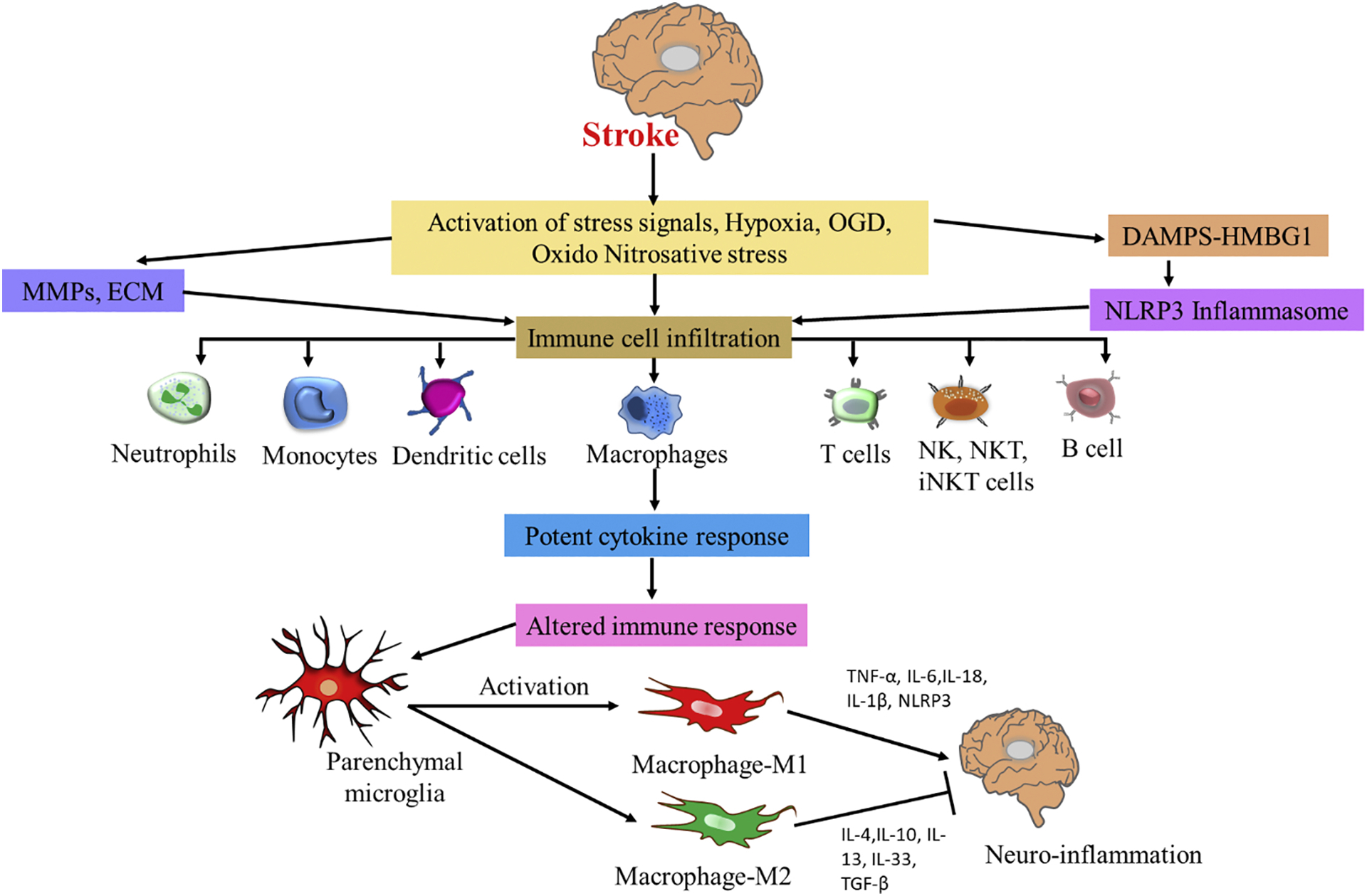
Stroke is the leading cause of death and the main cause of disability in surviving patients. The detrimental interaction between immune cells, glial cells, and matrix components in stroke pathology results in persistent inflammation that progresses to fibrosis. A substantial effort is being directed toward understanding the exact neuroinflammatory events that take place as a result of stroke. The initiation of a potent cytokine response, along with immune cell activation and infiltration in the ischemic core, has massive acute deleterious effects, generally exacerbated by comorbid inflammatory conditions. There is secondary neuroinflammation that promotes further injury, resulting in cell death, but conversely plays a beneficial role, by promoting recovery. This highlights the need for a better understanding of the neuroinflammatory and fibrotic processes, as well as the need to identify new mechanisms and potential modulators. In this review, we summarize several aspects of stroke-induced inflammation, fibrosis, and include a discussion of cytokine inhibitors/inducers, immune cells, and fibro-inflammation signaling inhibitors in order to identify new pharmacological means of intervention.
Keywords: Cytokines; Fibrosis; Immune cell infiltration; Neuroinflammation; Perlecan; Stroke.
Copyright © 2020 Elsevier B.V. All rights reserved.
Conflict of interest statement
Declaration of Competing Interest The authors have declared that no conflict of interest exists.
Figures
References
-
- Abulafia DP, de Rivero Vaccari JP, Lozano JD, Lotocki G, Keane RW, Dietrich WD, 2009. Inhibition of the inflammasome complex reduces the inflammatory response after thromboembolic stroke in mice. J. Cereb. Blood Flow Metab 29(3), 534–544. https://doi.10.1038/jcbfm.2008.143. - PubMed
-
- Adkins JN, Varnum SM, Auberry KJ, Moore RJ, Angell NH, Smith RD, Springer DL and Pounds JG, 2002. Toward a human blood serum proteome: analysis by multidimensional separation coupled with mass spectrometry. Mol Cell Proteomics. 1(12), 947–955. https://doi.10.1074/mcp.m200066-mcp200. - PubMed
-
- Aftabizadeh M, Tatarek-Nossol M, Andreetto E, El Bounkari O, Kipp M, Beyer C, Kapurniotu A, 2019. Blocking Inflammasome Activation Caused by beta-Amyloid Peptide (Abeta) and Islet Amyloid Polypeptide (IAPP) through an IAPP Mimic. ACS Chem. Neurosci 10(8), 3703–3717. https://doi.10.1021/acschemneuro.9b00260. - PubMed
-
- Agalave NM, Svensson CI, 2015. Extracellular high-mobility group box 1 protein (HMGB1) as a mediator of persistent pain. Mol. Med 20, 569–578.https://doi.10.2119/molmed.2014.00176. - PMC - PubMed
-
- Armstead WM, Hekierski H, Pastor P, Yarovoi S, Higazi AA, Cines DB, 2019. Release of IL-6 After Stroke Contributes to Impaired Cerebral Autoregulation and Hippocampal Neuronal Necrosis Through NMDA Receptor Activation and Upregulation of ET-1 and JNK. Transl. Stroke Res 10(1), 104–111. https://doi.10.1007/s12975-018-0617-z. - PubMed
Publication types
Grants and funding
LinkOut - more resources
Full Text Sources
Research Materials
