


A vulnerability index for the management of and response to the COVID-19 epidemic in India: an ecological study
- PMID: 32682459
- PMCID: PMC7365640
- DOI: 10.1016/S2214-109X(20)30300-4
A vulnerability index for the management of and response to the COVID-19 epidemic in India: an ecological study
Erratum in
-
Correction to Lancet Glob Health 2020; 8: e1142-51.Lancet Glob Health. 2020 Sep;8(9):e1131. doi: 10.1016/S2214-109X(20)30346-6. Lancet Glob Health. 2020. PMID: 32827477 Free PMC article. No abstract available.
Abstract
Background: COVID-19 is spreading rapidly in India and other parts of the world. Despite the Indian Government's efforts to contain the disease in the affected districts, cases have been reported in 627 (98%) of 640 districts. There is a need to devise a tool for district-level planning and prioritisation and effective allocation of resources. Based on publicly available data, this study reports a vulnerability index for identification of vulnerable regions in India on the basis of population and infrastructural characteristics.
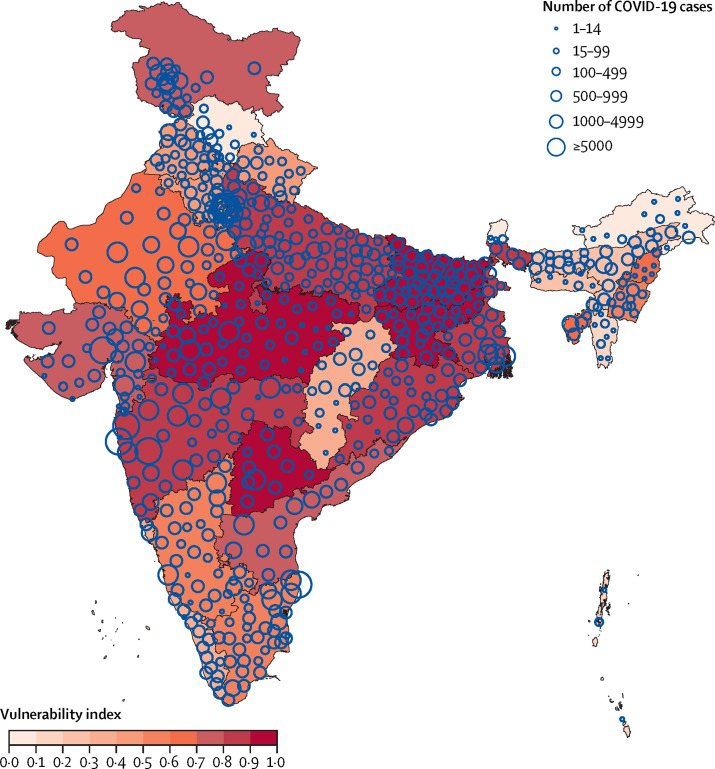
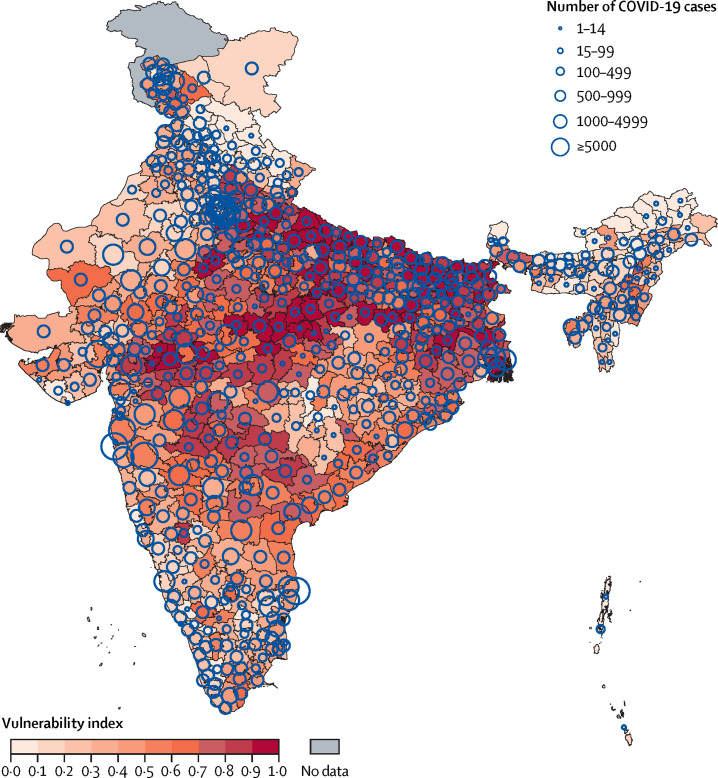
Methods: We computed a composite index of vulnerability at the state and district levels based on 15 indicators across the following five domains: socioeconomic, demographic, housing and hygiene, epidemiological, and health system. We used a percentile ranking method to compute both domain-specific and overall vulnerability and presented results spatially with number of positive COVID-19 cases in districts.
Findings: A number of districts in nine large states-Bihar, Madhya Pradesh, Telangana, Jharkhand, Uttar Pradesh, Maharashtra, West Bengal, Odisha, and Gujarat-located in every region of the country except the northeast, were found to have high overall vulnerability (index value more than 0·75). These states also had high vulnerability according to most of the five domains. Although our intention was not to predict the risk of infection for a district or a state, we observed similarities between vulnerability and the current concentration of COVID-19 cases at the state level. However, this relationship was not clear at the district level.
Interpretation: The vulnerability index presented in this paper identified a number of vulnerable districts in India, which currently do not have large numbers of COVID-19 cases but could be strongly impacted by the epidemic. Our index aims to help planners and policy makers effectively prioritise regions for resource allocation and adopt risk mitigation strategies for better preparedness and responses to the COVID-19 epidemic.
Funding: None.
Copyright © 2020 The Author(s). Published by Elsevier Ltd. This is an Open Access article under the CC BY 4.0 license. Published by Elsevier Ltd.. All rights reserved.
Figures
Comment in
-
Contextualising geographical vulnerability to COVID-19 in India.Lancet Glob Health. 2020 Sep;8(9):e1104-e1105. doi: 10.1016/S2214-109X(20)30329-6. Epub 2020 Jul 16. Lancet Glob Health. 2020. PMID: 32682458 Free PMC article. No abstract available.
-
Estimating vulnerability to COVID-19 in India.Lancet Glob Health. 2020 Dec;8(12):e1465. doi: 10.1016/S2214-109X(20)30426-5. Lancet Glob Health. 2020. PMID: 33220207 No abstract available.
-
Estimating vulnerability to COVID-19 in India - Authors' reply.Lancet Glob Health. 2020 Dec;8(12):e1467. doi: 10.1016/S2214-109X(20)30429-0. Lancet Glob Health. 2020. PMID: 33220209 No abstract available.
References
-
- WHO Rolling updates on coronavirus disease. https://www.who.int/emergencies/diseases/novel-coronavirus-2019/events-a...
-
- Johns Hopkins Center for Systems Science and Engineering Coronavirus resource center: COVID-19 dashboard by the Center for Systems Science and Engineering (CSSE) at Johns Hopkins University (JHU) https://coronavirus.jhu.edu/map.html
-
- Walker P, Whittaker C, Watser O. The global impact of COVID-19 and strategies for mitigation and suppression. March 26, 2020. https://www.imperial.ac.uk/media/imperial-college/medicine/sph/ide/gida-...
-
- Government of India Ministry of Information and Broadcasting. India's response to COVID outbreak. https://pib.gov.in/PressReleasePage.aspx?PRID=1608727
-
- Khan MI, Abraham A. No ‘room’ for social distancing: a look at India's housing and sanitation conditions. Econ Polit Wkly. 2020;55
MeSH terms
LinkOut - more resources
Full Text Sources
