


Interplay between platelets and coagulation
- PMID: 32682574
- PMCID: PMC7354275
- DOI: 10.1016/j.blre.2020.100733
Interplay between platelets and coagulation
Abstract
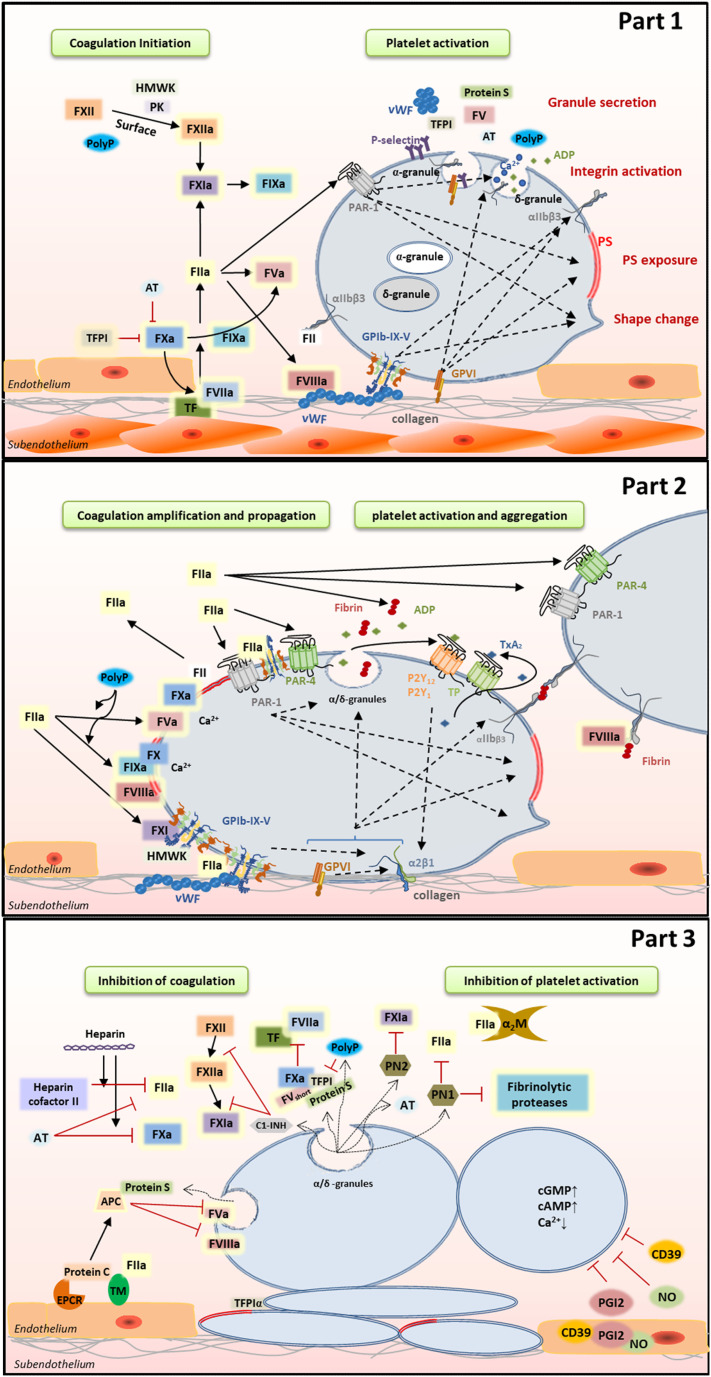
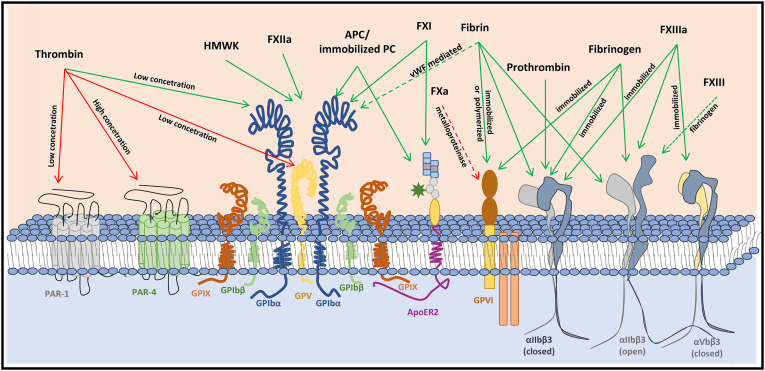
Haemostasis stops bleeding at the site of vascular injury and maintains the integrity of blood vessels through clot formation. This regulated physiological process consists of complex interactions between endothelial cells, platelets, von Willebrand factor and coagulation factors. Haemostasis is initiated by a damaged vessel wall, followed with a rapid adhesion, activation and aggregation of platelets to the exposed subendothelial extracellular matrix. At the same time, coagulation factors aggregate on the procoagulant surface of activated platelets to consolidate the platelet plug by forming a mesh of cross-linked fibrin. Platelets and coagulation mutually influence each other and there are strong indications that, thanks to the interplay between platelets and coagulation, haemostasis is far more effective than the two processes separately. Clinically this is relevant because impaired interaction between platelets and coagulation may result in bleeding complications, while excessive platelet-coagulation interaction induces a high thrombotic risk. In this review, platelets, coagulation factors and the complex interaction between them will be discussed in detail.
Keywords: Clinical disorders; Coagulation; Haemostasis; Platelet; Platelet-based coagulation.
Copyright © 2020 Elsevier Ltd. All rights reserved.
Conflict of interest statement
Yaqiu Sang reports a grant from the China Scholarship Council.
Figures
References
-
- Harrison P., Cramer E.M. Platelet alpha-granules. Blood Rev. 1993;7:52–62. - PubMed
-
- Thomas S.G. In: Platelets. Michelson A.D., editor. 2019. 3 - The structure of resting and activated platelets; pp. 47–77.
-
- McNicol A., Israels S.J. Platelet dense granules: structure, function and implications for haemostasis. Thromb. Res. 1999;95:1–18. - PubMed
-
- Reininger A.J. Function of von Willebrand factor in haemostasis and thrombosis. Haemophilia. 2008;14:11–26. - PubMed
Publication types
MeSH terms
Substances
LinkOut - more resources
Full Text Sources
Other Literature Sources
