Review
. 2020 Oct:144:105010.
doi: 10.1016/j.nbd.2020.105010. Epub 2020 Jul 16.

Passive immunotherapies targeting Aβ and tau in Alzheimer's disease

Affiliations
Review

Passive immunotherapies targeting Aβ and tau in Alzheimer's disease

Steven S Plotkin et al. Neurobiol Dis. 2020 Oct.

Abstract

Amyloid-β (Aβ) and tau proteins currently represent the two most promising targets to treat Alzheimer's disease. The most extensively developed method to treat the pathologic forms of these proteins is through the administration of exogenous antibodies, or passive immunotherapy. In this review, we discuss the molecular-level strategies that researchers are using to design an effective therapeutic antibody, given the challenges in treating this disease. These challenges include selectively targeting a protein that has misfolded or is pathological rather than the more abundant, healthy protein, designing strategic constructs for immunizing an animal to raise an antibody that has the appropriate conformational selectivity to achieve this end, and clearing the pathological protein species before prion-like cell-to-cell spread of misfolded protein has irreparably damaged neurons, without invoking damaging inflammatory responses in the brain that naturally arise when the innate immune system is clearing foreign agents. The various solutions to these problems in current clinical trials will be discussed.


Figures

Unlabelled Image
Graphical abstract
Fig. 1
Fig. 1
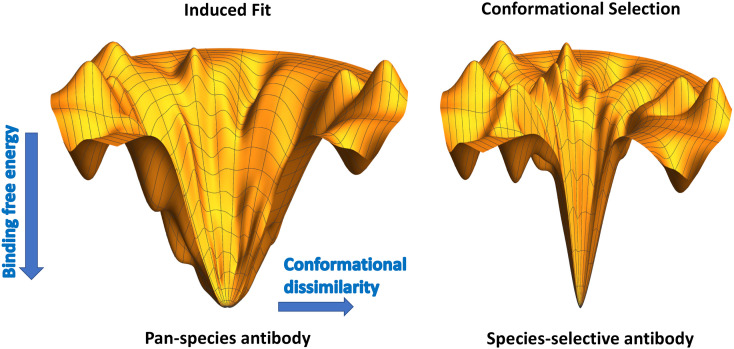
Schematics of energy landscapes of the binding free energy of an epitope to an antibody, as a function of conformational dissimilarity to the bound state structure, which is assumed to be at the lowest point. A conformationally-labile antibody is more prone to induced fit with different alternative conformations of a substrate ligand, and will thus lack binding selectivity (left). A conformationally-selective antibody will be unforgiving to even small conformational differences, which will be costly in terms of binding free energy.
Fig. 2
Fig. 2
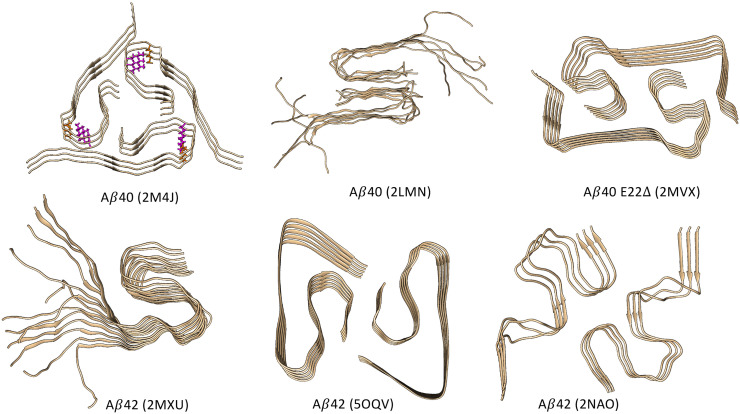
A selection of Aβ fibril structures, illustrating their polymorphism. Species (Aβ40, Aβ42, or the mutant Aβ40(E22Δ)) are indicated for each image, along with the PDB entry: 2M4J (Lu et al. (2013)), 2LMN (Paravastu et al. (2008)), 2MVX (Schütz et al. (2015)), 2MXU (Xiao et al. (2015)), 5OQV (Gremer et al. (2017)), and 2NAO (Wälti et al. (2016)). An example of ionic salt-bridges stabilizing the fibril structure is shown for structure 2M4J (D23-K28) in licorice. Structures 2LMN and 2MXU are incompletely resolved: Residues 1–8 are disordered in 2LMN and residues 1–10 are disordered in 2MXU; These residues are thus missing from the respective solid state NMR structural models. For these structures, the missing amino acids have been added and the structures have been equilibrated using all-atom equilibrium molecular dynamics. Consistent with the solid-state NMR data, these peptide regions remain disordered when molecular dynamics is implemented for these structures. For other structures such as 2M4J and 2NAO, these N-terminal peptide regions remain structured and are largely β-sheet.
Fig. 3
Fig. 3
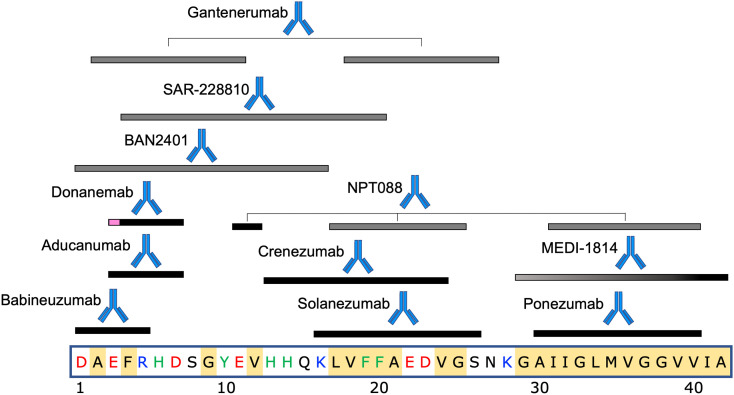
Epitope locations on the primary sequence of Aβ, for antibodies currently or recently in clinical trials. Black bars indicate epitope locations; gray bars indicate presumptive epitopes that likely subsume the actual epitope as a subset of the gray region. Gradient filling for MEDI-1814 represents the incompletely characterized epitope, but with known Aβ42 selectivity. Gantenerumab and NPT088 both have discontiguous epitopes on Aβ. Magenta region on the epitope for donanemab represents pyroglutamate at amino acid position 3. Amino acids in the primary sequence of Aβ are colored as follows. Red: negatively charged; Blue: positively charged; Green: aromatic; Yellow background: hydrophobic. The significant hydrophobicity and absence of aromatic residues in the C-terminal region is noteworthy. Specific epitope locations are listed in Table 1. (For interpretation of the references to colour in this figure legend, the reader is referred to the web version of this article.)
Fig. 4
Fig. 4
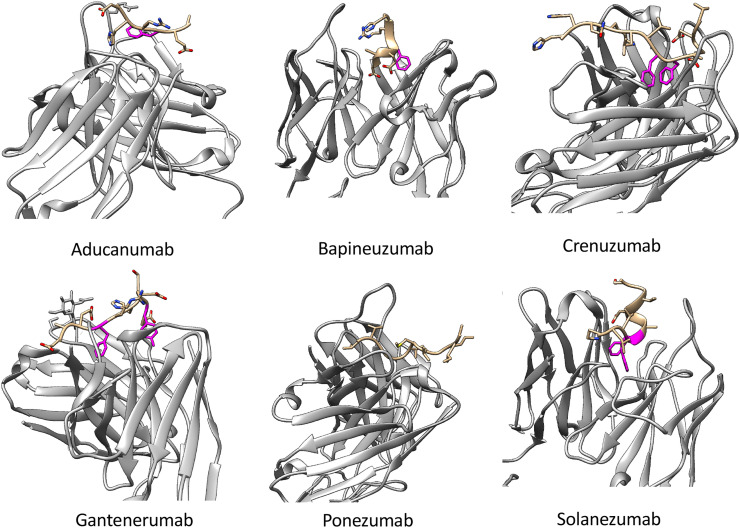
Antigen-binding regions of antibodies to Aβ in clinical development, with published co-crystal structures to their epitopes. Antibodies, Protein Databank entry, and epitopes are, from top left to right: aducanumab (PDB 6CO3, structured epitope amino acids 2-7) bapineuzumab (PDB 4HIX, structured epitope aa1-6) crenezumab (PDB 5VZY, structured epitope aa13-24), gantenerumab (PDB 5CSZ, structured epitope aa1-10), ponezumab (PDB 3U0T, structured epitope aa30-40.) solanezumab (PDB 4XXD, structured epitope aa16-26). Interacting aromatic rings are rendered in magenta for visualization. (For interpretation of the references to colour in this figure legend, the reader is referred to the web version of this article.)
Fig. 5
Fig. 5
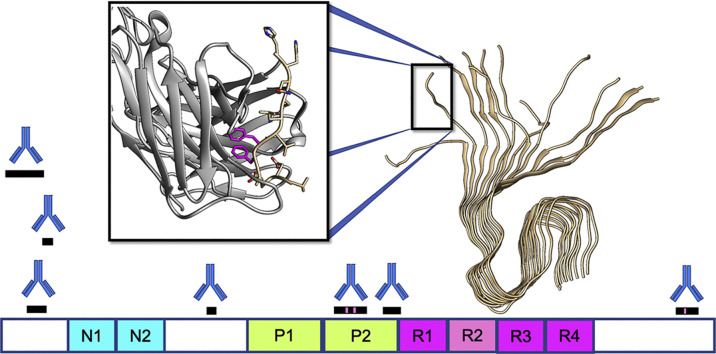
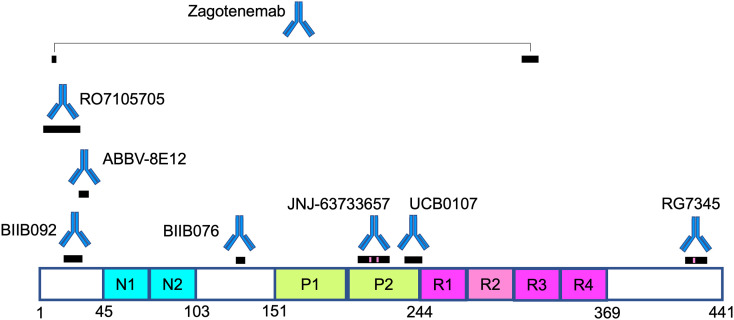
Epitope locations on the primary sequence of tau, for antibodies currently in clinical trials. Black bars indicate epitope locations; Pink bands on epitopes indicate phosphorylated sites and thus selectivity to the phosphorylated species. Domain structural features are shown for the longest isoform of tau (2N4R, 441 aa). The 2N4R isoform contains two N-terminal domains (N1 and N2 of 29 aa each), two proline-rich domains (P1 and P2 of 46 aa each), and four microtubule-binding domains (R1-R4 of 31 aa each). Zagotenemab has a discontiguous epitope. Specific epitope locations are listed in Table 2. (For interpretation of the references to colour in this figure legend, the reader is referred to the web version of this article.)
Fig. 6
Fig. 6
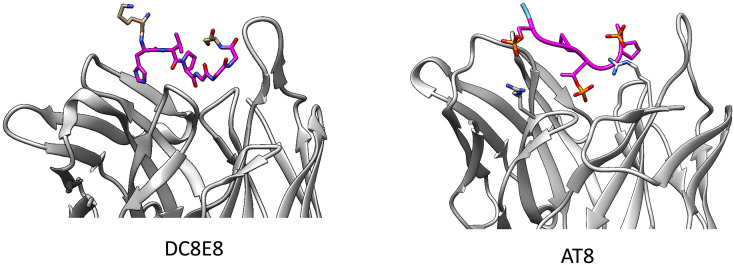
Co-crystal structures of the antigen-binding regions of two preclinical antibodies to tau, bound to their epitopes. Antibodies, Protein Databank entry, and epitopes are: (left) DC8E8, PDB 5MO3, structured epitope amino acids 298–305; (right) AT8, PDB 5E2W, structured epitope amino acids 202-209.

References

    1. Acton P., An Z., Bett A.J., Breese R., Chang L., Dodson E.C., Kinney G., Klein W., Lambert M.P., Liang X., Shughrue P., Strohl W.R., Viola K. 2010. Anti-addl antibodies and uses thereof. Patent (US) US7780963 US Patent 7,780,963.
    1. Acton P., An Z., Bett A.J., Breese R., Dodson E.C., Kinney G., Klein W., Lambert M.P., Liang X., Shughrue P., Strohl W.R., Viola K., Chang L. 2010. Anti-addl antibodies and uses thereof. Patent (US) US7811563 US Patent 7,811,563.
    1. Adolfsson O., Pihlgren M., Toni N., Varisco Y., Buccarello A.L., Antoniello K., Lohmann S., Piorkowska K., Gafner V., Atwal J.K., Maloney J., Chen M., Gogineni A., Weimer R.M., Mortensen D.L., Friesenhahn M., Ho C., Paul R., Pfeifer A., Muhs A., Watts R.J. An effector-reduced anti-β-amyloid (Aβ) antibody with unique Aβ binding properties promotes neuroprotection and glial engulfment of Aβ. J. Neurosci. 2012;32:9677–9689. - PMC - PubMed
    1. Adolfsson O., Ayalon G., Hotzel I., Di Cara D.M. 2016. Anti-tau antibodies and methods of use. Patent (US), WO2016–196726–A1.
    1. Alam R., Driver D., Wu S., Lozano E., Key S.L., Hole J.T., Hayashi Mansuo L., Lu J. Preclinical characterization of an antibody [LY3303560] targeting aggregated tau. Alzheimer’s Dement. 2017;13:592–593. - PubMed

Publication types

MeSH terms

Grants and funding