


Pathogenesis and management of myocardial injury in coronavirus disease 2019
- PMID: 32683753
- PMCID: PMC7405025
- DOI: 10.1002/ejhf.1967
Pathogenesis and management of myocardial injury in coronavirus disease 2019
Abstract
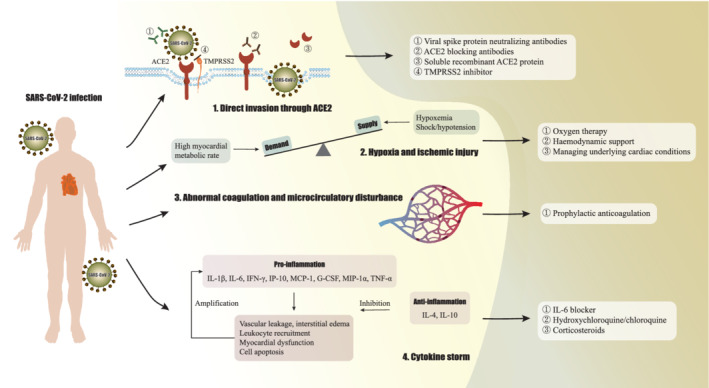
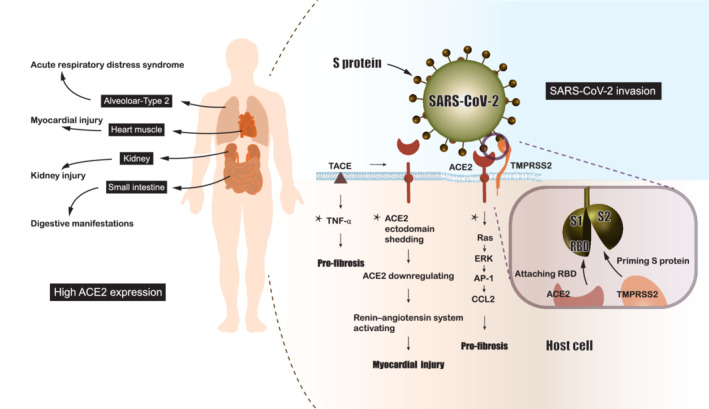
The outbreak of coronavirus disease 2019 (COVID-19), caused by severe acute respiratory syndrome coronavirus 2 (SARS-CoV-2) infection, has become a major health crisis and a worldwide pandemic. COVID-19 is characterized by high infectivity, long incubation period, diverse clinical presentations, and strong transmission intensity. COVID-19 can cause myocardial injury as well as other cardiovascular complications, particularly in senior patients with pre-existing medical conditions. The current review summarizes the epidemiological characteristics, potential mechanisms, clinical manifestations, and recent progress in the management of COVID-19 cardiovascular complications.
Keywords: Blood vessels; COVID-19; Heart; Inflammation; SARS-CoV-2.
© 2020 The Authors. European Journal of Heart Failure published by John Wiley & Sons Ltd on behalf of European Society of Cardiology.
Figures
References
-
- World Health Organization . Coronavirus disease (COVID‐19) outbreak. https://www.who.int/emergencies/diseases/novel‐coronavirus‐2019 (8 February 2020).
-
- Johns Hopkins University and Medicine . COVID‐19 map. Johns Hopkins Coronavirus Resource Centre. https://coronavirus.jhu.edu/map.html (23 January 2020).
-
- Huang C, Wang Y, Li X, Ren L, Zhao J, Hu Y, Zhang L, Fan G, Xu J, Gu X, Cheng Z, Yu T, Xia J, Wei Y, Wu W, Xie X, Yin W, Li H, Liu M, Xiao Y, Gao H, Guo L, Xie J, Wang G, Jiang R, Gao Z, Jin Q, Wang J, Cao B. Clinical features of patients infected with 2019 novel coronavirus in Wuhan, China. Lancet 2020;395:497–506. - PMC - PubMed
Publication types
MeSH terms
Grants and funding
LinkOut - more resources
Full Text Sources
Medical
Miscellaneous
