Case Reports
. 2020 Jun 24:2020:1536714.
doi: 10.1155/2020/1536714. eCollection 2020.

High-Dose Inhaled Nitric Oxide as Adjunct Therapy in Cystic Fibrosis Targeting Burkholderia multivorans

Affiliations
Case Reports

High-Dose Inhaled Nitric Oxide as Adjunct Therapy in Cystic Fibrosis Targeting Burkholderia multivorans

Bethany L Bartley et al. Case Rep Pediatr. .

Abstract

Background: Individuals with cystic fibrosis (CF) have persistent lung infections, necessitating the frequent use of antibiotics for pulmonary exacerbations. Some respiratory pathogens have intrinsic resistance to the currently available antibiotics, and any pathogen may acquire resistance over time, posing a challenge to CF care. Gaseous nitric oxide has been shown to have antimicrobial activity against a wide variety of microorganisms, including common CF pathogens, and offers a potential inhaled antimicrobial therapy. Case Presentation. Here, we present the case of a 16-year-old female with CF who experienced a precipitous decline in lung function over the prior year in conjunction with worsening antibiotic resistance of her primary pathogen, Burkholderia multivorans. She received 46 intermittent inhalations of 160 parts-per-million nitric oxide over a 28-day period. The gas was administered via a mechanical ventilator fitted with nitrogen dioxide scavenging chambers.

Conclusions: High-dose inhaled nitric oxide was safe, well tolerated, and showed clinical benefit in an adolescent with cystic fibrosis and pulmonary colonization with Burkholderia multivorans.


Conflict of interest statement

The authors have no conflicts of interest to disclose.

Figures
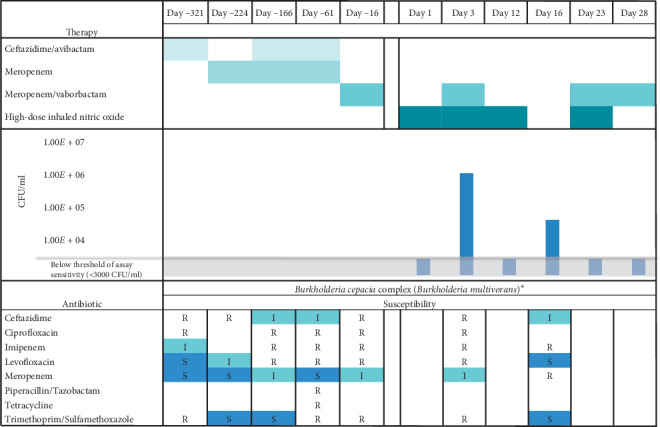
Figure 1
Figure 1
Timeline of antibiotic therapies, antibiotic susceptibility pattern of the primary pathogen (Burkholderia cepacia complex (Burkholderia multivorans)), and colony forming units (CFU) of this pathogen relative to the initiation of high-dose inhaled nitric oxide therapy on day 1. The antibiotic susceptibility data are reported as susceptible S, intermediate I, or resistant R. Due to limitations in commercial identification systems to reliably distinguish among species of the Burkholderia cepacia complex, Burkholderia multivorans identification was reported as the Burkholderia cepacia complex by our clinical microbiology laboratory. The patient's isolates had been confirmed as Burkholderia multivorans by the Burkholderia cepacia Research Laboratory and Repository (Ann Arbor, Michigan, USA) within the prior year.
Figure 2
Figure 2
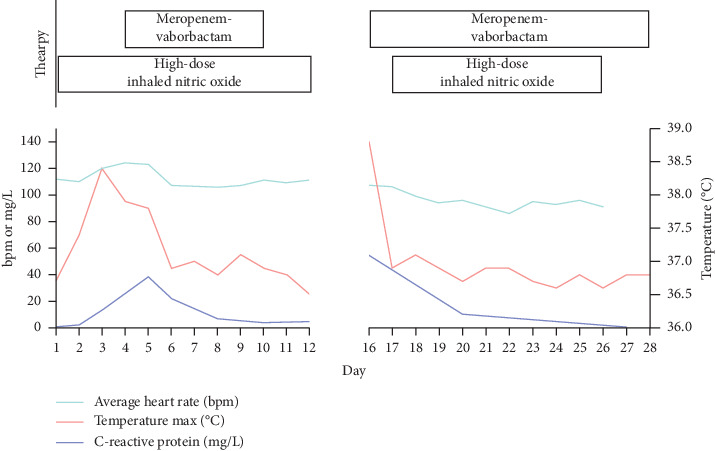
Relationship between therapies, vital signs, and inflammatory markers in an adolescent with CF, treated with intravenous antibiotics and high-dose inhaled nitric oxide. The first and second hospital admissions are shown on the left and right panels of the figure, respectively. Duration of therapy with either intravenous antibiotics or inhaled nitric oxide is shown at the top of the figure.
Figure 3
Figure 3
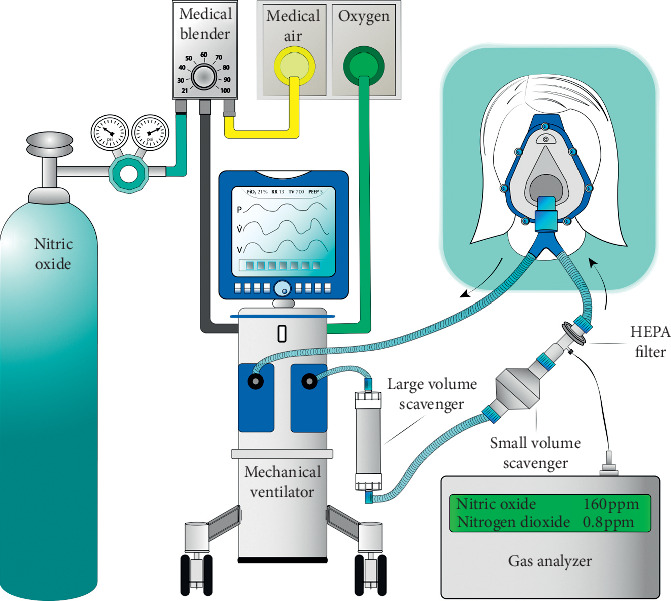
Schematic representation of the inhaled nitric oxide delivery system. The nitric oxide gas source was a 850 ppm nitric oxide in nitrogen tank. This gas was mixed with medical air in a gas blender, and the resulting gas mixture was blended with oxygen in the mechanical ventilator. The blender and FiO2 dial were both adjusted to achieve the targeted nitric oxide and oxygen concentrations. Large and small nitrogen dioxide scavengers were placed in series along the inspiratory limb. The gas mixture was delivered to the patient via a sealed facemask. Delivered gas was sampled just proximal to the patient, and nitric oxide and nitrogen dioxide concentrations were analyzed with a portable gas analyzer.
Figure 4
Figure 4
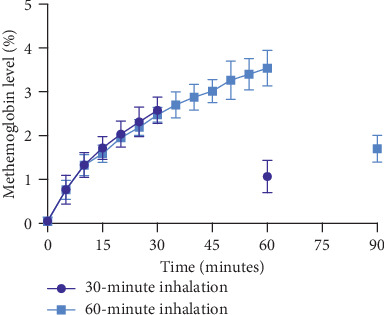
Methemoglobin levels (mean ± standard deviation) from data recorded at 5-minute intervals during 30-minute and 60-minute inhalations of high-dose nitric oxide. Curves demonstrate a reproducible and expected rise in methemoglobin during therapy and reduction 30 minutes after cessation (note: data from 45-minute inhalations were omitted for clarity, but follow a similar rise, peak, and decrease 30 minutes post-inhalation).

References

    1. Marshall B., Faro A., Fink A., et al. Cystic fibrosis foundation patient registry, 2017 Annual Data Report. Bethesda, MD, USA: Cystic Fibrosis Foundation; 2018. https://www.cff.org/Research/Researcher-Resources/Patient-Registry/2017-....
    1. Gilligan P. H. Infections in patients with cystic fibrosis. Clinics in Laboratory Medicine. 2014;34(2):197–217. doi: 10.1016/j.cll.2014.02.001. - DOI - PMC - PubMed
    1. Grasemann H., Al-Saleh S., Scott J. A., et al. Asymmetric dimethylarginine contributes to airway nitric oxide deficiency in patients with cystic fibrosis. American Journal of Respiratory and Critical Care Medicine. 2011;183(10):1363–1368. doi: 10.1164/rccm.201012-1995oc. - DOI - PubMed
    1. US Food and Drug Administration. INOmax (nitric oxide) for inhalation. 2009. https://www.accessdata.fda.gov/drugsatfda_docs/label/2009/020845s009lbl.pdf.
    1. Miller C., McMullin B., Ghaffari A., et al. Gaseous nitric oxide bactericidal activity retained during intermittent high-dose short duration exposure. Nitric Oxide. 2009;20(1):16–23. doi: 10.1016/j.niox.2008.08.002. - DOI - PubMed

Publication types

LinkOut - more resources