


Rigorous Hand Hygiene Practices Among Health Care Workers Reduce Hospital-Associated Infections During the COVID-19 Pandemic
- PMID: 32686571
- PMCID: PMC7372602
- DOI: 10.1177/2150132720943331
Rigorous Hand Hygiene Practices Among Health Care Workers Reduce Hospital-Associated Infections During the COVID-19 Pandemic
Abstract
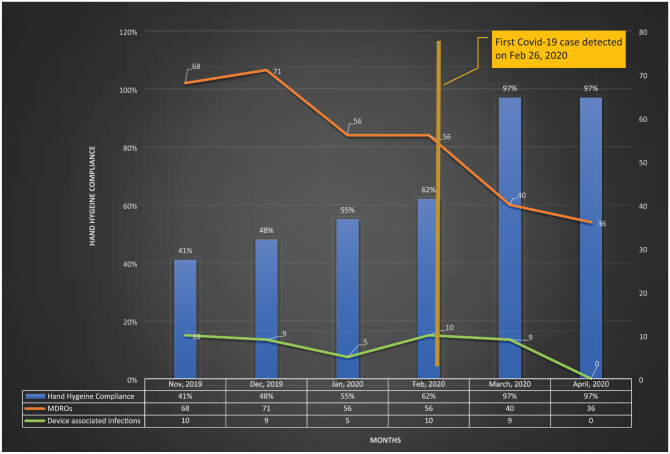
The experiences of these recent months have left us with as many new questions as they have given us new solutions. The main question that infection prevention and control department is having these days is "Why have hospital-associated infections (HAIs) reduced during COVID-19 pandemic?" What is the one unique strategy that has brought decline in increasing HAIs? Would it be appropriate to say that rigorous hand hygiene practices among health care workers (HCWs) have reduced HAIs in a tertiary care hospital of Pakistan? This commentary is written to understand the effect of rigorous hand hygiene among HCWs on number of HAIs during COVID-19 pandemic. Given the seriousness of this outbreak, it was observed that the hand hygiene has occupied a new place of importance in the minds of HCWs. We observed 4 times increase in the consumption of hand sanitizers after COVID-19 outbreak. The increased consumption of hand sanitizers was reflected in improved hand hygiene practices. A reduction was observed in the number of HAIs after the COVID-19 outbreak, and we assume that the dip in HAIs is associated with the improvement in hand hygiene practices in the recent months. In the wake of COVID-19 pandemic, these trends reassure us that hand hygiene compliance by HCWs alone can be effective in reducing HAIs in a hospital setting.
Keywords: COVID-19; hand hygiene compliance; hospital-associated infections (HAIs).
Conflict of interest statement
Figures

References
-
- Shafer E. Infection prevention in hospitals: the importance of hand hygiene. Infect Dis News. 2014;27(6):1 Accessed July 4, 2020 https://www.healio.com/news/infectious-disease/20140422/10_3928_1081_597...
-
- Center for Disease Control and Prevention. Types of healthcare-associated infections. Accessed May 18, 2020 https://www.cdc.gov/hai/infectiontypes.html
-
- World Health Organization. Evidence for hand hygiene guidelines. Accessed on May 18, 2020 https://www.who.int/gpsc/tools/faqs/evidence_hand_hygiene/en/
-
- Binder L, Millenson ML. In a pandemic, hospital staffers need to get better at hand-washing. Published March 25, 2020. Accessed on May 18, 2020 https://www.statnews.com/2020/03/25/pandemic-hospitals-more-handwashing/
MeSH terms
LinkOut - more resources
Full Text Sources
Medical
