. 2020 Aug;26(8):1801-1809.
doi: 10.3201/eid2608.200343.

Naturally Acquired Human Plasmodium cynomolgi and P. knowlesi Infections, Malaysian Borneo

Naturally Acquired Human Plasmodium cynomolgi and P. knowlesi Infections, Malaysian Borneo

Thamayanthi Nada Raja et al. Emerg Infect Dis. 2020 Aug.

Abstract

To monitor the incidence of Plasmodium knowlesi infections and determine whether other simian malaria parasites are being transmitted to humans, we examined 1,047 blood samples from patients with malaria at Kapit Hospital in Kapit, Malaysia, during June 24, 2013-December 31, 2017. Using nested PCR assays, we found 845 (80.6%) patients had either P. knowlesi monoinfection (n = 815) or co-infection with other Plasmodium species (n = 30). We noted the annual number of these zoonotic infections increased greatly in 2017 (n = 284). We identified 6 patients, 17-65 years of age, with P. cynomolgi and P. knowlesi co-infections, confirmed by phylogenetic analyses of the Plasmodium cytochrome c oxidase subunit 1 gene sequences. P. knowlesi continues to be a public health concern in the Kapit Division of Sarawak, Malaysian Borneo. In addition, another simian malaria parasite, P. cynomolgi, also is an emerging cause of malaria in humans.

Keywords: Malaria; Malaysian Borneo; Plasmodium cynomolgi; Plasmodium knowlesi; parasites; parasitic diseases; zoonoses.


Figures
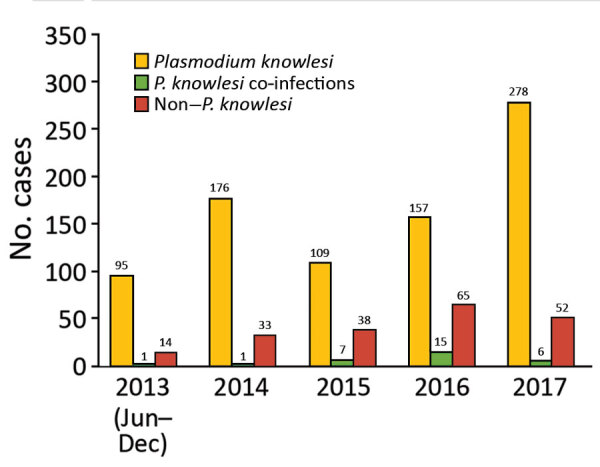
Figure 1
Figure 1
Number of patients admitted to Kapit Hospital with malaria during June 24, 2013–December 31, 2017, Malaysian Borneo. Non–P. knowlesi includes P. falciparum, P. malariae, P. ovale, and P. vivax. Infections with Plasmodium spp. other than P. knowlesi each year included the following. In 2013, P. knowlesi coinfections included 1 P. cynomolgi co-infection; non–P. knowlesi included 9 P. falciparum, 4 P. vivax, and 1 P. ovale. In 2014, P. knowlesi mixed included 1 P. falciparum coinfection; non–P. knowlesi included 14 P. falciparum, 4 P. malariae, 12 P. vivax, 3 P. ovale. In 2015, P. knowlesi co-infections included 3 P. falciparum and 4 P. vivax co-infections; non–P. knowlesi included 16 P. falciparum, 16 P. vivax, 1 P. malariae, 3 P. falciparum/P. vivax co-infections, 1 P. falciparum/P. ovale co-infection, and 1 P. vivax/P. ovale co-infection. In 2016, P. knowlesi co-infections included 8 P. falciparum, 6 P. vivax, and 1 P. cynomolgi co-infections; non–P. knowlesi included 41 P. falciparum, 14 P. vivax, 1 P. ovale, 3 P. falciparum/P. vivax co-infections, 1 P. falciparum/P. malariae co-infection, 4 P. falciparum/P. ovale co-infections, and 1 P. vivax/P. ovale co-infection. In 2017, P. knowlesi co-infections included 4 P. cynomolgi, and 2 P. vivax co-infections; non–P. knowlesi included 26 P. falciparum, 19 P. vivax, 3 P. malariae, 2 P. ovale, 1 P. falciparum/P. vivax co-infection, and 1 P. falciparum/P. malariae co-infection.
Figure 2
Figure 2
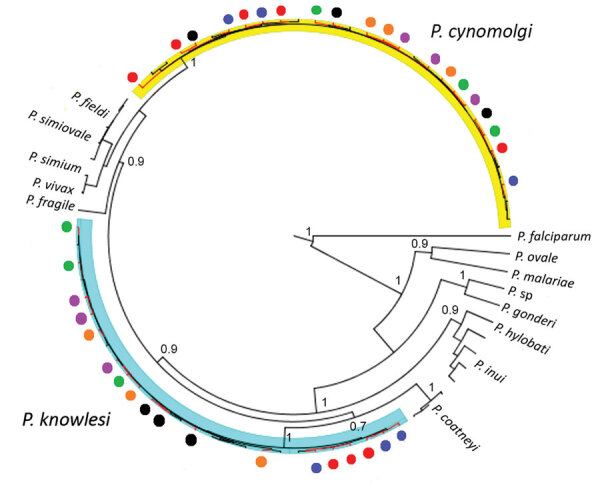
Maximum clade credibility tree for Plasmodium cytochrome c oxidase subunit 1 (COXI) sequences from samples from patients admitted to Kapit Hospital with malaria during June 24, 2013–December 31, 2017, Malaysian Borneo. Tree was generated by using strict clock model and Bayesian skyline coalescent tree prior. Circles indicate COXI sequences derived from patients: red indicates patient KT46; black indicates patient K07; orange indicates patient K199; purple indicates patient K221; blue indicates patient K222; and green indicates patient K229.
Figure 3
Figure 3
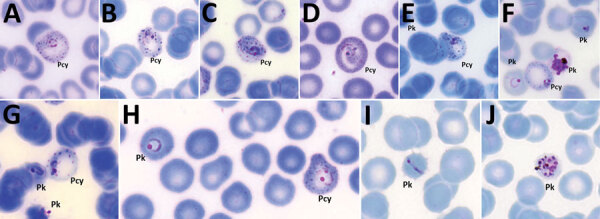
Plasmodium cynomolgi and P. knowlesi parasites in patient K07, admitted to Kapit Hospital, Kapit, Malaysia, with malaria in 2016. A–G) Early trophozoites of P. cynomolgi in enlarged and, at times, distorted erythrocytes, with Schüffner’s stippling and either single, double, or triple chromatin dots. E–H) P. knowlesi and P. cynomolgi early trophozoites. I) Band form trophozoite of P. knowlesi. J) Schizont of P. knowlesi. Pcy, P. cynomolgi; Pk, P. knowlesi. Original magnification ×100.
Figure 4
Figure 4
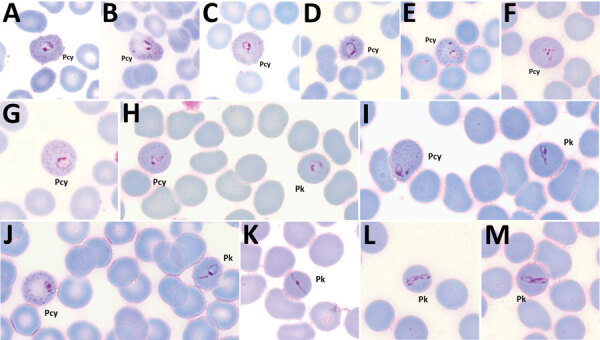
Plasmodium cynomolgi and P. knowlesi parasites in patient K199, admitted to Kapit , Kapit, Malaysia, with malaria in 2017. A–G) Early trophozoites of P. cynomolgi within enlarged and, at times, distorted erythrocytes, with Schüffner’s stippling and single, double, or triple chromatin dots. H–J) Early trophozoites of P. knowlesi and P. cynomolgi. K–M) Band form trophozoites of P. knowlesi. Pcy, P. cynomolgi; Pk, P. knowlesi. Magnification ×100.
Figure 5
Figure 5
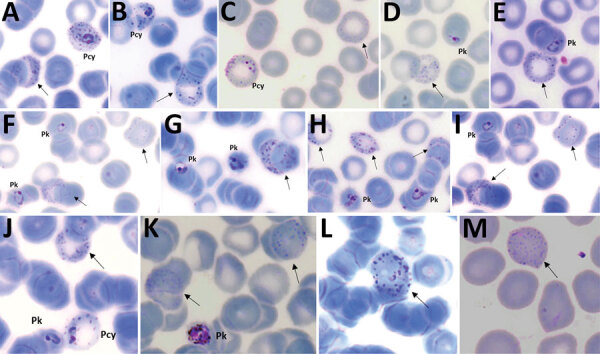
Plasmodium cynomolgi and P. knowlesi parasites in patient K07, admitted to Kapit , Kapit, Malaysia, with malaria in 2016. Arrows indicate Schüffner’s stippling in erythrocytes without parasites. A–C) Early trophozoites of P. cynomolgi; D–I) early trophozoites of P. knowlesi; J) early trophozoites of P. knowlesi and P. cynomolgi; K) gametocyte of P. knowlesi. Pcy, P. cynomolgi; Pk, P. knowlesi. Magnification ×100.

References

    1. Coatney GR, Collins WE, Warren M, Contacos PG. The primate malarias. Washington (DC): US National Institute of Allergy and Infectious Diseases; 1971.
    1. Ramasamy R. Zoonotic malaria - global overview and research and policy needs. Front Public Health. 2014;2:123. 10.3389/fpubh.2014.00123 - DOI - PMC - PubMed
    1. Singh B, Kim Sung L, Matusop A, Radhakrishnan A, Shamsul SS, Cox-Singh J, et al. A large focus of naturally acquired Plasmodium knowlesi infections in human beings. Lancet. 2004;363:1017–24. 10.1016/S0140-6736(04)15836-4 - DOI - PubMed
    1. Singh B, Daneshvar C. Human infections and detection of Plasmodium knowlesi. Clin Microbiol Rev. 2013;26:165–84. 10.1128/CMR.00079-12 - DOI - PMC - PubMed
    1. Zaw MT, Lin Z. Human Plasmodium knowlesi infections in South-East Asian countries. J Microbiol Immunol Infect. 2019;52:679–84. 10.1016/j.jmii.2019.05.012 - DOI - PubMed

Publication types

LinkOut - more resources