


Comparison of postoperative cognitive decline in patients undergoing conventional vs miniaturized cardiopulmonary bypass: A randomized, controlled trial
- PMID: 32687088
- PMCID: PMC7559974
- DOI: 10.4103/aca.ACA_192_18
Comparison of postoperative cognitive decline in patients undergoing conventional vs miniaturized cardiopulmonary bypass: A randomized, controlled trial
Abstract
Background: Neurocognitive dysfunction is a common complication of coronary artery bypass grafting (CABG) with incidence of 19-38%. The miniaturized cardiopulmonary bypass (MCPB) system was developed to reduce hemodilution and inflammation and provides better cerebral protection than conventional cardiopulmonary bypass (CCPB). In a meta-analysis, MCPB was associated with a 10-fold reduction in the incidence of strokes. However, its effect on postoperative cognitive decline (POCD) is unknown. We assessed if MCPB decreases POCD after CABG and compared the risk factors.
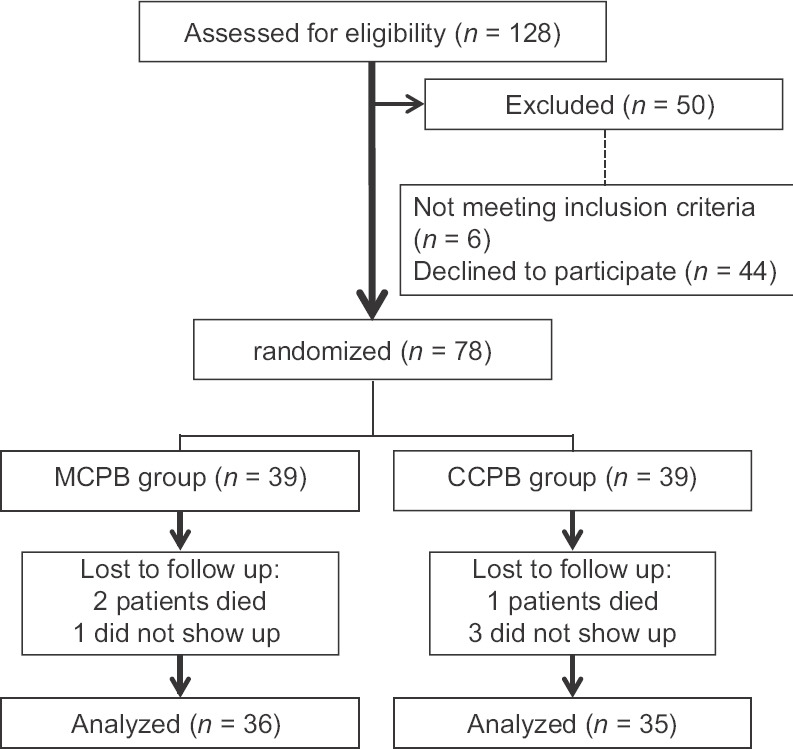
Methods: A total of 71 Asian patients presenting for elective CABG at a tertiary center were enrolled. They were randomly assigned to MCPB (n = 36) or CCPB group (n = 35) and followed up in a single-blinded, prospective, randomized controlled trial. The primary outcome was POCD as measured by the repeatable battery of neuropsychological status (RBANS). Inflammatory markers (tumor necrosis factor-alpha and interleukin-6), hematocrit levels, and neutron-specific enolase (NSE) levels were studied.
Results: Overall, the incidence of POCD at 3 months was 50%, and this was not significantly different between both groups (51.4 vs 50.0%, P = 0.90). Having <6 years of formal education [risk ratio (RR) = 3.014, 95% confidence interval (CI) = 1.054-8.618, P = 0.040] was significantly associated with POCD in the CCPB group, while the lowest hematocrit during cardiopulmonary bypass was independently associated with POCD in the MCPB group (RR = 0.931, 95% CI = 0.868-0.998, P = 0.044). The postoperative inflammatory markers and NSE levels were similar between the two groups.
Conclusions: This study shows that the MCPB was not superior to CCPB with cell salvage and biocompatible tubing with regard to the neurocognitive outcomes measured by the RBANS.
Keywords: Cardiopulmonary bypass; postoperative cognitive decline; repeatable battery of neuropsychological status.
Conflict of interest statement
There are no conflicts of interest.
Figures
References
-
- Toeg HD, Nathan H, Rubens F, Wozny D, Boodhwani M. Clinical impact of neurocognitivedeficits after cardiac surgery. J Thorac Cardiovasc Surg. 2013;145:1545–9. - PubMed
-
- Hammon JW, Jr, Stump DA, Kon ND, Cordell AR, Hudspeth AS, Oaks TE, et al. Risk factors and solutions for the development of neurobehavioral changes after coronary artery bypass grafting. Ann Thorac Surg. 1997;63:1613–8. - PubMed
-
- Djaiani G, Fedorko L, Borger MA, Green R, Carroll J, Marcon M, et al. Continuous-flow cell saver reduces cognitive decline in elderly patients after coronary bypass surgery. Circulation. 2007;116:1888–95. - PubMed
-
- Fromes Y, Gaillard D, Ponzio O, Chauffert M, Gerhardt MF, Deleuze P, et al. Reduction of the inflammatory response following coronary bypass grafting with total minimal extracorporeal circulation. Eur J Cardiothorac Surg. 2002;22:527–33. - PubMed
Publication types
MeSH terms
LinkOut - more resources
Full Text Sources
Medical