


COVID-19 Pandemic: Global Impact and Potential Implications for Cardiovascular Disease in Canada
- PMID: 32691023
- PMCID: PMC7275173
- DOI: 10.1016/j.cjco.2020.06.003
COVID-19 Pandemic: Global Impact and Potential Implications for Cardiovascular Disease in Canada
Abstract
Background: The literature indicates that cardiovascular disease (CVD; including stroke), older age, and availability of health care resources affect COVID-19 case fatality rates (CFRs). The cumulative effect of COVID-19 CFRs in global CVD populations and the extrapolated effect on access to health care services in the CVD population in Canada are not fully known. In this study we explored the relationships of factors that might affect COVID-19 CFRs and estimated the potential indirect effects of COVID-19 on Canadian health care resources.
Methods: Country-level epidemiological data were analyzed to study the correlation, main effect, and interaction between COVID-19 CFRs and: (1) the proportion of the population with CVD; (2) the proportion of the population 65 years of age or older; and (3) the availability of essential health services as defined by the World Health Organization Universal Health Coverage index. For indirect implications on health care resources, estimates of the volume of postponed coronary artery bypass grafting, percutaneous coronary intervention, and valve surgeries in Ontario were calculated.
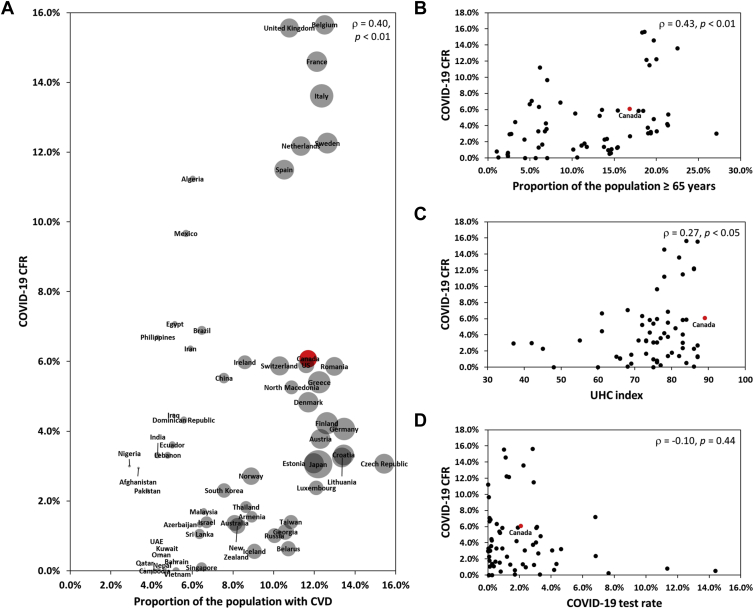
Results: Positive correlations were found between COVID-19 CFRs and: (1) the proportion of the population with CVD (ρ = 0.40; P = 0.001); (2) the proportion of the population 65 years of age or older (ρ = 0.43; P = 0.0005); and (3) Universal Health Coverage index (ρ = 0.27; P = 0.03). For every 1% increase in the proportion of the population 65 years of age or older or proportion of the population with CVD, the COVID-19 CFR was 9% and 19% higher, respectively. Approximately 1252 procedures would be postponed monthly in Ontario because of current public health measures.
Conclusions: Countries with more prevalent CVD reported higher COVID-19 CFRs. Strain on health care resources is likely in Canada.
Contexte: La littérature indique que les maladies cardiovasculaires (MCV, incluant les accidents vasculaires cérébraux), l’âge avancé et la facilité d’accès aux ressources de soins de santé ont une incidence sur les taux de létalité (TL) des cas de COVID-19. L’effet cumulatif du TL de la COVID-19 dans l’ensemble de la population atteinte de MCV et l’impact anticipé sur l'accès aux services de santé dans la population atteinte de MCV au Canada ne sont pas entièrement connus. Cette étude a exploré les liens entre les facteurs pouvant influencer le TL des cas de COVID-19 et a estimé le potentiel impact indirect de la COVID-19 sur les ressources de soins de santé au Canada.
Méthodes: Les données épidémiologiques à l’échelle du pays ont été analysées pour étudier la corrélation, l’effet principal et l’interaction entre le TL de laCOVID-19 et : 1) la proportion de la population souffrant de MCV, 2) la proportion de la population ≥ 65 ans, et 3) l’accessibilité des services de santé essentiels tels que définis par l’indice de couverture sanitaire universelle (CSU) de l’Organisation Mondiale de la Santé. Pour les implications indirectes concernant les ressources de santé, des estimations du volume d’opération de pontages coronariens, d'interventions coronariennes percutanées et de chirurgies valvulaires reportées en Ontario ont été calculées.
Résultats: Des corrélations positives ont été trouvées entre le TL de la COVID-19 et 1) la proportion de la population souffrant de MCV (ρ= 0,40, P = 0,001), 2) la proportion de la population ≥ 65 ans (ρ= 0,43, P = 0,0005), et 3) l’indice CSU (ρ= 0,27, P = 0,03). Pour chaque augmentation de 1 % de la proportion de la population ≥ 65 ans ou de la proportion de la population souffrant de MCV, le TL de la COVID-19 était respectivement supérieur de 9 % et 19 %. Environ 1 252 interventions seraient reportées chaque mois en Ontario en raison des mesures de santé publique actuelles.
Conclusions: Les pays où les MCV sont plus répandues ont signalé un TL de la COVID-19 plus élevé. Il est probable que les ressources de soins de santé soient soumises à de fortes contraintes au Canada.
© 2020 Canadian Cardiovascular Society. Published by Elsevier Inc.
Figures
References
-
- Lippi G., Wong J., Henry B.M. Hypertension and its severity or mortality in Coronavirus Disease 2019 (COVID-19): a pooled analysis. Pol Arch Intern Med. 2020;130:304–309. - PubMed
LinkOut - more resources
Full Text Sources
