


Neighborhood environment perceptions associate with depression levels and cardiovascular risk among middle-aged and older adults: Data from the Washington, DC cardiovascular health and needs assessment
- PMID: 32691611
- PMCID: PMC7855489
- DOI: 10.1080/13607863.2020.1793898
Neighborhood environment perceptions associate with depression levels and cardiovascular risk among middle-aged and older adults: Data from the Washington, DC cardiovascular health and needs assessment
Abstract
Objectives: Little is understood about associations between neighborhood characteristics and depression, a cardiovascular disease (CVD) risk factor, in diverse populations. We examined relationships between perceived/objective neighborhood characteristics, depression, and CVD markers within the Washington, DC CV Health/Needs Assessment, an evaluation among predominantly African-American (AA) adults in resource-limited DC communities.
Method: Factor analysis of overall neighborhood environment perception (NEP) identified three NEP sub-scores:1) violence; 2) physical/social environment; 3) social cohesion (higher score = more favorable perception). Objective neighborhood characteristics were measured by geospatially-derived scores of walkability, transportation, and crime. Depression was defined by the revised Center for Epidemiologic Studies Depression Scale (CESD-R). We used linear-regression modeling to examine neighborhood measures and CESD-R associations. To investigate a subsequent connection with CVD risk, we examined relationships between CESD-R and CVD-associated cytokines in a population subset.
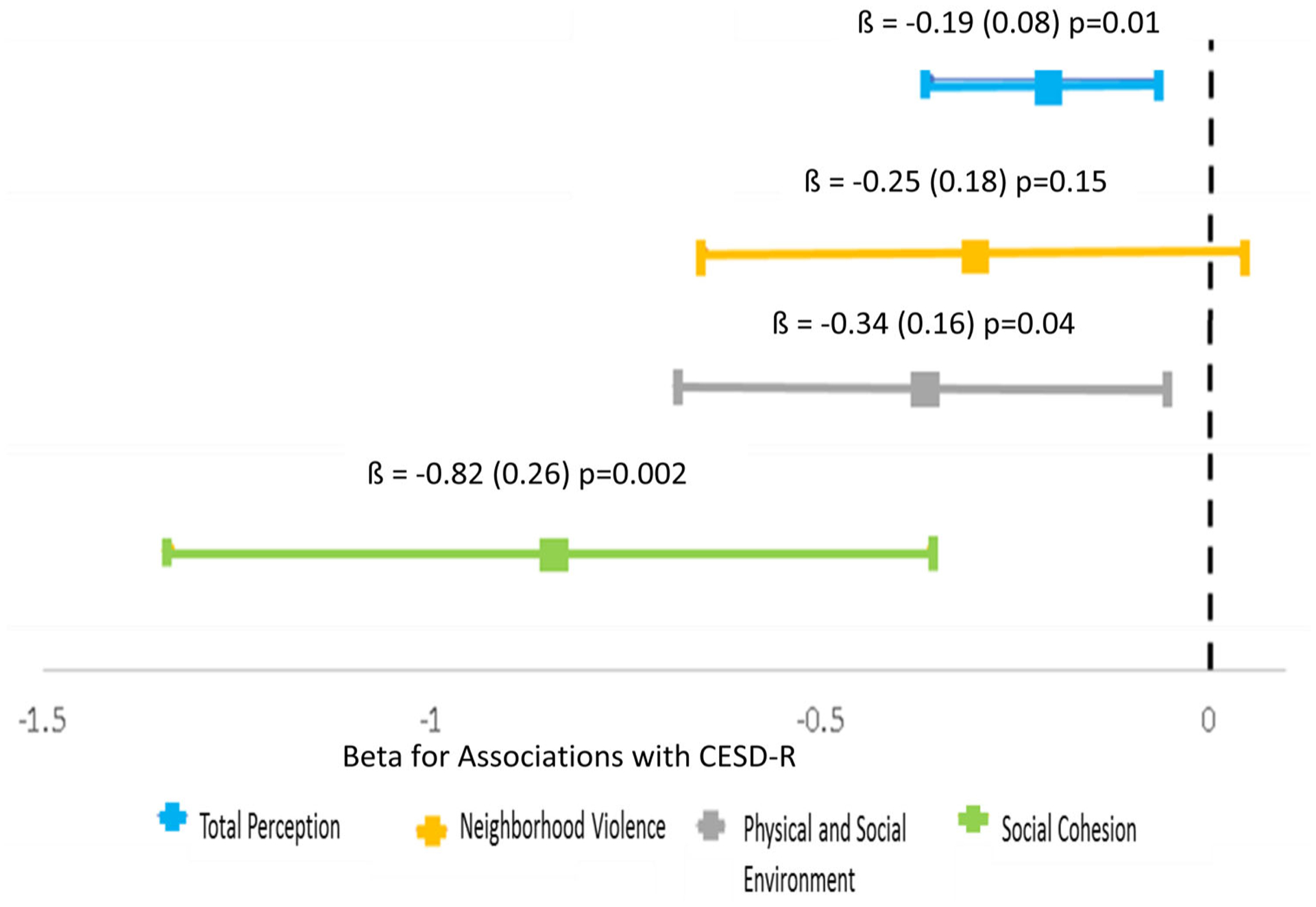
Results: Participants (N = 99; mean age = 59.06; 99% AA) had a mean CESD-R score = 5.8(SD = 8.88). In adjusted models, CESD-R scores decreased by 0.20 units (p = 0.01) for every overall NEP unit-increase. Perceived physical/social environment (β = -0.34, p = 0.04) and social cohesion (β = -0.82, p = 0.01) were related to CESD-R while perceived violence was not (β = -0.28, p = 0.1). Of objective neighborhood environment measures (i.e. walk, transit, bike, personal crime, and property crime scores), only property crime score was associated with depression (β = 4.99, p < 0.03). In population subset (n = 42), higher CESD-R associated with higher IL-1β (β = 21.25, p < 0.01) and IL-18 (β = 0.006, p = 0.01).
Conclusion: Favorable neighborhood perceptions are related to lower depressive symptoms in a predominantly AA cohort from Washington, DC resource-limited communities. Neighborhood perceptions appear to be strongly associated with depressive symptoms compared to objective characteristics. Increasing CESD-R scores were related to higher pro-inflammatory markers. Improving neighborhood perceptions may be beneficial to psychological well-being and CV health for urban minority residents.
Keywords: Neighborhood environment; cardiovascular disease; depression; inflammatory markers; psychosocial health.
Conflict of interest statement
Disclosure statement
No potential conflict of interest was reported by the author(s).
Figures

References
-
- Ahuja C, Ayers C, Hartz J, Adu-Brimpong J, Thomas S, Mitchell V, … Powell-Wiley TM (2018). Examining relationships between perceptions and objective assessments of neighborhood environment and sedentary time: Data from the Washington, D.C. cardiovascular health and needs assessment. Preventive Medicine Reports, 9, 42–48. doi: 10.1016/j.pmedr.2017.12.002 - DOI - PMC - PubMed
-
- Alesci S, Martinez PE, Kelkar S, Ilias I, Ronsaville DS, Listwak SJ, … Gold PW (2005). Major depression is associated with significant diurnal elevations in plasma interleukin-6 levels, a shift of its circadian rhythm, and loss of physiological complexity in its secretion: Clinical implications. The Journal of Clinical Endocrinology & Metabolism, 90(5), 2522–2530. doi: 10.1210/jc.2004-1667 - DOI - PubMed
-
- Andrews MR, Tamura K, Claudel SE, Xu S, Ceasar JN, Collins BS, Langerman S, Mitchell VM, Baumer Y, & Powell-Wiley TM (2020). Geospatial analysis of neighborhood deprivation index (NDI) for the United States by county. Journal of Maps, 16(1), 101–112. doi: 10.1080/17445647.2020.1750066 - DOI - PMC - PubMed
Publication types
MeSH terms
Grants and funding
LinkOut - more resources
Full Text Sources
Miscellaneous
