


Effects of the COVID-19 lockdown on human sleep and rest-activity rhythms
- PMID: 32693067
- PMCID: PMC7284244
- DOI: 10.1016/j.cub.2020.06.021
Effects of the COVID-19 lockdown on human sleep and rest-activity rhythms
Abstract
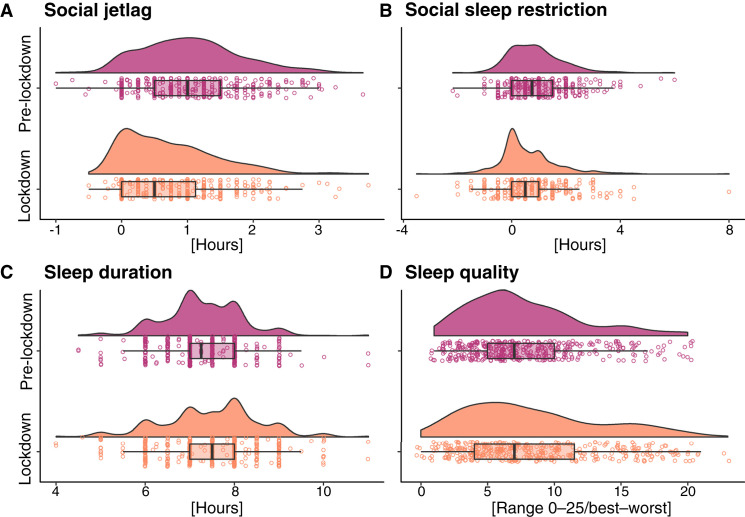
In modern societies, human rest-activity rhythms and sleep result from the tensions and dynamics between the conflicting poles of external social time (e.g., work hours and leisure activities) and an individual's internal biological time. A mismatch between the two has been suggested to induce 'social jetlag' [1] and 'social sleep restriction', that is, shifts in sleep timing and differences in sleep duration between work days and free days. Social jetlag [2,3] and sleep restrictions [4] have repeatedly been associated with negative consequences on health, mental wellbeing, and performance. In a large-scale quasi-experimental design, we investigated the effects of the phase with the most rigorous COVID-19 restrictions on the relationship between social and biological rhythms as well as sleep during a six-week period (mid-March until end of April 2020) in three European societies (Austria, Germany, Switzerland). We found that, on one hand, the restrictions reduced the mismatch between external (social) and internal (biological) sleep-wake timing, as indexed by significant reductions in social jetlag and social sleep restriction, with a concomitant increase in sleep duration. Sleep quality on the other hand was slightly reduced. The improved individual sleep-wake timing can presumably be attributed to an increased flexibility of social schedules, for instance due to more work being accomplished from home. However, this unprecedented situation also led to a significant increase in self-perceived burden, which was attendant to the decrease in sleep quality. These adverse effects may be alleviated by exposure to natural daylight as well as physical exercise.
Copyright © 2020 Elsevier Inc. All rights reserved.
Figures
Comment in
-
Behavior: How a Global Social Lockdown Unlocks Time for Sleep.Curr Biol. 2020 Jul 20;30(14):R822-R823. doi: 10.1016/j.cub.2020.06.037. Epub 2020 Jun 16. Curr Biol. 2020. PMID: 32693079 Free PMC article.
-
Lockdown-Folgen: Die Schlafdauer steigt, die Schlafqualität sinkt.MMW Fortschr Med. 2021 Feb;163(2):18. doi: 10.1007/s15006-021-9569-4. MMW Fortschr Med. 2021. PMID: 33527270 Free PMC article. German. No abstract available.
References
-
- Wittmann M., Dinich J., Merrow M., Roenneberg T. Social jetlag: misalignment of biological and social time. Chronobiol. Int. 2006;23:497–509. - PubMed
-
- Levandovski R., Dantas G., Fernandes L.C., Caumo W., Torres I., Roenneberg T., Hidalgo M.P.L., Allebrandt K.V. Depression scores associate with chronotype and social jetlag in a rural population. Chronobiol. Int. 2011;28:771–778. - PubMed
-
- Depner C.M., Melanson E.L., Eckel R.H., Snell-Bergeon J.K., Perreault L., Bergman B.C., Higgins J.A., Guerin M.K., Stothard E.R., Morton S.J. Ad libitum weekend recovery sleep fails to prevent metabolic dysregulation during a repeating pattern of insufficient sleep and weekend recovery sleep. Curr. Biol. 2019;29:957–967.e4. - PMC - PubMed
-
- Ghotbi N., Pilz L.K., Winnebeck E.C., Vetter C., Zerbini G., Lenssen D., Frighetto G., Salamanca M., Costa R., Montagnese S., Roenneberg T. The μMCTQ: an ultra-short version of the Munich ChronoType Questionnaire. J. Biol. Rhythms. 2019;35:98–110. - PubMed
Publication types
MeSH terms
Grants and funding
LinkOut - more resources
Full Text Sources
Miscellaneous
