


Maternal childbirth experience in induced and spontaneous labour measured in a visual analog scale and the factors influencing it; a two-year cohort study
- PMID: 32693773
- PMCID: PMC7372821
- DOI: 10.1186/s12884-020-03106-4
Maternal childbirth experience in induced and spontaneous labour measured in a visual analog scale and the factors influencing it; a two-year cohort study
Abstract
Background: Poor maternal childbirth experience plays a role in family planning and subsequent pregnancies. The aim of this study was to compare childbirth experiences in induced and spontaneous labor and to investigate the factors influencing the childbirth experience.
Methods: This two-year cohort study included all women with term singleton pregnancies in cephalic presentation aiming for vaginal delivery at Helsinki University Hospital between January 2017 and December 2018. Maternal satisfaction in the childbirth experience was measured after delivery using a Visual Analog Scale (VAS) score. A low childbirth experience score was defined as VAS < 5. The characteristics and delivery outcomes of the study population were collected in the hospital database and analyzed by SPSS.
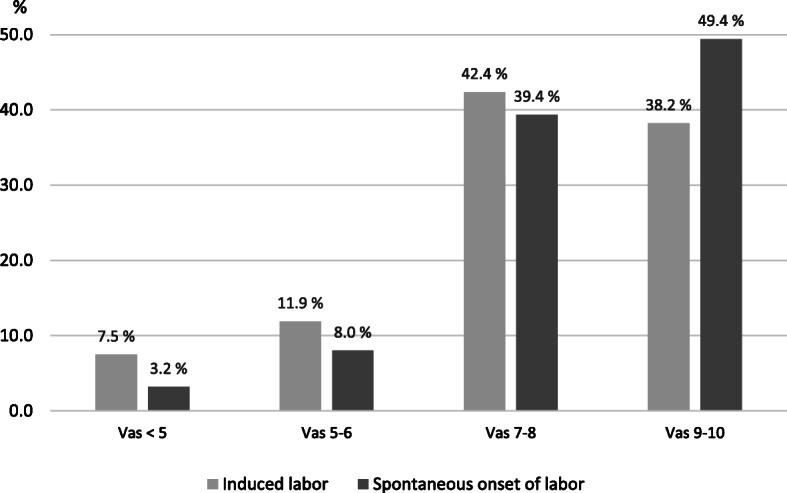
Results: A total of 18,396 deliveries were included in the study, of which 28.9% (n = 5322) were induced and 71.1% (n = 13 074) were of spontaneous onset. The total caesarean delivery rate was 9.3% (n = 1727). Overall, 4.5% (n = 819) of the women had a low childbirth experience VAS score. The women who underwent labor induction were less satisfied with their birth experience compared to women with spontaneous onset of labor [7.5% (n = 399) vs. 3.2% (n = 420); p < 0.001]. Poor childbirth experience was associated with primiparity [OR 2.0 (95% CI 1.6-2.4)], labor induction [OR 1.6 (95% CI 1.4-1.9)], caesarean delivery [OR 4.5 (95% CI 3.7-5.5)], operative vaginal delivery [OR 3.3 (95% CI 2.7-4.0)], post-partum hemorrhage [OR 1.3 (95% CI 1.1-1.6)], and maternal infections [OR 1.7 (95% CI 1.3-2.4)].
Conclusions: Poor childbirth experience was associated with labor induction, primiparity, operative delivery, and labor complications, such as post-partum hemorrhage and maternal infections. These results highlight the aspects of care for which patient experience may be improved by additional support and counselling.
Keywords: Childbirth experience; Induction of labor; Maternal satisfaction; Operative delivery; Visual analogue scale.
Conflict of interest statement
The authors declare that they have no competing interests.
Figures
References
-
- Vuori E, Gissler M. National Institute of Finland for Health and Welfare. Perinatal statistics: parturients, deliveries and newborns 2018.
-
- Zeitlin J, Mohangoo AD, Delnord M, Cuttini M (2013) The second European Perinatal Health Report: documenting changes over 6 years in the health of mothers and babies in Europe. J Epidemiol Community Health 67(12):983–5. - PubMed
-
- Martin JA, Hamilton BE, Osterman MJK, Driscoll AK, Drake P. Births: Final Data for 2017. Natl Vital Stat Rep. 2018;67(8):1–50. - PubMed
-
- Nuutila M, Halmesmäki E, Hiilesmaa V, Ylikorkala O (1999) Women's anticipations of and experiences with induction of labor. Acta Obstet Gynecol Scand 78(8):704–9. - PubMed
MeSH terms
LinkOut - more resources
Full Text Sources
Medical
