. 2020 Jul 21;10(1):12024.
doi: 10.1038/s41598-020-68719-3.

Evolutionary algorithms converge towards evolved biological photonic structures

Affiliations

Evolutionary algorithms converge towards evolved biological photonic structures

Mamadou Aliou Barry et al. Sci Rep. .

Abstract

Nature features a plethora of extraordinary photonic architectures that have been optimized through natural evolution in order to more efficiently reflect, absorb or scatter light. While numerical optimization is increasingly and successfully used in photonics, it has yet to replicate any of these complex naturally occurring structures. Using evolutionary algorithms inspired by natural evolution and performing particular optimizations (maximize reflection for a given wavelength, for a broad range of wavelength or maximize the scattering of light), we have retrieved the most stereotypical natural photonic structures. Whether those structures are Bragg mirrors, chirped dielectric mirrors or the gratings on top of Morpho butterfly wings, our results indicate how such regular structures might have spontaneously emerged in nature and to which precise optical or fabrication constraints they respond. Comparing algorithms show that recombination between individuals, inspired by sexual reproduction, confers a clear advantage that can be linked to the fact that photonic structures are fundamentally modular: each part of the structure has a role which can be understood almost independently from the rest. Such an in silico evolution also suggests original and elegant solutions to practical problems, as illustrated by the design of counter-intuitive anti-reflective coatings for solar cells.


Conflict of interest statement

The authors declare no competing interests.

Figures
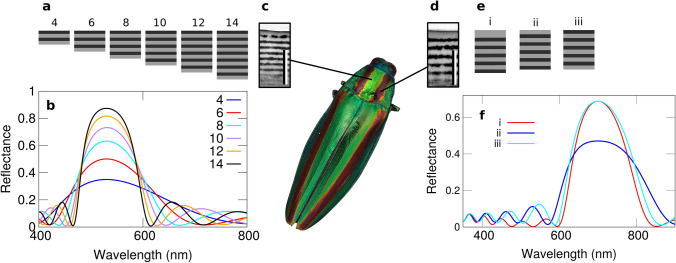
Figure 1
Figure 1
Retrieving dielectric mirrors through optimization. (a) Solutions obtained through optimization for different numbers of layers, ranging from 4 to 14 and drawn using Octave. (b) Associated reflectance spectrum showing a higher reflection in the green part of the spectrum, around 530 nm. (c,d) TEM images of the cuticular surface structure of the Japanese Jewel beetle, Chrysochroa fulgidissima (green and purple part of the elytron, respectively), bar: 1 μm. (e) Dielectric mirrors beginning with the lower index with a λ/2 (i) and λ/4 (ii) thickness and dielectric mirror beginning with the higher index for the same number of layers (iii). (f) Corresponding reflectance spectra showing similar efficiencies for structures (i) and (iii) in reflecting light in the red part of the spectrum.
Figure 2
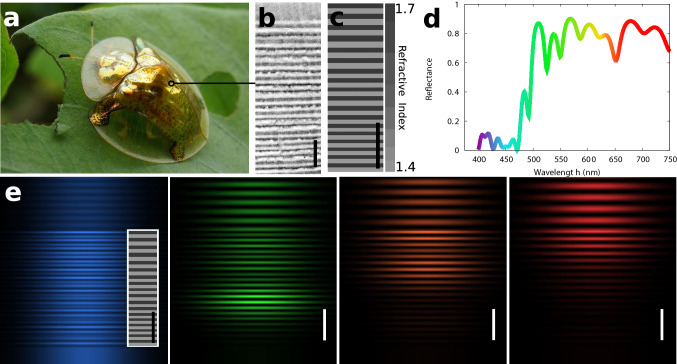
Figure 2
Retrieving chirped dielectric mirrors. (a) Aspidomorpha tecta, “Fool’s gold beetle”, photograph by Indri Basuki. (b) TEM image of the structure on the cuticule, taken from. (c) Result of the optimization by evolutionary algorithms with a larger period at the top than at the bottom. (d) Reflection spectrum of the structure. (e) Electric field distribution map upon normal-incidence illumination, obtained using Moosh, showing how different wavelength (and thus colors) are reflected (or not) at different depth in the chirped dielectric mirror. From left to right: blue (400 nm), green (530 nm), orange (600 nm) and red (700 nm). In the blue region of the spectrum (left), light can be seen crossing the whole structure without any damping and propagating again in the substrate. Scale bars: 1 μm.
Figure 3
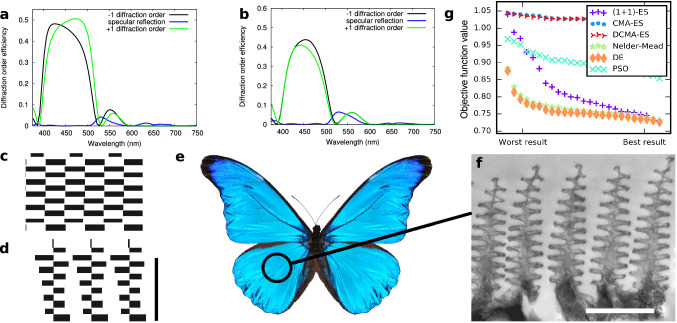
Figure 3
Retrieving the Morpho wing scale architecture.a Diffraction efficiency of the diffraction orders for the optimal structure (shown in c) found by the algorithms with no constraint except for the horizontal periodicity (fixed). b Diffraction efficiencies for the structure found (shown in d) when including a fabrication constraint and a pressure towards a lighter architecture. The bar represents 1 μm. e Actual view of a Morpho rethenor, photograph by John Nielsen. f TEM images of the cuticular surface of Morpho rhetenor (taken from). The bar represents 1 μm. g Score (lowest value of the objective function reached) for each algorithm with 12 layers and penalization; the x-axis represents the different runs, sorted (best run on the right). See Supplementary Information.
Figure 4
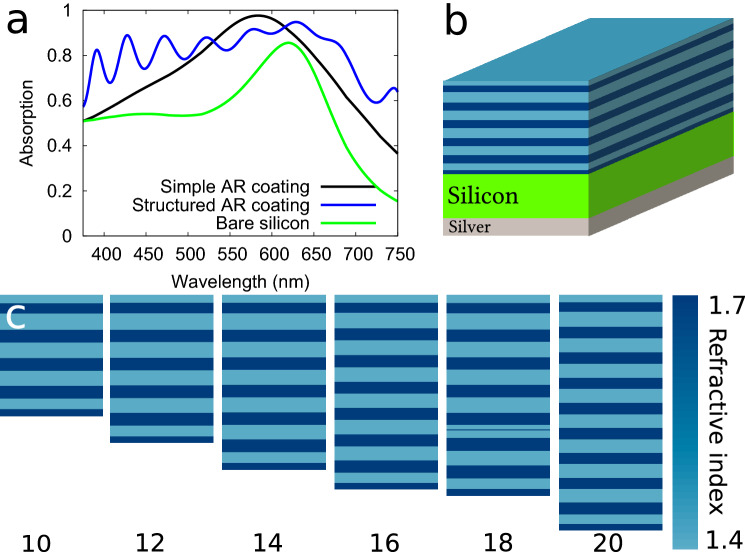
Figure 4
Anti-reflective coatings produced by evolutionary optimization. (a) Absorption spectra for a 89 nm thick amorphous silicon layer covered, bare or covered with different anti-reflective coatings. (b) Scheme of the structure with the multilayered anti-reflective coating designed by the algorithms with 12 layers. (c) Results of the optimization for different numbers of layers on top of a 10 μm thick amorphous silicon layer.

References

    1. Vukusic P, Sambles JR. Photonic structures in biology. Nature. 2003;424:852–855. doi: 10.1038/nature01941. - DOI - PubMed
    1. Kinoshita S, Yoshioka S, Miyazaki J. Physics of structural colors. Rep. Prog. Phys. 2008;71:076401. doi: 10.1088/0034-4885/71/7/076401. - DOI
    1. Kinoshita S. Structural Colors in the Realm of Nature. Singapore: World Scientific; 2008.
    1. Parker AR, McPhedran RC, McKenzie DR, Botten LC, Nicorovici N. Aphrodite’s iridescence. Nature. 2001;409:36–37. doi: 10.1038/35051168. - DOI - PubMed
    1. Vukusic P, Sambles J, Lawrence C, Wootton R. Quantified interference and diffraction in single morpho butterfly scales. Proc. R. Soc. Lond. B Biol. Sci. 1999;266:1403–1411. doi: 10.1098/rspb.1999.0794. - DOI

Publication types