


High-Risk HPV Oncoproteins and PD-1/PD-L1 Interplay in Human Cervical Cancer: Recent Evidence and Future Directions
- PMID: 32695664
- PMCID: PMC7338567
- DOI: 10.3389/fonc.2020.00914
High-Risk HPV Oncoproteins and PD-1/PD-L1 Interplay in Human Cervical Cancer: Recent Evidence and Future Directions
Abstract
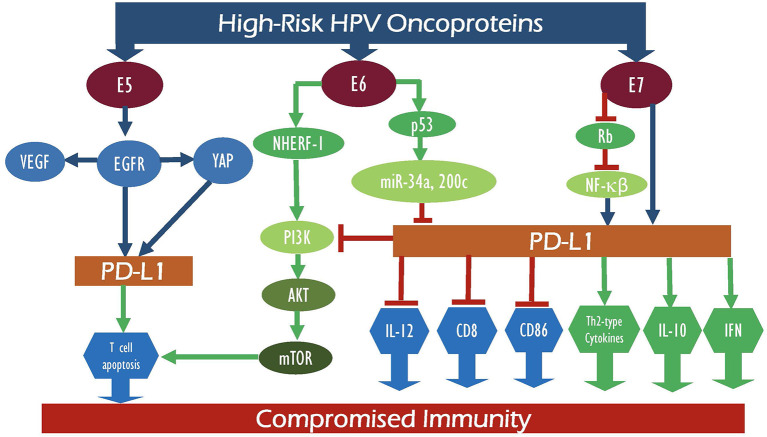
Cervical cancer is the fourth most common malignancy in women worldwide and a leading cause of cancer-related mortality in developing countries. Important etiological factors in this cancer are high-risk human papillomaviruses (HPV), as roughly 96% of cervical cancer cases are positive for these oncoviruses. On the other hand, it has been recently pointed out that E6/E7 oncoproteins of high-risk HPV can upregulate the programmed cell death-1/programmed cell death-ligand 1 (PD-1/PD-L1) axis. Likewise, several recent reports showed that checkpoint blockades targeting PD-1/PD-L1 pathways have achieved efficient clinical responses via suppressing cancer progression and improving survival in several types of human cancers including metastatic cervical cancer. In this review, we summarize recent advances in our understanding of the PD-1/PD-L1 signaling pathway and its interaction with high-risk HPV and their oncoproteins, which could have an important impact on the management of HPV-associated cancers including cervical.
Keywords: PD-1/PD-L1; cervical cancer; high-risk HPV; immunotherapy; oncoproteins.
Copyright © 2020 Allouch, Malki, Allouch, Gupta, Vranic and Al Moustafa.
Figures
References
-
- WHO Cervical Cancer. WHO: (2018) Available online at: https://www.who.int/cancer/prevention/diagnosis-screening/cervical-cance... (accessed April 02, 2020).
-
- Bruni L, Albero G, Serrano B, Mena M, Gómez D, Muñoz J, et al. . ICO/IARC Information Centre on HPV and Cancer (HPV Information Centre). Human Papillomavirus and Related Diseases in report. Barcelona: ICO/IARC; (2018).
Publication types
LinkOut - more resources
Full Text Sources
Research Materials
