


The Moderating Role of Child Maltreatment in Treatment Efficacy for Adolescent Depression
- PMID: 32696103
- PMCID: PMC7484366
- DOI: 10.1007/s10802-020-00682-z
The Moderating Role of Child Maltreatment in Treatment Efficacy for Adolescent Depression
Abstract
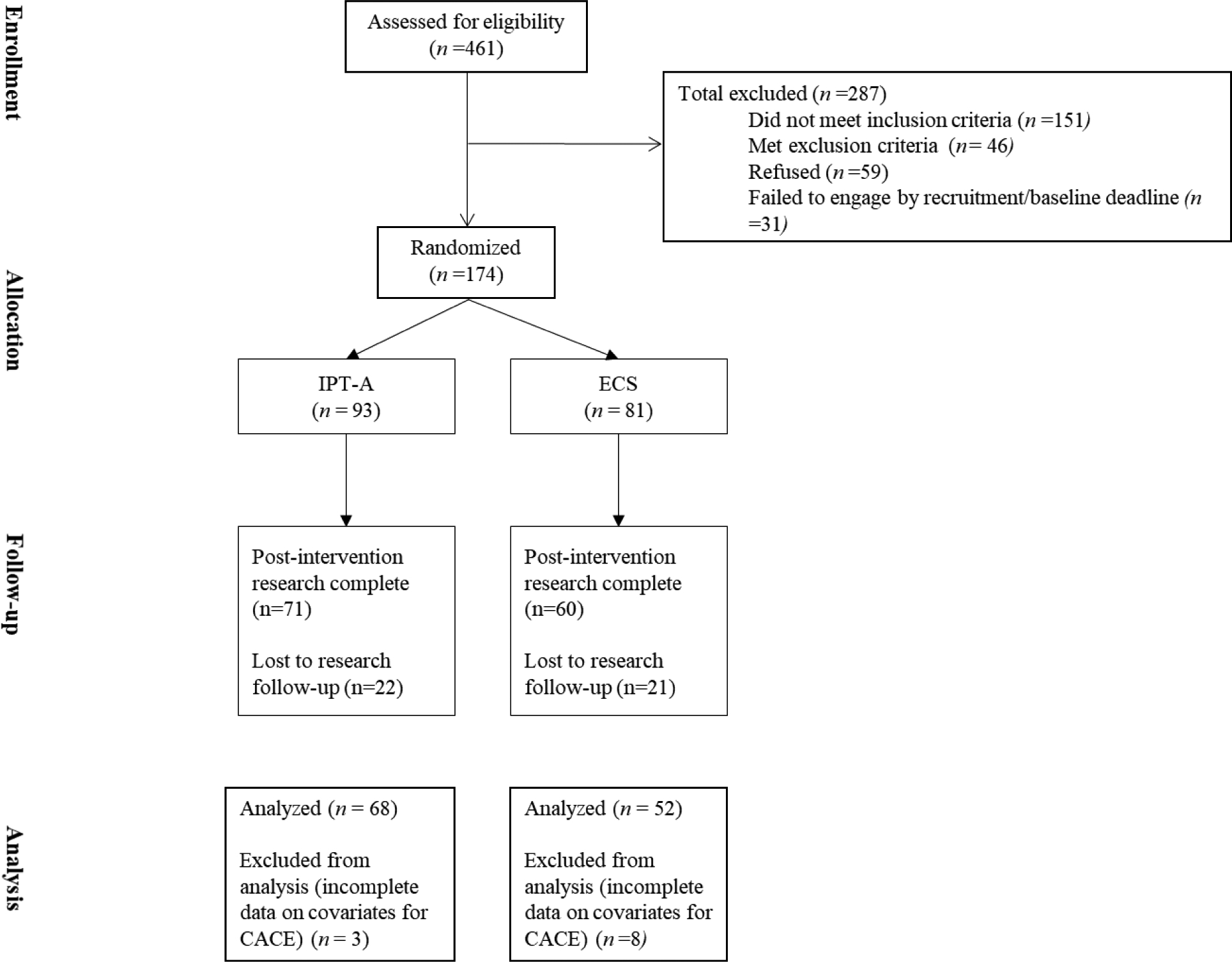
Adolescent girls are at heightened risk of depression, and because adolescent depression may initiate a negative developmental cascade, intervention early in adolescence has potential for altering a negative developmental trajectory. Identifying risk factors that impact response to intervention may inform decisions about the type of treatment to provide for adolescent girls with depression. Understanding moderators of outcomes in evidence-based treatment is critical to the delivery of timely and effective interventions. Matching patients effectively with optimal intervention will not only expedite the alleviation of patients' distress, but will also reduce unnecessary time and resources spent on less advantageous interventions. The current investigation examines the efficacy of Interpersonal Psychotherapy for Depressed Adolescents (IPT-A) in a racially and ethnically diverse sample of 120 low-income adolescent girls age 13-15 with and without histories of child maltreatment. Adolescent and parent report of depressive symptoms were assessed at the beginning and end of treatment and a diagnosis of subsyndromal symptoms of depression or depression were required for purposes of inclusion. Results indicated that among adolescent girls who had experienced two or more subtypes of maltreatment, IPT-A was found to be more efficacious than Enhanced Community Standard (ECS) treatment. Importantly, when the subtype of maltreatment experienced was further probed, among girls with a history of sexual abuse, we found preliminary evidence that IPT-A was significantly more effective than ECS in reducing depressive symptoms, and the effect size was large. Thus, if a history of maltreatment is present, especially including sexual abuse, specifically addressing the interpersonal context associated with depressive symptoms may be necessary.
Keywords: Adolescence; Child maltreatment; Depression; Developmental psychopathology; Interpersonal psychotherapy; Intervention.
Conflict of interest statement
Disclosure of potential conflicts of interest
The corresponding author certifies that neither she nor any of the contributing authors have any conflict of interest to disclose.
References
-
- Alloy LB, Abramson LY, Whitehouse WG, Hogan ME, Tashman NA, Steinberg DL, … & Donovan P (1999). Depressogenic cognitive styles: Predictive validity, information processing and personality characteristics, and developmental origins. Behaviour Research and Therapy, 37(6), 503–531. - PubMed
-
- American Psychological Association (2019). Clinical practice guideline for treatment depressive across three age cohorts.. Retrieved from https://www.apa.org/depression-guideline/guideline.pdf.
-
- Angold A, & Costello EJ (2006). Puberty and depression. Child and Adolescent Psychiatric Clinics, 15(4), 919–937. - PubMed
-
- Avenevoli S, Knight E, Kessler RC, & Merikangas KR (2008). Epidemiology of depression in children and adolescents In Abela JRZ & Hankin BL (Eds.), Handbook of depression in children and adolescents (pp. 6–32). New York, NY: Guilford Press.
Publication types
MeSH terms
Grants and funding
LinkOut - more resources
Full Text Sources
