Comment
doi: 10.15252/msb.20209757.
The Cancer Dependency Map enables drug mechanism-of-action investigations
Affiliations
- PMID: 32696566
- PMCID: PMC7373940
- DOI: 10.15252/msb.20209757
Item in Clipboard
Comment
The Cancer Dependency Map enables drug mechanism-of-action investigations
Mol Syst Biol.
2020 Jul.
Abstract
How do small molecules exert their effects in mammalian cells? This seemingly simple question continues to represent one of the fundamental challenges of modern translational science and as such has long been the subject of intense scientific scrutiny. In their recent study, Garnett and colleagues (Gonçalves et al, 2020) demonstrate proof-of-concept for a new way to attack this problem systematically for Oncology drugs, by identifying correlated CRISPR- and drug-killing profiles in the Cancer Dependency Map dataset.
© 2020 The Authors. Published under the terms of the CC BY 4.0 license.
Figures
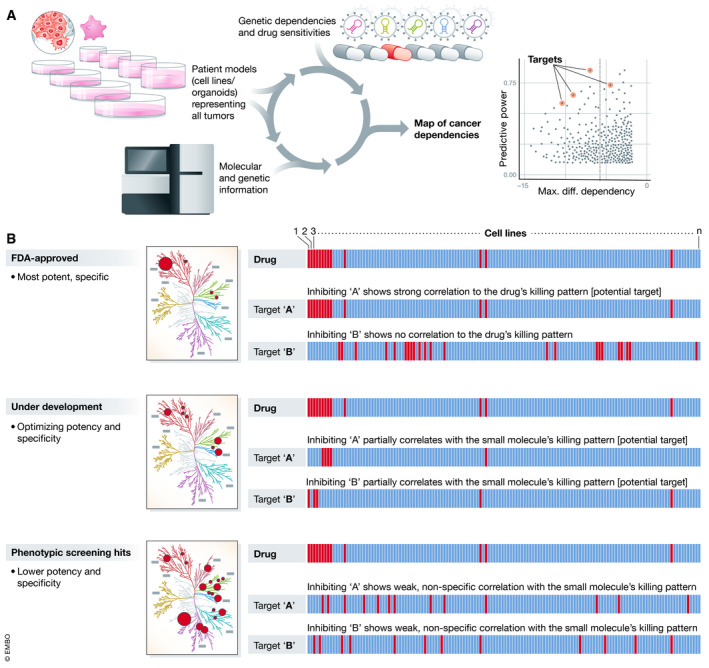
(A) By profiling hundreds of patient models of human cancer, the Cancer Dependency Map systematically identifies gene dependencies, small molecule sensitivities, and the markers that predict their response. (B) Correlations of genetic dependencies and drug sensitivities across cell lines can inform small molecule target(s) identification and mechanism‐of‐action. Red bars: cell killing; blue bars: no cell killing.
Comment on
-
Drug mechanism-of-action discovery through the integration of pharmacological and CRISPR screens.Mol Syst Biol. 2020 Jul;16(7):e9405. doi: 10.15252/msb.20199405. Mol Syst Biol. 2020. PMID: 32627965 Free PMC article.
References
-
- Behan FM, Iorio F, Picco G, Gonçalves E, Beaver CM, Migliardi G, Santos R, Rao Y, Sassi F, Pinnelli M et al (2019) Prioritization of cancer therapeutic targets using CRISPR‐Cas9 screens. Nature 568: 511–516 - PubMed
-
- Brown EJ, Albers MW, Shin TB, Ichikawa K, Keith CT, Lane WS, Schreiber SL (1994) A mammalian protein targeted by G1‐arresting rapamycin‐receptor complex. Nature 369: 756–758 - PubMed
Publication types
MeSH terms
Grants and funding
LinkOut - more resources
Full Text Sources
Medical