


Socio-economic inequalities in the effectiveness of workplace health promotion programmes on body mass index: An individual participant data meta-analysis
- PMID: 32696580
- PMCID: PMC7583467
- DOI: 10.1111/obr.13101
Socio-economic inequalities in the effectiveness of workplace health promotion programmes on body mass index: An individual participant data meta-analysis
Abstract
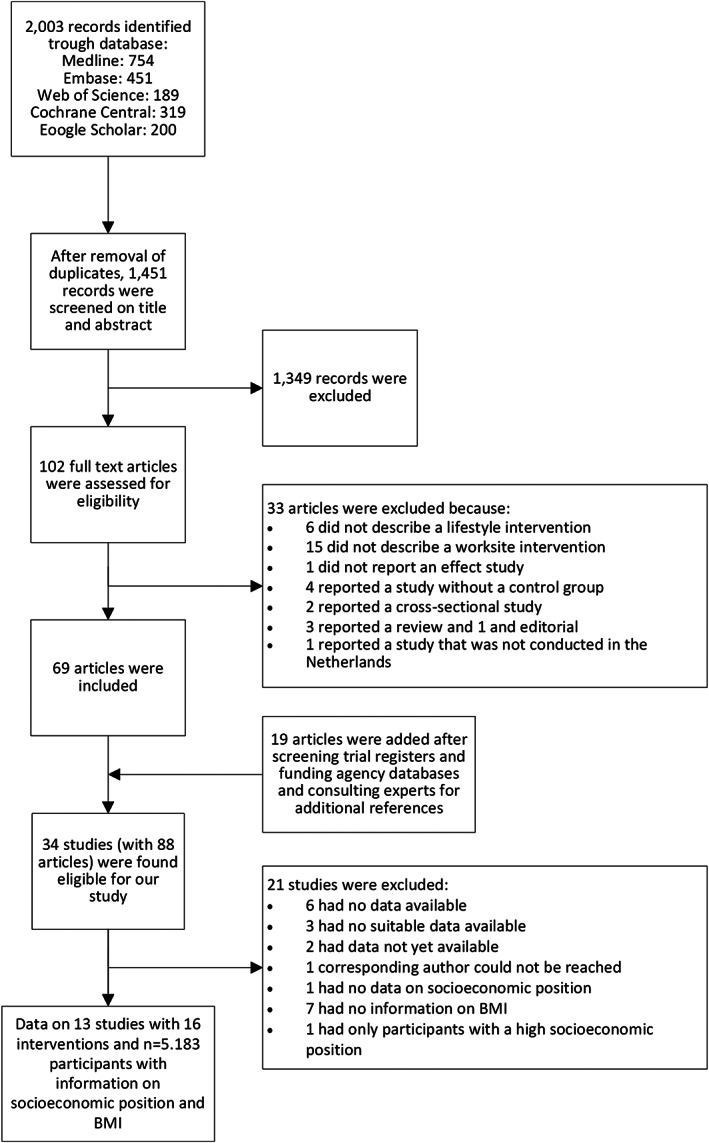
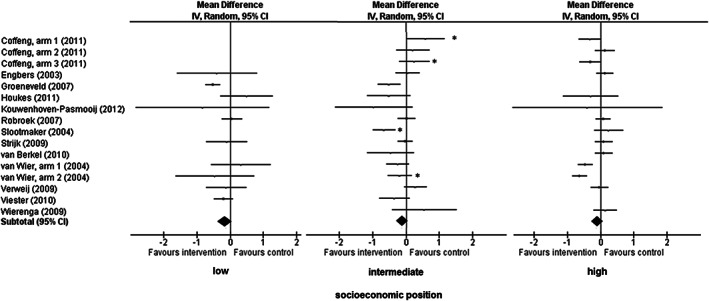
This individual participant data meta-analysis assessed the effectiveness of workplace health promotion programmes on body mass index (BMI) across socio-economic groups and whether study and intervention characteristics explained inequalities in effectiveness. Studies were eligible if they assessed the effect of a workplace health promotion programme on BMI in the Netherlands, included workers of at least two different socio-economic positions (SEPs) and had a study design with premeasurement and postmeasurement and control condition. Data of 13 studies presenting 16 interventions (5183 participants) were harmonized. In a two-stage meta-analysis, the interaction between intervention and SEP on BMI was tested with linear mixed models for each study. Subsequently, the interaction terms were pooled. The influence of study and intervention characteristics on the effectiveness of workplace health promotion programmes was evaluated using meta-regression analyses. Compared with control conditions, workplace health promotion programmes overall showed a statistically non-significant 0.12 kg/m2 (95% CI: -0.01, 0.25) decrease in BMI, which did not differ across SEP. Interventions evaluated within randomized controlled trials, agentic interventions, those that focused on high-risk groups, included a counselling component, consisted of more than five sessions, or were offered at the individual level did statistically significantly reduce BMI. No evidence was found for intervention-generated SEP inequalities.
Keywords: inequity; obesity; socio-economic inequalities; workplace.
© 2020 The Authors. Obesity Reviews published by John Wiley & Sons Ltd on behalf of World Obesity Federation.
Conflict of interest statement
The institutions of the authors received one grant from Netherlands Organisation for Health Research and Development (ZonMw) during the conduct of the study. Prof. Dr. A. J. van der Beek reports personal fees from spin‐off company Evalua Nederland B.V. and grants from Dutch National Social Security Agency outside the submitted work.
Figures
References
-
- Roskam AJR, Kunst AE, Van Oyen H, et al. Comparative appraisal of educational inequalities in overweight and obesity among adults in 19 European countries. Int J Epidemiol. 2010;39(2):392‐404. - PubMed
-
- Giskes K, Avendano M, Brug J, Kunst AE. A systematic review of studies on socioeconomic inequalities in dietary intakes associated with weight. Obes Rev. 2010;11(6):413‐429. - PubMed
-
- O'Neill J, Tabish H, Welch V, et al. Applying an equity lens to interventions: using PROGRESS ensures consideration of socially stratifying factors to illuminate inequities in health. J Clin Epidemiol. 2014;67(1):56‐64. - PubMed
-
- Beauchamp A, Backholer K, Magliano D, Peeters A. The effect of obesity prevention interventions according to socioeconomic position: a systematic review. Obes Rev. 2014;15(7):541‐554. - PubMed
Publication types
MeSH terms
LinkOut - more resources
Full Text Sources
