


The CYB5R3c .350C>G and G6PD A alleles modify severity of anemia in malaria and sickle cell disease
- PMID: 32697331
- PMCID: PMC8095369
- DOI: 10.1002/ajh.25941
The CYB5R3c .350C>G and G6PD A alleles modify severity of anemia in malaria and sickle cell disease
Abstract
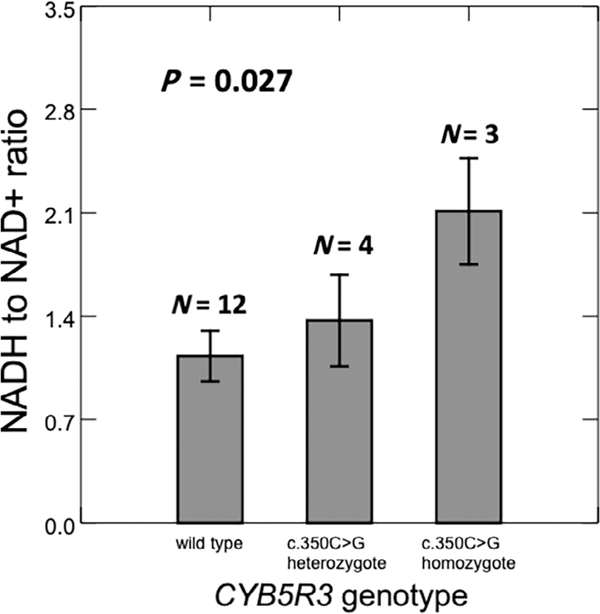
Genetic modifiers of anemia in Plasmodium falciparum infection and sickle cell disease (SCD) are not fully known. Both conditions are associated with oxidative stress, hemolysis and anemia. The CYB5R3 gene encodes cytochrome b5 reductase 3, which converts methemoglobin to hemoglobin through oxidation of NADH. CYB5R3c.350C > G encoding CYB5R3T117S , the most frequent recognized African-specific polymorphism, does not have known functional significance, but its high allele frequency (23% in African Americans) suggests a selection advantage. Glucose-6-phosphate dehydrogenase (G6PD) is essential for protection from oxidants; its African-polymorphic X-linked A+ and A- alleles, and other variants with reduced activity, coincide with endemic malaria distribution, suggesting protection from lethal infection. We examined the association of CYB5R3c.350C > G with severe anemia (hemoglobin <5 g/dL) in the context of G6PD A+ and A- status among 165 Zambian children with malaria. CYB5R3c.350C > G offered protection against severe malarial anemia in children without G6PD deficiency (G6PD wild type or A+/A- heterozygotes) (odds ratio 0.29, P = .022) but not in G6PD A+ or A- hemizygotes/homozygotes. We also examined the relationship of CYB5R3c.350C > G with hemoglobin concentration among 267 children and 321 adults and adolescents with SCD in the US and UK and found higher hemoglobin in SCD patients without G6PD deficiency (β = 0.29, P = .022 children; β = 0.33, P = .004 adults). Functional studies in SCD erythrocytes revealed mildly lower activity of native CYB5R3T117S compared to wildtype CYB5R3 and higher NADH/NAD+ ratios. In conclusion, CYB5R3c.350C > G appears to ameliorate anemia severity in malaria and SCD patients without G6PD deficiency, possibly accounting for CYB5R3c.350C > G selection and its high prevalence.
© 2020 Wiley Periodicals LLC.
Conflict of interest statement
CONFLICT OF INTEREST
All authors declare no conflict of interest with the content of the manuscript.
Figures


References
-
- Becker K, Tilley L, Vennerstrom JL, Roberts D, Rogerson S, Ginsburg H. Oxidative stress in malaria parasite-infected erythrocytes: host-parasite interactions. Int J Parasitol. 2004;34(2):163–189. - PubMed
-
- Das BS, Nanda NK. Evidence for erythrocyte lipid peroxidation in acute falciparum malaria. Trans R Soc Trop Med Hyg. 1999;93(1):58–62. - PubMed
-
- Omodeo-Sale F, Motti A, Basilico N, Parapini S, Olliaro P, Taramelli D. Accelerated senescence of human erythrocytes cultured with Plasmodium falciparum. Blood. 2003;102(2):705–711. - PubMed
-
- Amer J, Ghoti H, Rachmilewitz E, Koren A, Levin C, Fibach E. Red blood cells, platelets and polymorphonuclear neutrophils of patients with sickle cell disease exhibit oxidative stress that can be ameliorated by antioxidants. Br J Haematol. 2006;132(1):108–113. - PubMed
Publication types
MeSH terms
Substances
Grants and funding
LinkOut - more resources
Full Text Sources
Medical
Miscellaneous