


Prevalence of dengue virus serotypes in the 2017 outbreak in Peshawar, KP, Pakistan
- PMID: 32697383
- PMCID: PMC7521314
- DOI: 10.1002/jcla.23371
Prevalence of dengue virus serotypes in the 2017 outbreak in Peshawar, KP, Pakistan
Abstract
Background: Dengue is a viral disease, transmitted by infected Aedes aegypti and Aedes albopictus female mosquitoes. Worldwide, 96 million infections were estimated in 2010. The dengue virus comprises four distinct serotypes (DENV-1, DENV-2, DENV-3, and DENV-4) which belong to the genus Flavivirus. Determining the serotypes during dengue outbreaks is crucial for its effective management in terms of diagnostics improvement and polyvalent vaccine development. The aim of the present study is to determine the prevalence rate of dengue virus serotypes in the samples collected from patients during the 2017 outbreak in Khyber Pakhtunkhwa, Pakistan.
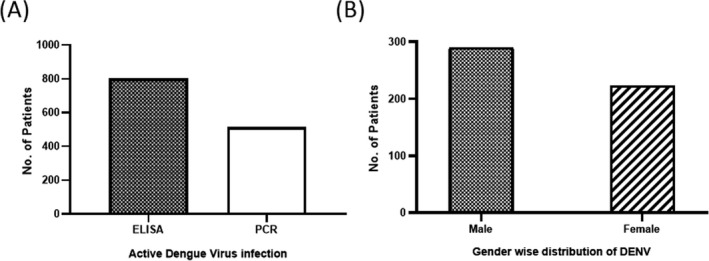
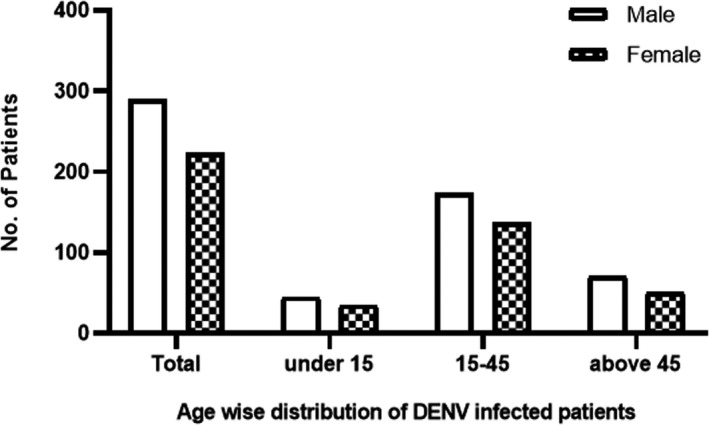
Methods: A total of 800 ELISA-positive samples were collected, of which 513 (290 males, 223 females) samples were confirmed positive by PCR.
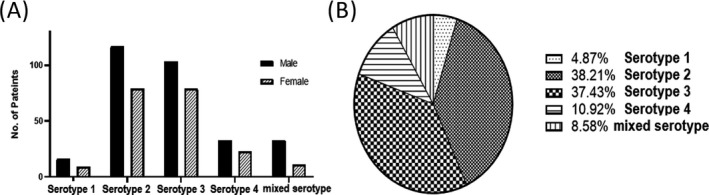
Results: Out of 513, 25 were found serotype 1 (5%), 196 were serotype 2 (38%), 192 were serotype 3 (37%), 56 were serotype 4 (11%), and 44 (8%) were found to have mix serotypes.
Conclusion: We can conclude that serotypes 2 and 3 of dengue virus were the predominated serotypes of dengue virus in the 2017 outbreak in Peshawar, capital city of Khyber Pakhtunkhwa, Pakistan.
Keywords: KP-Pakistan; dengue; dengue virus; prevalence; serotyping.
© 2020 The Authors. Journal of Clinical Laboratory Analysis published by Wiley Periodicals LLC.
Conflict of interest statement
The authors declare that there is no conflict of interests regarding the publication of this paper.
Figures
References
-
- WHO/ TDR . Dengue: guidelines for diagnosis, treatment, prevention, and control. Special Programme for Research and Training in Tropical Diseases. 2009. 147.
-
- Rasheed SB, Butlin RK, Boots M. A review of dengue as an emerging disease in Pakistan. Public Health. 2013;127:11‐17. - PubMed
-
- Humayoun MA, Waseem T, Jawa AA, Hashmi MS, Akram J. Multiple dengue serotypes and high frequency of dengue hemorrhagic fever at two tertiary care hospitals in Lahore during the 2008 dengue virus outbreak in Punjab, Pakistan. Int J Infect Dis. 2010;14:e54‐e59. - PubMed
-
- Ooi EE, Gubler DJ. Dengue in Southeast Asia: epidemiological characteristics and strategic challenges in disease prevention. Cad Saude Publica. 2009;25(Suppl 1):115‐124. - PubMed
MeSH terms
Grants and funding
LinkOut - more resources
Full Text Sources
Medical
