


Differences in the gut Firmicutes to Bacteroidetes ratio across age groups in healthy Ukrainian population
- PMID: 32698765
- PMCID: PMC7374892
- DOI: 10.1186/s12866-020-01903-7
Differences in the gut Firmicutes to Bacteroidetes ratio across age groups in healthy Ukrainian population
Abstract
Background: Gut microbiota plays an important role in physiological and pathological processes of the host organism, including aging. Microbiota composition was shown to vary significantly throughout the life course. Age-related changes in the composition of microbiota were reported in several human studies. In present study, age-related dynamics of phylogenetic profile of gut microbiota was investigated in 1550 healthy participants from Ukrainian population.
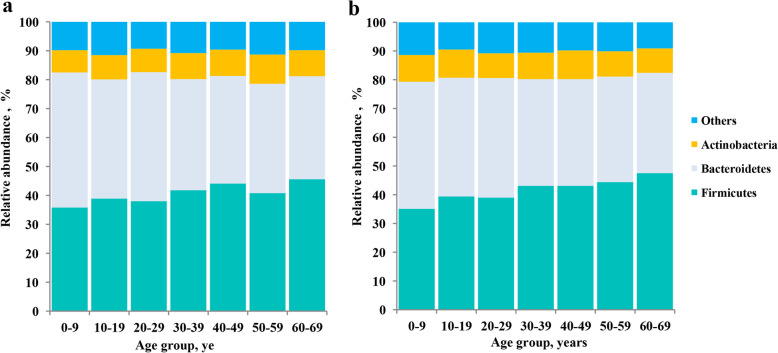
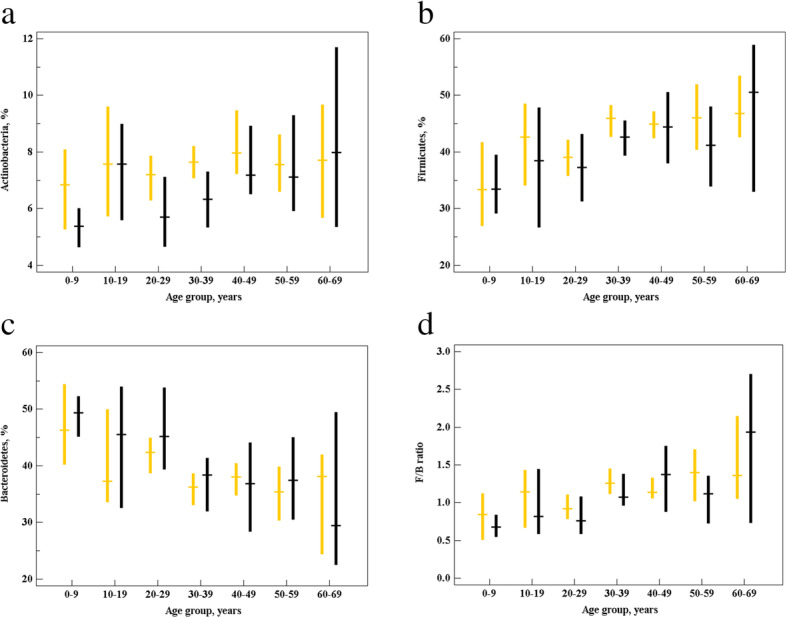
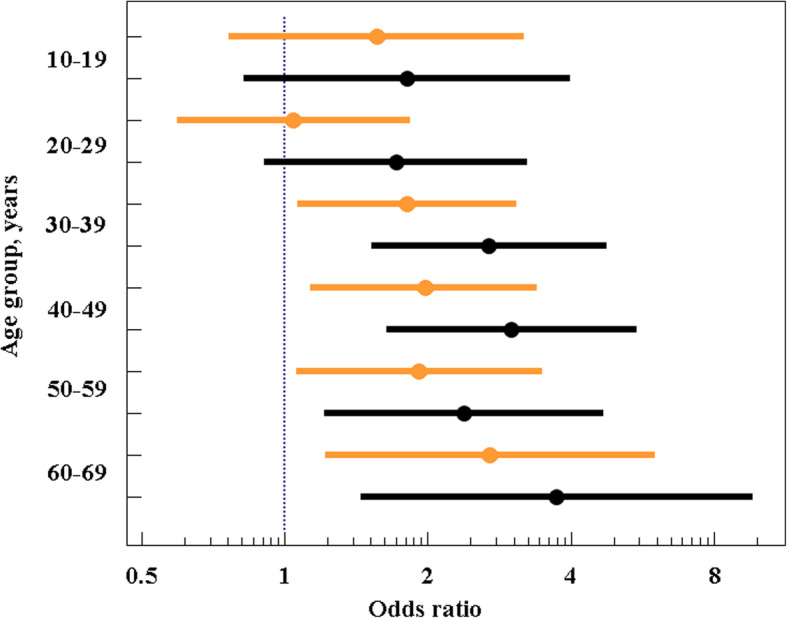
Results: Significant changes in the microbiota composition determined by qRT-PCR at the level of major microbial phyla across age groups have been observed. The relative abundance of Actinobacteria and Firmicutes phyla increased, while that of Bacteroidetes decreased from childhood to elderly age. Accordingly, the Firmicutes/Bacteroidetes (F/B) ratio was shown to significantly increase until elder age. In both sexes, odds to have F/B > 1 tended to increase with age, reaching maximum values in elder age groups [OR = 2.7 (95% CI, 1.2-6.0) and OR = 3.7 (95% CI, 1.4-9.6) for female and male 60-69-year age groups, respectively, compared to same-sex reference (0-9-year) age groups].
Conclusions: In conclusion, data from our study indicate that composition of the human intestinal microbiota at the level of major microbial phyla significantly differs across age groups. In both sexes, the F/B ratio tends to increase with age from 0-9-year to 60-69-year age groups. Further studies are needed for a better understanding of mechanisms underlying age-related dynamics of human microbiota composition.
Keywords: Age-related changes; Aging; Firmicutes/Bacteroidetes ratio; Gut microbiota composition.
Conflict of interest statement
The authors declare no competing interests.
Figures
References
-
- Finlay BB, Pettersson S, Melby MK, et al. The microbiome mediates environmental effects on aging. Bioessays. 2019;41(10):e1800257. - PubMed
Publication types
MeSH terms
Substances
LinkOut - more resources
Full Text Sources
Other Literature Sources
Medical
