


Characterization of putative drug resistant biomarkers in Plasmodium falciparum isolated from Ghanaian blood donors
- PMID: 32698879
- PMCID: PMC7376723
- DOI: 10.1186/s12879-020-05266-2
Characterization of putative drug resistant biomarkers in Plasmodium falciparum isolated from Ghanaian blood donors
Abstract
Background: Plasmodium falciparum parasites, which could harbour anti-malaria drug resistance genes, are commonly detected in blood donors in malaria-endemic areas. Notwithstanding, anti-malaria drug resistant biomarkers have not been characterized in blood donors with asymptomatic P. falciparum infection.
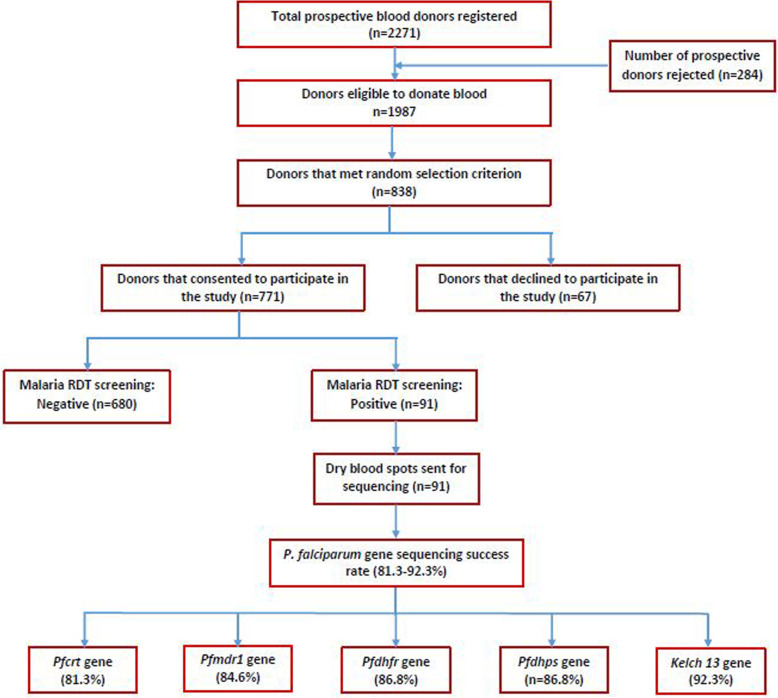
Methods: A total of 771 blood donors were selected from five districts in the Greater Accra Region, Ghana. Each donor sample was screened with malaria rapid diagnostic test (RDT) kit and parasitaemia quantified microscopically. Dried blood spots from malaria positive samples were genotyped for P. falciparum chloroquine resistance transporter (Pfcrt), P. falciparum multi-drug resistance (Pfmdr1), P. falciparum dihydropteroate-synthetase (Pfdhps), P. falciparum dihydrofolate-reductase (Pfdhfr) and Kelch 13 propeller domain on chromosome 13 (Kelch 13) genes.
Results: Of the 771 blood donors, 91 (11.8%) were positive by RDT. Analysis of sequence reads indicated successful genotyping of Pfcrt, Pfmdr1, Pfdhfr, Pfdhps and Kelch 13 genes in 84.6, 81.3, 86.8, 86.9 and 92.3% of the isolates respectively. Overall, 21 different mutant haplotypes were identified in 69 isolates (75.8%). In Pfcrt, CVIET haplotype was observed in 11.6% samples while in Pfmdr1, triple mutation (resulting in YFN haplotype) was detected in 8.1% of isolates. In Pfdhfr gene, triple mutation resulting in IRNI haplotype and in Pfdhps gene, quintuple mutation resulting in AGESS haplotype was identified in 17.7% parasite isolates. Finally, five non-synonymous Kelch 13 alleles were detected; C580Y (3.6%), P615L (4.8%), A578S (4.8%), I543V (2.4%) and A676S (1.2%) were detected.
Conclusion: Results obtained in this study indicated various frequencies of mutant alleles in Pfcrt, Pfmdr1, Pfdhfr, Pfdhps and Kelch 13 genes from P. falciparum infected blood donors. These alleles could reduce the efficacy of standard malaria treatment in transfusion-transmitted malaria cases. Incorporating malaria screening into donor screening protocol to defer infected donors is therefore recommended.
Keywords: Blood donors; Ghana; Mutant haplotypes; Plasmodium falciparum; Putative drug resistant biomarkers.
Conflict of interest statement
None to declare
Figures

References
-
- Bruce-Chwatt LJ. Transfusion malaria revisited. Trop Dis Bull. 1982;79:827–840. - PubMed
MeSH terms
Substances
Grants and funding
LinkOut - more resources
Full Text Sources
Medical
