


Wernicke-Kleist-Leonhard phenotypes of endogenous psychoses: a review of their validity
- PMID: 32699504
- PMCID: PMC7365293
- DOI: 10.31887/DCNS.2020.22.1/jfoucher
Wernicke-Kleist-Leonhard phenotypes of endogenous psychoses: a review of their validity
Abstract
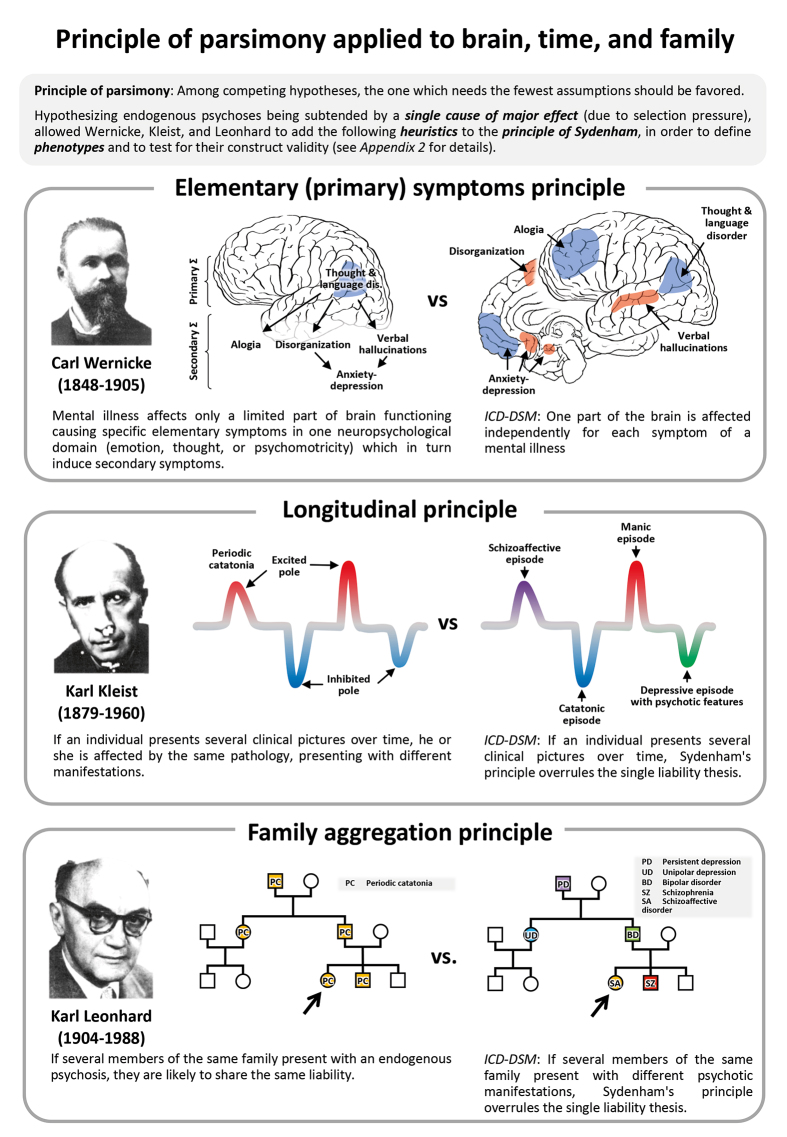
While the ICD-DSM paradigm has been a major advance in clinical psychiatry, its usefulness for biological psychiatry is debated. By defining consensus-based disorders rather than empirically driven phenotypes, consensus classifications were not an implementation of the biomedical paradigm. In the field of endogenous psychoses, the Wernicke-Kleist-Leonhard (WKL) pathway has optimized the descriptions of 35 major phenotypes using common medical heuristics on lifelong diachronic observations. Regarding their construct validity, WKL phenotypes have good reliability and predictive and face validity. WKL phenotypes come with remarkable evidence for differential validity on age of onset, familiality, pregnancy complications, precipitating factors, and treatment response. Most impressive is the replicated separation of high- and low-familiality phenotypes. Created in the purest tradition of the biomedical paradigm, the WKL phenotypes deserve to be contrasted as credible alternatives with other approaches currently under discussion. .
Mettre la traduction ES.
Mettre la traduction FR.
Keywords: endogenous psychosis; Kleist; Leonhard; Wernicke; affect laden paraphrenia; bipolar; cataphasia; catatonia; classification; cycloid psychoses; deep phenotyping; epistemology; hebephrenia; periodic catatonia; phenotype; schizophrenia; supersensitivity psychosis; system schizophrenia; unipolar.
© 2019, AICHServier GroupCopyright © 2019 AICH Servier Group. All rights reserved.
References
-
- Kupfer DJ, First MB, Regier DA, Kupfer DJ, First MB, Regier DA. Washington, DC: American Psychiatric Association; 2002. Introduction A Research Agenda for DSM-V pp. xviii–xix.
-
- Foucher J-R, Bennouna Greene V. La CIM et le DSM ou l’impossible validation : pourquoi le ver est dans le fruit. Ann Médico-psychologiques, Rev Psychiatr. 2010;168(8):609–615.
-
- Friedman RA. Grief, depression, and the DSM-5. N Engl J Med. 2012;366(20):1855–1857. - PubMed
-
- Foucher JR, et al Bases épistémologiques de la recherche sur les psychoses. Quelle solution pour le choc des cadres paradigmatiques ? Ann Med Psychol. 2019 doi: 10.1016/j.amp.2018. 10.022. - DOI
-
- Boorse C. Health as a theoretical concept. Philos Sci. 1977;44(4):542–573.
Publication types
MeSH terms
LinkOut - more resources
Full Text Sources
Medical
