Review
. 2020 Oct;35(5):421-438.
doi: 10.1177/0748730420940483. Epub 2020 Jul 23.

Novel Approaches for Assessing Circadian Rhythmicity in Humans: A Review

Affiliations
Review

Novel Approaches for Assessing Circadian Rhythmicity in Humans: A Review

Derk-Jan Dijk et al. J Biol Rhythms. 2020 Oct.

Abstract

The temporal organization of molecular and physiological processes is driven by environmental and behavioral cycles as well as by self-sustained molecular circadian oscillators. Quantification of phase, amplitude, period, and disruption of circadian oscillators is essential for understanding their contribution to sleep-wake disorders, social jet lag, interindividual differences in entrainment, and the development of chrono-therapeutics. Traditionally, assessment of the human circadian system, and the output of the SCN in particular, has required collection of long time series of univariate markers such as melatonin or core body temperature. Data were collected in specialized laboratory protocols designed to control for environmental and behavioral influences on rhythmicity. These protocols are time-consuming, expensive, and not practical for assessing circadian status in patients or in participants in epidemiologic studies. Novel approaches for assessment of circadian parameters of the SCN or peripheral oscillators have been developed. They are based on machine learning or mathematical model-informed analyses of features extracted from 1 or a few samples of high-dimensional data, such as transcriptomes, metabolomes, long-term simultaneous recording of activity, light exposure, skin temperature, and heart rate or in vitro approaches. Here, we review whether these approaches successfully quantify parameters of central and peripheral circadian oscillators as indexed by gold standard markers. Although several approaches perform well under entrained conditions when sleep occurs at night, the methods either perform worse in other conditions such as shift work or they have not been assessed under any conditions other than entrainment and thus we do not yet know how robust they are. Novel approaches for the assessment of circadian parameters hold promise for circadian medicine, chrono-therapeutics, and chrono-epidemiology. There remains a need to validate these approaches against gold standard markers, in individuals of all sexes and ages, in patient populations, and, in particular, under conditions in which behavioral cycles are displaced.

Keywords: biomarkers; data science; heart rate; light; machine learning; mathematical models; skin temperature; transcriptomics.


Conflict of interest statement

Conflict of interest statement: The authors have no potential conflicts of interest with respect to the research, authorship, and/or publication of this article.

Figures

Figure 1.
Figure 1.
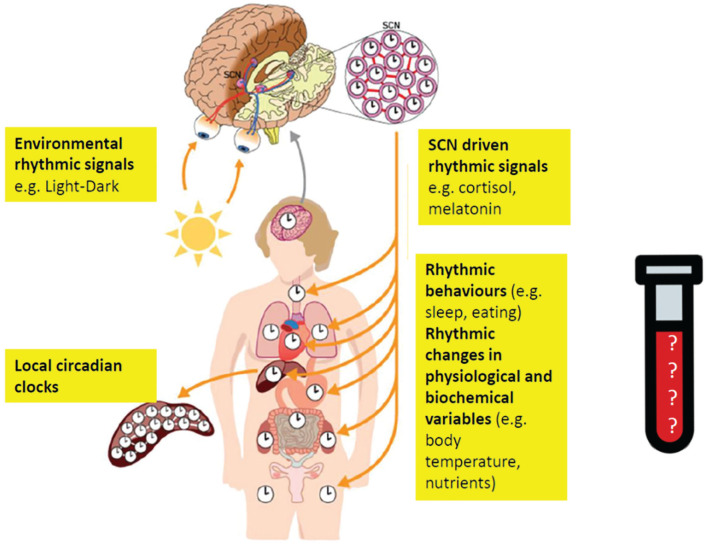
A biomarker for which rhythm and what generates this rhythm? Modified from Bollinger and Schibler (2014). Structure of the human circadian timing system. Molecular clocks and circadian rhythms are present in the brain, including the SCN-based oscillator and periphery. A circadian biomarker may provide information about the rhythms in the SCN or in peripheral tissues and organs. Rhythms in organs and tissues are influenced by external rhythmic signals, SCN-driven signals, local circadian oscillators, and behavioral rhythms, such as sleep or eating. A biological sample will contain many features (transcripts, proteins, metabolites). These various features will be influenced by SCN input, the local circadian oscillator, and behavior. The selection of the final feature set for the biomarker will depend on the purpose of the biomarker (e.g., assessing SCN phase or phase of tissue-specific circadian oscillator). In many cases, the tissue or organ of interest will not be accessible, and the features will be extracted from, for example, blood, which makes the identification of robust biomarkers even more challenging.
Figure 2.
Figure 2.
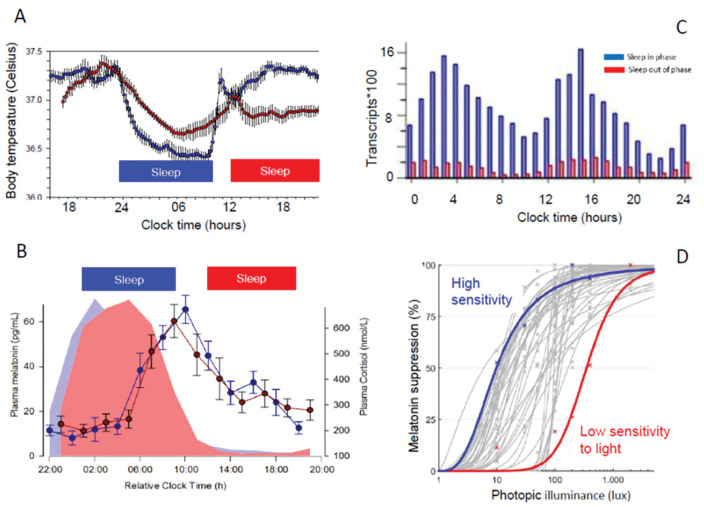
Effects of sleep-wake cycle and light exposure on rhythmic variables. (A) Daily rhythm of core body temperature is altered when sleep occurs in phase (at night) versus out of phase. Recalculated from Dijk and Czeisler (1995). (B) Rhythms of plasma melatonin and cortisol are not much affected by sleeping in phase (during the night) or out of phase (during the day). Data from Archer et al. (2014). (C) Frequency distribution of the acrohases of rhythmic transcripts in whole blood when sleeping in phase (blue) and out of phase. From Archer et al. (2014). (D) Individual-level dose-response curves for melatonin suppression and light levels. Blue, high-sensitivity individual; red, low-sensitivity individual. From Phillips et al. (2019).
Figure 3.
Figure 3.
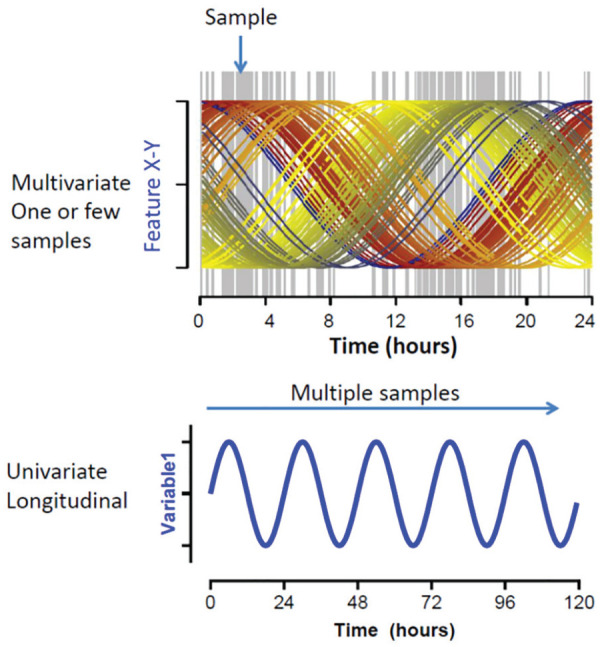
Univariate multiple sampling versus multivariate single sample. (A) A multivariate biomarker will require 1 or 2 samples separated by several hours, and by containing information about multiple rhythmic features, the relative level of each of those features can classify the overall circadian timing (Laing et al., 2017). (B) With a univariate biomarker, a time series of points assessing a single feature is collected. Depending on the variability of the feature, “noise” from periodic behaviors or physiologic changes and/or environmental changes may influence any 1 data point or cycle, but multiple cycles of data will provide an accurate assessment of the underlying rhythmic process.
Figure 4.
Figure 4.
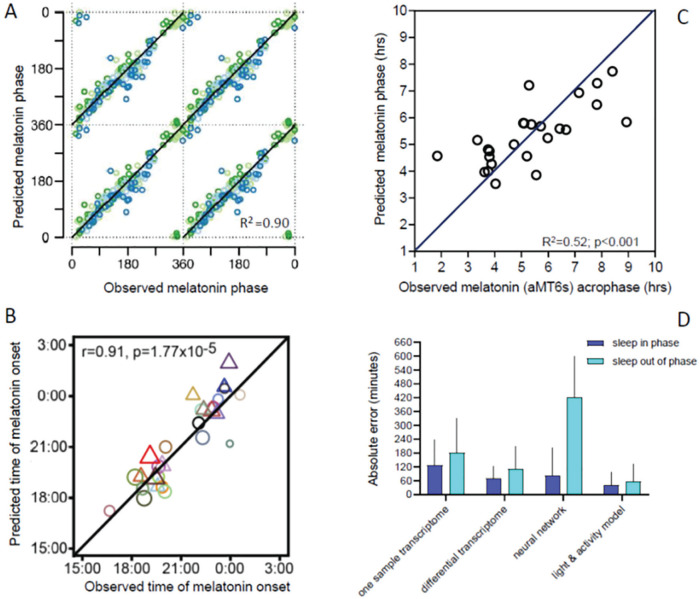
Examples of predictors of circadian melatonin phase and impact of sleeping “out of phase” on accuracy of biomarker prediction. (A) Prediction of plasma melatonin phase from 2 samples taken 12 h apart across the circadian cycle during wakefulness (green symbols), nocturnal sleep (light blue symbols), and misplaced sleep (dark blue circles). From Laing et al. (2017). (B) Prediction of salivary melatonin phase from one sample taken in the afternoon during wakefulness from extreme morning and evening types living on their habitual sleep-wake schedule. Men, triangles; women, circles. The size of the circles indicates the age of the participants. From Wittenbrink et al. (2018). (C) Prediction of urinary 6 sulfatoxy melatonin phase from recordings of activity, light exposure, and a mathematical model for the effects of light in participants living on a nocturnal schedule. From Stone et al. (2019a). (D) Absolute error and its standard deviation of various biomarkers when tested on participants sleeping during the night (in phase) or during the day (out of phase) in either the laboratory or in a shift-work situation. In all cases, the biomarker-predicted phase was compared with a gold standard phase marker (plasma melatonin for the transcriptome predictors; Laing et al., 2017) and urinary 6-sulfatoxy melatonin for the neural network (Stone et al., 2019b) and light model (Stone et al., 2019a). In all cases, accuracy was worse for the out-of-phase condition. Color version of the figure is available online.

References

    1. Ang JE, Revell V, Mann A, Mantele S, Otway DT, Johnston JD, Thumser AE, Skene DJ, Raynaud F. (2012) Identification of human plasma metabolites exhibiting time-of-day variation using an untargeted liquid chromatography-mass spectrometry metabolomic approach. Chronobiol Int 29:868-881. - PMC - PubMed
    1. Archer SN, Laing EE, Moller-Levet CS, van der Veen DR, Bucca G, Lazar AS, Santhi N, Slak A, Kabiljo R, von Schantz M, et al. (2014) Mistimed sleep disrupts circadian regulation of the human transcriptome. Proc Natl Acad Sci U S A 111:E682-691. - PMC - PubMed
    1. Archer SN, Oster H. (2015) How sleep and wakefulness influence circadian rhythmicity: effects of insufficient and mistimed sleep on the animal and human transcriptome. J Sleep Res 24:476-493. - PubMed
    1. Arnardottir ES, Nikonova EV, Shockley KR, Podtelezhnikov AA, Anafi RC, Tanis KQ, Maislin G, Stone DJ, Renger JJ, Winrow CJ, et al. (2014) Blood-gene expression reveals reduced circadian rhythmicity in individuals resistant to sleep deprivation. Sleep 37:1589-1600. - PMC - PubMed
    1. Atger F, Gobet C, Marquis J, Martin E, Wang J, Weger B, Lefebvre G, Descombes P, Naef F, Gachon F. (2015) Circadian and feeding rhythms differentially affect rhythmic mRNA transcription and translation in mouse liver. Proc Natl Acad Sci U S A 112:E6579-6588. - PMC - PubMed

Publication types

LinkOut - more resources