


Secretion of severe acute respiratory syndrome coronavirus 2 in urine
- PMID: 32701726
- PMCID: PMC7386676
- DOI: 10.1097/MOU.0000000000000808
Secretion of severe acute respiratory syndrome coronavirus 2 in urine
Abstract
Purpose of review: Despite the plethora of publications discussing the severe respiratory coronavirus 2 (SARS-CoV-2), evidence of viral secretion in urine is sparse.
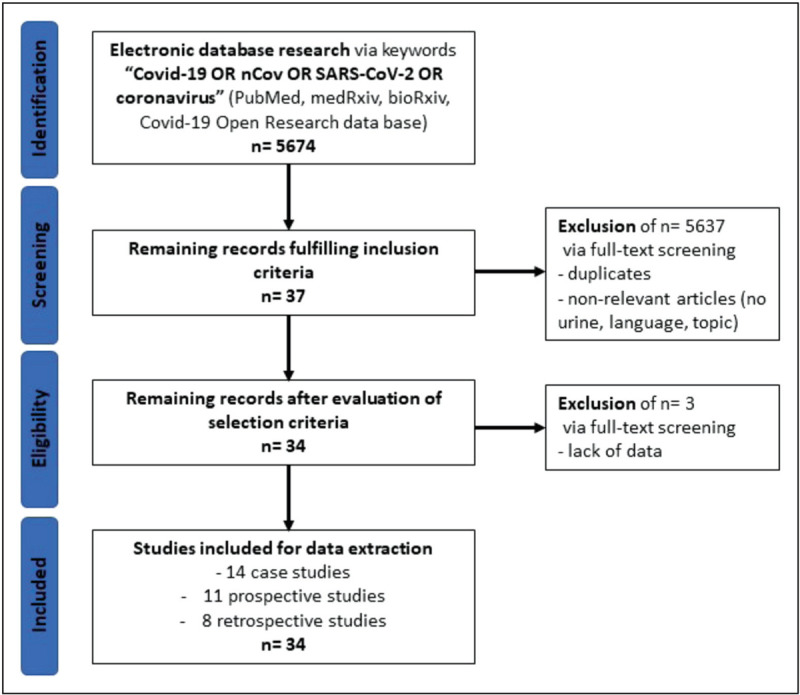
Recent findings: We could identify 34 publications including a total of 2172 patients. Among those, 549 patients were tested for SARS-CoV-2 secretion in urine, which was detected in only 38 patients (6.9%). Within the seven studies displaying positive results, the majority of positive patients (86.8%) was from not yet peer-reviewed studies including weak data and heterogeneous techniques for sample testing. Furthermore, none of the studies available in the literature addressed the virulence of detected viral RNA in urine.
Summary: Overall, only seven studies were able to detect SARS-CoV-2 secretion in urine, all of them with a considerably low rate of positivity. However, these studies were of rather low quality considering their methodology. Despite this, as SARS-CoV-2 has been detected in urine, it is of importance to discuss safety and urinary hygiene protocols. Until further research provides valid data on viral shedding and virulence in urine, potential risk of transmission through urine cannot be ruled out. Therefore, safety and hygiene measures need to be discussed.
Conflict of interest statement
The authors have no relevant affiliations or financial involvement with any organization or entity with a financial interest in or financial conflict with the subject matter or materials discussed in the manuscript. This includes employment, consultancies, honoraria, stock ownership or options, expert testimony, grants or patents received or pending, or royalties.
Figures
References
-
- WHO. Laboratory testing for 2019 novel coronavirus (2019-nCoV) in suspected human cases 2020 [Interim guidance]. https://www.who.int/publications-detail/laboratory-testing-for-2019-nove.... [Accessed 05 July 2020].
-
- Tan W, Lu Y, Zhang J, et al. Viral kinetics and antibody responses in patients with COVID-19. medRxiv 2020.
-
- Diao B, Wen K, Chen J, et al. Diagnosis of acute respiratory syndrome coronavirus 2 infection by detection of nucleocapsid protein. medRxiv 2020.
Publication types
MeSH terms
LinkOut - more resources
Full Text Sources
Miscellaneous
