


The impact of the COVID-19 pandemic on cancer deaths due to delays in diagnosis in England, UK: a national, population-based, modelling study
- PMID: 32702310
- PMCID: PMC7417808
- DOI: 10.1016/S1470-2045(20)30388-0
The impact of the COVID-19 pandemic on cancer deaths due to delays in diagnosis in England, UK: a national, population-based, modelling study
Erratum in
-
Correction to Lancet Oncol 2020; 21: 1023-34.Lancet Oncol. 2021 Jan;22(1):e5. doi: 10.1016/S1470-2045(20)30752-X. Lancet Oncol. 2021. PMID: 33387506 Free PMC article. No abstract available.
Abstract
Background: Since a national lockdown was introduced across the UK in March, 2020, in response to the COVID-19 pandemic, cancer screening has been suspended, routine diagnostic work deferred, and only urgent symptomatic cases prioritised for diagnostic intervention. In this study, we estimated the impact of delays in diagnosis on cancer survival outcomes in four major tumour types.
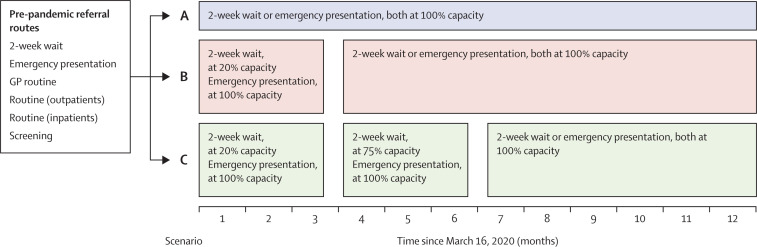
Methods: In this national population-based modelling study, we used linked English National Health Service (NHS) cancer registration and hospital administrative datasets for patients aged 15-84 years, diagnosed with breast, colorectal, and oesophageal cancer between Jan 1, 2010, and Dec 31, 2010, with follow-up data until Dec 31, 2014, and diagnosed with lung cancer between Jan 1, 2012, and Dec 31, 2012, with follow-up data until Dec 31, 2015. We use a routes-to-diagnosis framework to estimate the impact of diagnostic delays over a 12-month period from the commencement of physical distancing measures, on March 16, 2020, up to 1, 3, and 5 years after diagnosis. To model the subsequent impact of diagnostic delays on survival, we reallocated patients who were on screening and routine referral pathways to urgent and emergency pathways that are associated with more advanced stage of disease at diagnosis. We considered three reallocation scenarios representing the best to worst case scenarios and reflect actual changes in the diagnostic pathway being seen in the NHS, as of March 16, 2020, and estimated the impact on net survival at 1, 3, and 5 years after diagnosis to calculate the additional deaths that can be attributed to cancer, and the total years of life lost (YLLs) compared with pre-pandemic data.
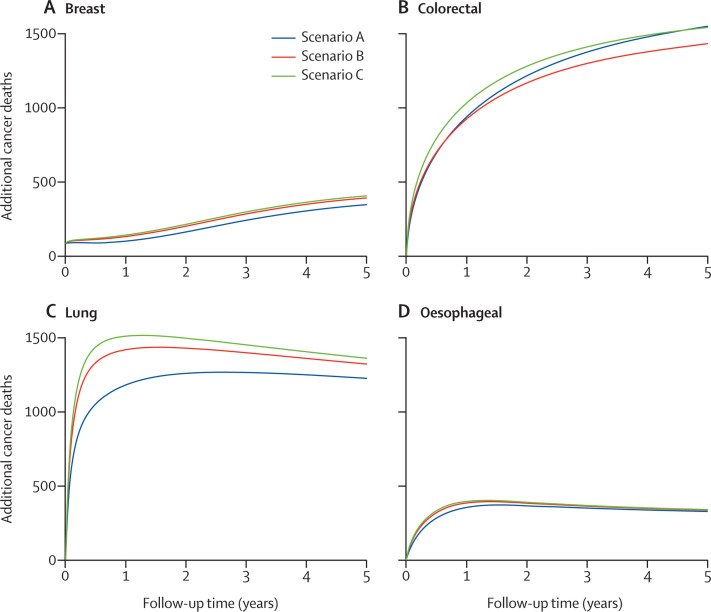
Findings: We collected data for 32 583 patients with breast cancer, 24 975 with colorectal cancer, 6744 with oesophageal cancer, and 29 305 with lung cancer. Across the three different scenarios, compared with pre-pandemic figures, we estimate a 7·9-9·6% increase in the number of deaths due to breast cancer up to year 5 after diagnosis, corresponding to between 281 (95% CI 266-295) and 344 (329-358) additional deaths. For colorectal cancer, we estimate 1445 (1392-1591) to 1563 (1534-1592) additional deaths, a 15·3-16·6% increase; for lung cancer, 1235 (1220-1254) to 1372 (1343-1401) additional deaths, a 4·8-5·3% increase; and for oesophageal cancer, 330 (324-335) to 342 (336-348) additional deaths, 5·8-6·0% increase up to 5 years after diagnosis. For these four tumour types, these data correspond with 3291-3621 additional deaths across the scenarios within 5 years. The total additional YLLs across these cancers is estimated to be 59 204-63 229 years.
Interpretation: Substantial increases in the number of avoidable cancer deaths in England are to be expected as a result of diagnostic delays due to the COVID-19 pandemic in the UK. Urgent policy interventions are necessary, particularly the need to manage the backlog within routine diagnostic services to mitigate the expected impact of the COVID-19 pandemic on patients with cancer.
Funding: UK Research and Innovation Economic and Social Research Council.
Copyright © 2020 The Author(s). Published by Elsevier Ltd. This is an Open Access article under the CC BY-NC-ND 4.0 license. Published by Elsevier Ltd.. All rights reserved.
Figures
Comment in
-
Cancer diagnostic delay in the COVID-19 era: what happens next?Lancet Oncol. 2020 Aug;21(8):1000-1002. doi: 10.1016/S1470-2045(20)30391-0. Epub 2020 Jul 20. Lancet Oncol. 2020. PMID: 32702312 Free PMC article. No abstract available.
-
Effect of radiotherapy interruption due to COVID-19 outbreak.Radiother Oncol. 2021 Feb;155:1-2. doi: 10.1016/j.radonc.2020.09.055. Epub 2020 Oct 11. Radiother Oncol. 2021. PMID: 33053379 Free PMC article. No abstract available.
-
Too long to wait: the impact of COVID-19 on elective surgery.Lancet Rheumatol. 2021 Feb;3(2):e83. doi: 10.1016/S2665-9913(21)00001-1. Epub 2021 Jan 28. Lancet Rheumatol. 2021. PMID: 33778775 Free PMC article. No abstract available.
-
Economic impact of avoidable cancer deaths caused by diagnostic delay during the COVID-19 pandemic: A national population-based modelling study in England, UK.Eur J Cancer. 2021 Jul;152:233-242. doi: 10.1016/j.ejca.2021.04.019. Epub 2021 May 5. Eur J Cancer. 2021. PMID: 34049776 Free PMC article.
References
-
- UK Government Coronavirus (COVID-19) guidance. 2020. https://www.gov.uk/government/collections/coronavirus-covid-19-list-of-g...
-
- Tørring ML, Murchie P, Esteva M. The signal and the noise in colorectal cancer diagnosis: exploring and explaining the relationship between diagnostic delays and stage at diagnosis using the Ca-PRI Colorectal Cancer Collaboration dataset. Eur J Cancer Care. 2015;24(suppl 2):22.
-
- NHS England . NHS England and NHS Improvement; April 7, 2020. Publication approval reference 001559. Specialty guides for patient management during the coronavirus pandemic. Clinical guide for the management of essential cancer surgery for adults during the coronavirus pandemic.
-
- National Institute for Health and Care Excellence . National Institute for Health and Care Excellence; March 20, 2020. COVID-19 rapid guidelines: delivery of systemic anticancer treatments.https://www.nice.org.uk/guidance/ng161/resources/covid19-rapid-guideline... - PubMed
Publication types
MeSH terms
Grants and funding
LinkOut - more resources
Full Text Sources
Medical
Research Materials
