. 2020 Jul;54(4):318-331.
doi: 10.4132/jptm.2020.02.26. Epub 2020 Apr 15.

Current status of cytopathology practices in Korea: annual report on the Continuous Quality Improvement program of the Korean Society for Cytopathology for 2018

Affiliations

Current status of cytopathology practices in Korea: annual report on the Continuous Quality Improvement program of the Korean Society for Cytopathology for 2018

Yosep Chong et al. J Pathol Transl Med. 2020 Jul.

Abstract

Background: The Korean Society for Cytopathology has conducted the Continuous Quality Improvement program for cytopathology laboratories in Korea since 1995. In 2018 as part of the program, an annual survey of cytologic data was administered to determine the current status of cytopathology practices in Korea.

Methods: A questionnaire was administered to 211 cytopathology laboratories. Individual laboratories submitted their annual statistics regarding cytopathology practices, diagnoses of gynecologic samples, inadequacy rates, and gynecologic cytology-histology correlation review (CHCR) data for 2018. In addition, proficiency tests and sample adequacy assessments were conducted using five consequent gynecologic slides.

Results: Over 10 million cytologic exams were performed in 2018, and this number has almost tripled since this survey was first conducted in 2004 (compounded annual growth rate of 7.2%). The number of non-gynecologic samples has increased gradually over time and comprised 24% of all exams. The overall unsatisfactory rate was 0.14%. The ratio of the cases with atypical squamous cells to squamous intraepithelial lesions accounted for up to 4.24. The major discrepancy rate of the CHCR in gynecologic samples was 0.52%. In the proficiency test, the major discrepancy rate was approximately 1%. In the sample adequacy assessment, a discrepancy was observed in 0.1% of cases.

Conclusions: This study represents the current status of cytopathology practices in Korea, illustrating the importance of the Continuous Quality Improvement program for increasing the accuracy and credibility of cytopathologic exams as well as developing national cancer exam guidelines and government projects on the prevention and treatment of cancer.

Keywords: Accuracy; Cytology; Quality; Statistics; Surveys.


Conflict of interest statement

Conflicts of Interest

Y.C., contributing editor and S.W.H., the senior editor of the Journal of Pathology and Translational Medicine, were not involved in the editorial evaluation or decision to publish this article. All remaining authors have declared no conflicts of interest.

Figures

Fig. 1.
Fig. 1.
Overall statistics of cytopathology exams from 2004 to 2018. GYN, gynecologic samples; Non-GYN, non-gynecologic samples.
Fig. 2.
Fig. 2.
Number and proportion of cytopathology exams according to types of sample (A) and institution (B). GYN, gynecologic samples; Non-GYN, non-gynecologic samples; FNA, fine-needle aspiration; CSF, cerebrospinal fluid; ERCP, endoscopic retrograde cholangiopancreatography; Univ. Hos., university hospitals; Gen. Hos., general hospitals; Com. Lab., commercial laboratories.
Fig. 3.
Fig. 3.
Proportion of conventional smear (CS) and liquid-based preparation (LBP) cytology. Change in proportion between 2017 and 2018 of all samples (A), gynecologic samples (GYN) (B), non-gynecologic samples (Non-GYN) (C), fine-needle aspiration (FNA) (D), urine (E), and body fluid (F). (G) Proportion of CS and LBP cytology of gynecologic samples from 2004 to 2018. Univ. Hos., university hospitals; Gen. Hos., general hospitals; Com. Lab., commercial laboratories.
Fig. 4.
Fig. 4.
Trends in gynecologic sample cytologic diagnoses from 2012 to 2018 and correlation analysis according to atypical squamous cells to squamous intraepithelial lesions ratio (ASC/SIL ratio). Trends in the number of total gynecologic (GYN) samples, atypical squamous cells (ASC), squamous intraepithelial lesions (SIL), cervical cancers, and ASC/SIL ratio from 2012 to 2018 (A), ASC/SIL ratio according to institutions (B), correlation of total case number versus liquid-based preparation (LBP) coverage among 211 participating institutions in 2018 (C), correlation of total case number versus ASC/SIL ratio in 2018 (D), correlation of LBP coverage versus ASC/SIL ratio in 2018 (E). Com. Lab., commercial laboratories; Gen. Hos., general hospitals; Univ. Hos., university hospitals.
Fig. 5.
Fig. 5.
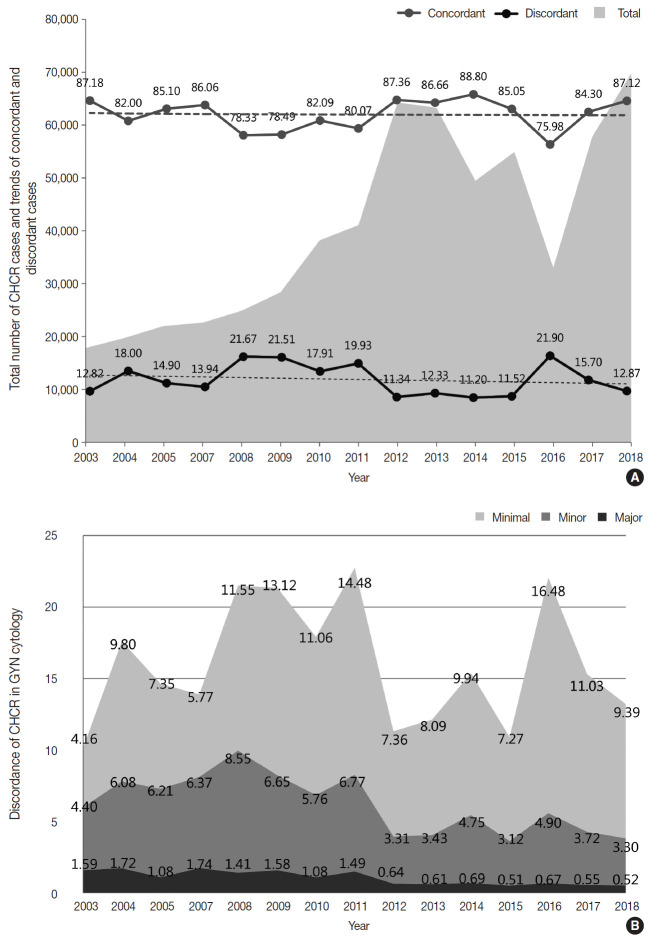
The results of cytology-histology correlation review (CHCR) from 2003 to 2018. (A) Total number of CHCR cases and trends of the proportions of concordant (category O) and discordant cases. (B) Trends in discordant cases with minimal (category A), minor (category B), and major (category C) clinical impact. GYN, gynecologic samples.
Fig. 6.
Fig. 6.
Proficiency test (PT) results according to institutions in 2018. Overall concordance of PT (A), and concordance of PT in gynecologic samples (B), thyroid fine-needle aspiration (FNA) cytology samples (C), body fluid samples (D), urine (E), and other FNA samples (F). GYN, gynecologic samples; Univ. Hos., university hospitals; Gen. Hos., general hospitals; Com. Lab., commercial laboratories.

References

    1. Lee HK, Kim SN, Khang SK, Kang CS, Yoon HK. Quality control program and its results of Korean Society for Cytopathologists. Korean J Cytopathol. 2008;19:65–71.
    1. Kim Y, Jun JK, Choi KS, Lee HY, Park EC. Overview of the National Cancer screening programme and the cancer screening status in Korea. Asian Pac J Cancer Prev. 2011;12:725–30. - PubMed
    1. Suh M, Song S, Cho HN, et al. Trends in participation rates for the national cancer screening program in Korea, 2002-2012. Cancer Res Treat. 2017;49:798–806. - PMC - PubMed
    1. Oh EJ, Jung CK, Kim DH, et al. Current Cytology Practices in Korea: A nationwide survey by the Korean Society for Cytopathology. J Pathol Transl Med. 2017;51:579–87. - PMC - PubMed
    1. Jung M. National Cancer Screening Programs and evidence-based healthcare policy in South Korea. Health Policy. 2015;119:26–32. - PubMed

LinkOut - more resources