


Diagnostic and Interventional Radiology Case Volume and Education in the Age of Pandemics: Impact Analysis and Potential Future Directions
- PMID: 32703647
- PMCID: PMC7372272
- DOI: 10.1016/j.acra.2020.07.014
Diagnostic and Interventional Radiology Case Volume and Education in the Age of Pandemics: Impact Analysis and Potential Future Directions
Abstract
Rationale and objectives: To assess the immediate impact of the COVID-19 pandemic on Diagnostic and Interventional Radiology education, and to propose measures to preserve and augment trainee education during future crises.
Materials and methods: Diagnostic Radiology (DR) studies and Interventional Radiology (IR) procedures at a single tertiary-care teaching institution between 2015 and 2020 were reviewed. DR was divided by section: body, cardiothoracic, musculoskeletal (MSK), neuroradiology, nuclear medicine, pediatrics, and women's imaging. IR was divided by procedural types: arterial, venous, lymphatic, core, neuro, pediatrics, dialysis, cancer embolization or ablation, noncancer embolization, portal hypertension, and miscellaneous. Impact on didactic education was also assessed. ANOVA, t test, and multiple comparison correction were used for analysis.
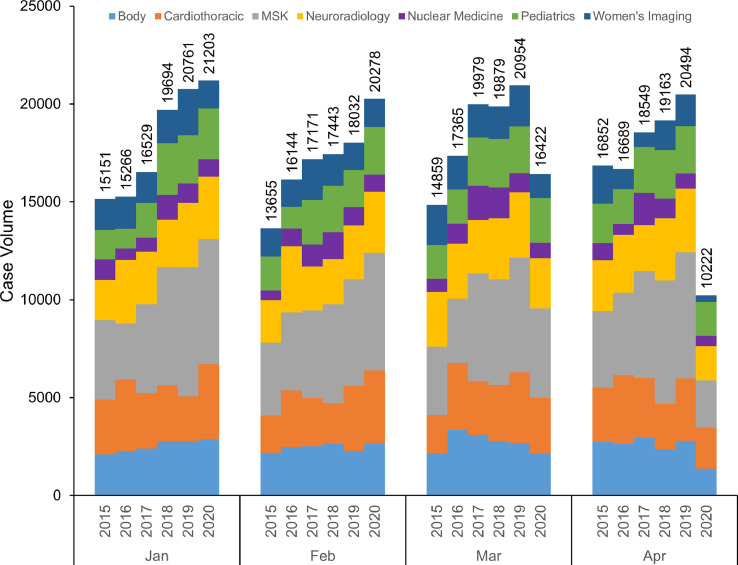
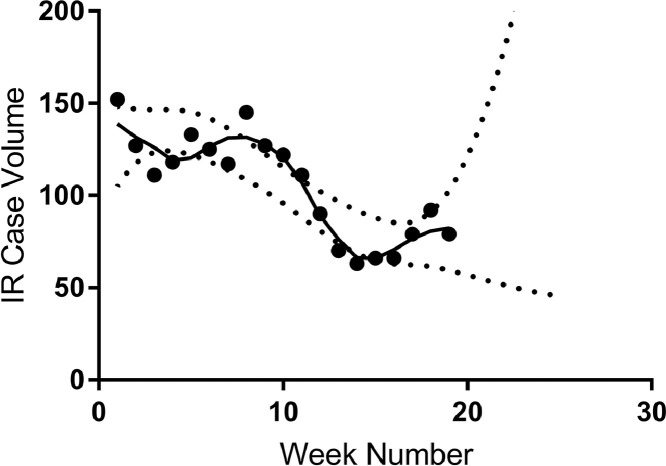
Results: DR and IR caseloads decreased significantly in April 2020 compared to April of the prior 5 years (both p < 0.0001). Case volumes were reduced in body (49.2%, p < 0.01), MSK (54.2%, p < 0.05), neuro (39.3%, p < 0.05), and women's imaging (75.5%, p < 0.05) in DR, and in arterial (62.6%, p < 0.01), neuro IR (57.6%, p < 0.01) and core IR (42.6%, p < 0.05) in IR. IR trainee average caseload in April 2020 decreased 51.9% compared to April of the prior 5 years (p < 0.01). Utilization of online learning increased in April. Trainees saw significant increases in overall DR didactics (31.3%, p = 0.02) and no reduction in IR didactics, all online. Twelve major national and international DR and IR meetings were canceled or postponed between March and July.
Conclusion: Decreases in caseload and widespread cancellation of conferences have had significant impact on DR/IR training during COVID-19 restrictions. Remote learning technologies with annotated case recording, boards-style case reviews, procedural simulation and narrated live cases as well as online lectures and virtual journal clubs increased during this time. Whether remote learning can mitigate lost opportunities from in-person interactions remains uncertain. Optimizing these strategies will be important for potential future restricted learning paradigms and can also be extrapolated to augment trainee education during unrestricted times.
Keywords: COVID; Education; IR/DR Residency; Quality Improvement; Virtual training.
Copyright © 2020 The Association of University Radiologists. All rights reserved.
Figures

References
-
- WHO. WHO Director-General's opening remarks at the media briefing on COVID-19 - 11 March 2020 [Internet]. 2020. Available at: https://www.who.int/dg/speeches/detail/who-director-general-s-opening-re.... Accessed March 11, 2020.
-
- CDC. Interim Guidance for Healthcare Facilities: Preparing for Community Transmission of COVID-19 in the US | CDC [Internet]. 2020. Available at: https://www.cdc.gov/coronavirus/2019-ncov/hcp/guidance-hcf.html. Accessed February 29, 2020.
MeSH terms
LinkOut - more resources
Full Text Sources
Miscellaneous
