


Serum lipoprotein (a) associates with a higher risk of reduced renal function: a prospective investigation
- PMID: 32703886
- PMCID: PMC7529054
- DOI: 10.1194/jlr.RA120000771
Serum lipoprotein (a) associates with a higher risk of reduced renal function: a prospective investigation
Abstract
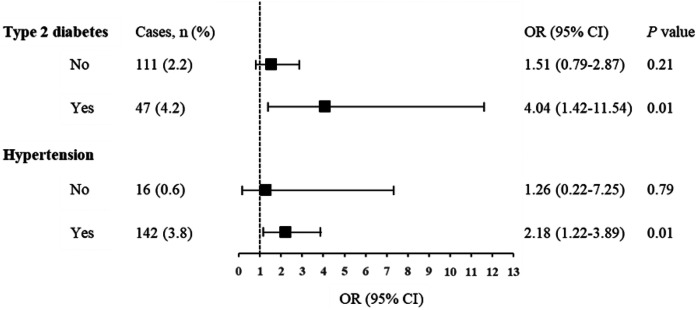
Lipoprotein (a) [Lp(a)] is a well-known risk factor for cardiovascular disease, but analysis on Lp(a) and renal dysfunction is scarce. We aimed to investigate prospectively the association of serum Lp(a) with the risk of reduced renal function, and further investigated whether diabetic or hypertensive status modified such association. Six thousand two hundred and fifty-seven Chinese adults aged ≤40 years and free of reduced renal function at baseline were included in the study. Reduced renal function was defined as estimated glomerular filtration rate <60 ml/min/1.73 m2 During a mean follow-up of 4.4 years, 158 participants developed reduced renal function. Each one-unit increase in log10-Lp(a) (milligrams per deciliter) was associated with a 1.99-fold (95% CI 1.15-3.43) increased risk of incident reduced renal function; the multivariable-adjusted odds ratio (OR) for the highest tertile of Lp(a) was 1.61 (95% CI 1.03-2.52) compared with the lowest tertile (P for trend = 0.03). The stratified analysis showed the association of serum Lp(a) and incident reduced renal function was more prominent in participants with prevalent diabetes [OR 4.04, 95% CI (1.42-11.54)] or hypertension [OR 2.18, 95% CI (1.22-3.89)]. A stronger association was observed in the group with diabetes and high Lp(a) (>25 mg/dl), indicating a combined effect of diabetes and high Lp(a) on the reduced renal function risk. An elevated Lp(a) level was independently associated with risk of incident reduced renal function, especially in diabetic or hypertensive patients.
Keywords: epidemiology.; hypertension; lipids; renal dysfunction; type 2 diabetes.
Copyright © 2020 Xuan et al. Published by The American Society for Biochemistry and Molecular Biology, Inc.
Conflict of interest statement
Conflict of interest—The authors declare that they have no conflicts of interest with the contents of this article.
Figures
Similar articles
-
Association Between Lipoprotein (A) and Diabetic Nephropathy in Patients With Type 2 Diabetes Mellitus: A Meta-Analysis.Front Endocrinol (Lausanne). 2021 Mar 24;12:633529. doi: 10.3389/fendo.2021.633529. eCollection 2021. Front Endocrinol (Lausanne). 2021. PMID: 33841331 Free PMC article.
-
Serum lipoprotein (a) is associated with increased risk of stroke in Chinese adults: A prospective study.Atherosclerosis. 2019 Oct;289:8-13. doi: 10.1016/j.atherosclerosis.2019.07.025. Epub 2019 Jul 26. Atherosclerosis. 2019. PMID: 31437611
-
Relationship Between Lipoprotein(a), Renal Function Indicators, and Chronic Kidney Disease: Evidence From a Large Prospective Cohort Study.JMIR Public Health Surveill. 2024 Jan 31;10:e50415. doi: 10.2196/50415. JMIR Public Health Surveill. 2024. PMID: 38294877 Free PMC article.
-
Lipoprotein(a)and renal function decline, cardiovascular disease and mortality in type 2 diabetes and microalbuminuria.J Diabetes Complications. 2020 Jul;34(7):107593. doi: 10.1016/j.jdiacomp.2020.107593. Epub 2020 Apr 19. J Diabetes Complications. 2020. PMID: 32349898
-
The relationship between lipoprotein(a) and the complications of diabetes mellitus.Acta Diabetol. 2003 Jun;40(2):65-76. doi: 10.1007/s005920300007. Acta Diabetol. 2003. PMID: 12861403 Review.
Cited by
-
Machine learning algorithms for diabetic kidney disease risk predictive model of Chinese patients with type 2 diabetes mellitus.Ren Fail. 2025 Dec;47(1):2486558. doi: 10.1080/0886022X.2025.2486558. Epub 2025 Apr 7. Ren Fail. 2025. PMID: 40195601 Free PMC article.
-
Association between serum lipoprotein(a) and mildly reduced eGFR: a cross-sectional study.BMC Nephrol. 2023 Dec 8;24(1):364. doi: 10.1186/s12882-023-03417-6. BMC Nephrol. 2023. PMID: 38066475 Free PMC article.
-
Prediction models for risk of diabetic kidney disease in Chinese patients with type 2 diabetes mellitus.Ren Fail. 2022 Dec;44(1):1454-1461. doi: 10.1080/0886022X.2022.2113797. Ren Fail. 2022. PMID: 36036430 Free PMC article.
-
Association Between Lipoprotein (A) and Diabetic Nephropathy in Patients With Type 2 Diabetes Mellitus: A Meta-Analysis.Front Endocrinol (Lausanne). 2021 Mar 24;12:633529. doi: 10.3389/fendo.2021.633529. eCollection 2021. Front Endocrinol (Lausanne). 2021. PMID: 33841331 Free PMC article.
-
PCSK-9 Inhibitors Can Significantly Improve the Coronary Slow Flow Caused by Elevated Lipoprotein (a) in ST-Elevation Myocardial Infarction Patients With Chronic Kidney Disease.Catheter Cardiovasc Interv. 2025 Jul;106(1):396-407. doi: 10.1002/ccd.31543. Epub 2025 Apr 25. Catheter Cardiovasc Interv. 2025. PMID: 40277036 Free PMC article.
References
-
- Tsimikas S. 2017. A test in context: lipoprotein(a): diagnosis, prognosis, controversies, and emerging therapies. J. Am. Coll. Cardiol. 69: 692–711. - PubMed
-
- Tsimikas S., Fazio S., Ferdinand K. C., Ginsberg H. N., Koschinsky M. L., Marcovina S. M., Moriarty P. M., Rader D. J., Remaley A. T., Reyes-Soffer G., et al. . 2018. NHLBI Working Group recommendations to reduce lipoprotein(a)-mediated risk of cardiovascular disease and aortic stenosis. J. Am. Coll. Cardiol. 71: 177–192. - PMC - PubMed
-
- van der Valk F. M., Bekkering S., Kroon J., Yeang C., Van den Bossche J., van Buul J. D., Ravandi A., Nederveen A. J., Verberne H. J., Scipione C., et al. . 2016. Oxidized phospholipids on lipoprotein(a) elicit arterial wall inflammation and an inflammatory monocyte response in humans. Circulation. 134: 611–624. - PMC - PubMed
MeSH terms
Substances
LinkOut - more resources
Full Text Sources
Miscellaneous
